
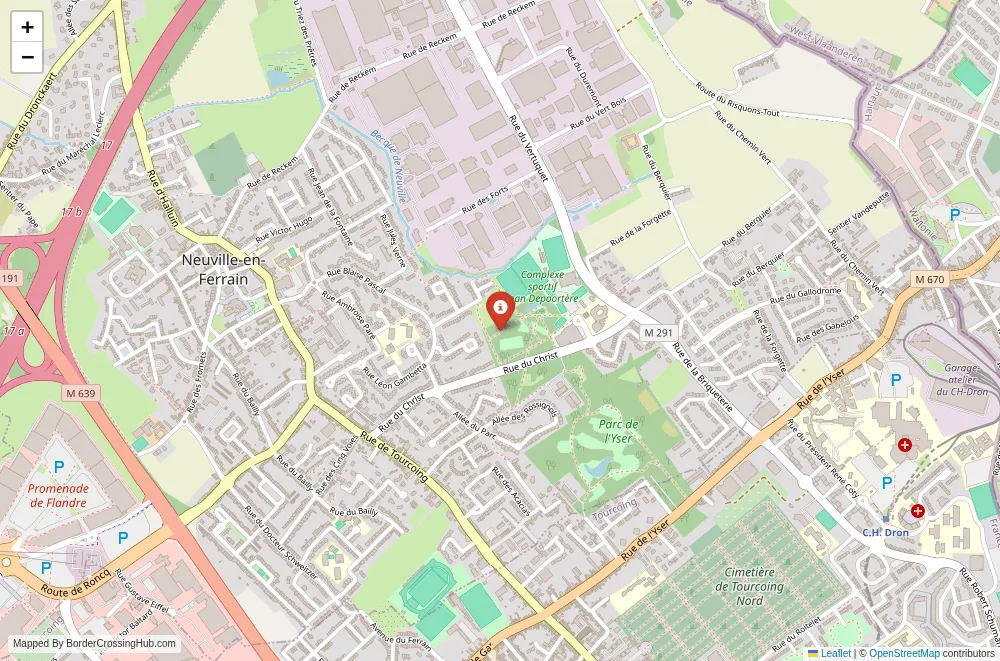
Approximate Border Location
Wait Times
Cars 0-15m; peaks 20-75m shopping
Just crossed? Tap to report:
Operating Hours
Open 24 hrs (12:00 AM-11:59 PM)
Crossing Types
Ped,cars,buses,trucks; no routine checks
Border Type
Land crossing via local roads
Peak Times
Sat 10:00 AM-06:00 PM; holiday eves
Daily Crossings
20,000-70,000/day
Currency Exchange
EUR only; ATMs on both sides
Safety Information
Roundabout congestion; watch cyclists
Languages Spoken
French/Dutch
Accessibility Features
Curb cuts common; accessible shops
About Mouscron & Tourcoing
Monthly Update (March 2026):
As of 03/2026, the Mouscron & Tourcoing Border Crossing remains active but mostly stable. Vehicles pass back and forth through the urban streets with little formality, though rush hour traffic can slow things on the French side. Pedestrians and cyclists move through easily during the day. Weekday commuting patterns and local shopping trips tend to drive the busiest moments.
No Cell Service at the Border? No Problem.
Don’t get caught scrambling for paperwork when you lose signal. Download the complete Europe Transit Guide directly to your device and access every critical detail, fast-track strategy, and border rule – 100% offline.
Mouscron connects Belgium to France in a densely built-up urban area, where the border weaves through streets, sidewalks, and open spaces as part of the continuous Lille metropolitan region.
Location and Basic Connections
You reach this crossing where the Belgian city of Mouscron in Hainaut province adjoins Tourcoing in northern France’s Nord department. It lies in the heart of the cross-border Eurometropole Lille-Kortrijk-Tournai, with roads running parallel or side by side across the line. Foreign visitors pass here when traveling between Belgian West Flanders towns and French cities like Lille, Roubaix, or farther south, or simply for shopping and daily errands in this merged urban zone. Alternative names include the Mouscron-Tourcoing border. As a Schengen internal point, it normally allows unrestricted movement, but temporary spot checks remain in place as of February 2026.
Historical Background and Geopolitical Role
The border traces medieval divisions between French and Flemish territories, solidified after Belgium’s independence in 1830 via the Treaty of London. The area industrialized heavily in the 19th century with textile mills and factories that often straddled the line, fostering shared economic growth. One early milestone came in the 1840s when the rail line from Tourcoing to Mouscron became one of the first railways to cross a European border, boosting trade and connectivity. World War I brought devastation nearby in Flanders, while World War II saw tactical importance due to rail and road links. Post-war Benelux cooperation and Schengen implementation in 1995 erased routine barriers, turning it into a fluid corridor for commuters, shoppers, and businesses in one of Europe’s most integrated border regions. Agreements like the Mouscron-Roubaix-Tourcoing-Wattrelos healthcare pact extend cooperation into services for residents on both sides.
Current Status and Safety Considerations
France continues temporary internal border controls with Belgium until at least April 30, 2026, driven by persistent jihadist threats, rises in antisemitic incidents, criminal networks facilitating smuggling and irregular migration, and pressures near northern coastal areas that could allow infiltration by radicalized individuals. Belgium extends targeted internal checks on major roads, buses, selected trains, and some intra-Schengen flights until July 31, 2026, focusing on security and migration. At urban crossings like this, police perform random stops for ID verification or vehicle inspections rather than fixed posts. Travelers describe these as brief in busy city settings, with most passages unaffected. The area has typical urban safety: low crime overall, no widespread border-specific scams reported, but keep valuables secure in crowded commercial zones. Carry your passport or national ID at all times to handle any check smoothly.
Operating Hours and Wait Times
The crossing stays open 24 hours on public roads and paths, with no standard infrastructure to interrupt flow under normal Schengen conditions. Temporary controls introduce variability: many crossings occur without intervention, while a random stop might add 5 to 20 minutes for document review or questions. Urban traffic peaks during morning and evening commutes or weekends raise the slight chance of checks near main streets. No long queues form like at external borders. Weather has little impact beyond occasional rain slowing city driving.
Visa Requirements for Foreign Visitors
Schengen rules govern entry: EU/EEA/Swiss citizens move freely with valid ID or passport. Non-EU nationals qualify for visa exemptions up to 90 days in any 180-day period if eligible, or require a Schengen visa. The Entry/Exit System (EES), fully operational by April 2026 at external borders, registers non-EU travelers there but not routinely at internal points; spot checks may still confirm your status. Present your passport during any control, along with proof of purpose, funds, accommodation, or onward travel if requested. No fees apply at this crossing.
Crossing Procedures Step by Step
You drive, cycle, or walk along streets where the border often runs unmarked except for subtle signs, boundary markers, or parallel roads divided by a narrow strip. Normally, no stop occurs as buildings and activity continue seamlessly. If police conduct a control, they may wave you over roadside or at a junction for ID presentation and basic travel questions. Provide documents promptly; interactions wrap up quickly amid local traffic. Pedestrians and cyclists use the same paths without separate facilities. The transition blends instantly, with French on one side shifting to Dutch/French bilingualism on the Belgian.
Transportation Options and Road Details
Local buses and trams link Mouscron directly to Tourcoing and onward to Lille, with frequent services across the urban area. Trains from Lille or Kortrijk stop nearby, offering easy connections. Major motorways like the E17 and E403 provide quick access for longer trips. Roads remain well-paved and busy, passing residential neighborhoods, shops, commercial strips, and occasional river views along the Leie. Traffic flows steadily but thickens during rush hours. Cycling paths weave through parts of the zone, convenient for short cross-border hops.
Nearby Attractions and Practical Tips
Tourcoing features textile heritage museums and vibrant markets; Mouscron offers local parks, events, and easy access to Kortrijk. Head to Lille for Flemish-influenced architecture, grand squares, and cultural sites just minutes away. Always carry ID due to controls. Euros and cards work interchangeably on both sides. Dress for changeable northern weather, with layers for wind or rain. Shoppers cross frequently for price variations in groceries or goods. For drivers, note minor speed limit differences across the line. Avoid peak commute times if possible to minimize any traffic overlap with checks.
Cultural and Economic Significance
The crossing underpins deep integration where residents live, work, and shop across the line daily. Shared industrial past in textiles lingers in architecture and traditions, while bilingual signs and mixed dialects reflect Flemish-French influences. Cross-border commerce thrives in retail, services, and healthcare via dedicated pacts. It exemplifies Schengen’s aim of seamless movement, adapted to current security needs through targeted rather than permanent checks.
Final Planning Notes
Check official sources for the latest on temporary controls before your trip, keep ID accessible, and factor in minor delays for possible random stops. This urban link makes exploring the Lille-Kortrijk area straightforward and convenient when you stay prepared.
No reviews yet.