
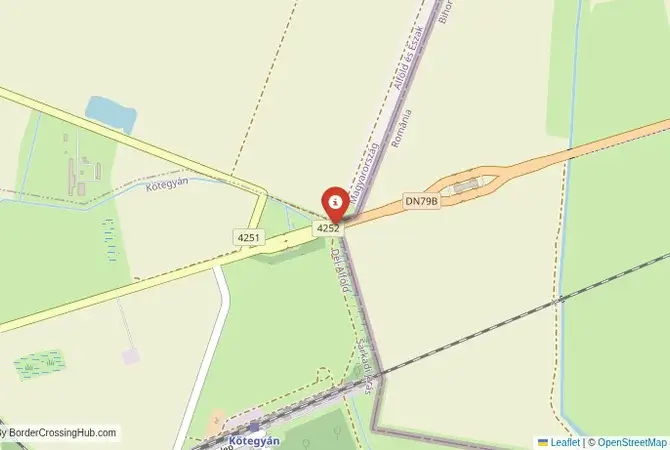
Approximate Border Location
Wait Times
10-50 min pedestrians/vehicles
Just crossed? Tap to report:
Operating Hours
6:00 AM-10:00 PM
Crossing Types
Pedestrians, vehicles
Border Type
Land crossing via road
Peak Times
7-10 AM
Daily Crossings
1500-2500 travelers/vehicles
Currency Exchange
Near Méhkerék (HUF, RON)
Safety Information
Rural, low crime
Languages Spoken
Hungarian/Romanian
Accessibility Features
Ramps, assistance
About Méhkerék & Salonta
Monthly Update (April 2026):
The road stays quiet for long stretches, with only a few cars at a time. In April 2026, Méhkerék & Salonta Border Crossing is mostly stable and low traffic. Checks are straightforward but not especially fast. Weather and local movement patterns shape the flow.
No Cell Service at the Border? No Problem.
Don’t get caught scrambling for paperwork when you lose signal. Download the complete South America Transit Guide directly to your device and access every critical detail, fast-track strategy, and border rule – 100% offline.
A Crossing Rich in Culture
The crossing between Méhkerék in Hungary and Salonta in Romania is unique along the entire border. Méhkerék is officially the only municipality in Hungary with a Romanian ethnic majority. This fact alone transforms the crossing from a simple transit point into a place of deep cultural significance. It is a border that does not divide a community but rather serves as a regulated point of passage within it. To cross here is to witness the living reality of a minority community that has preserved its language, faith, and traditions on Hungarian soil, while maintaining strong ties to its cultural homeland just across the line.
Operational Details
This checkpoint connects Hungary’s Békés County with Romania’s Bihor County. It is a 24/7 crossing, open to both passenger and commercial freight traffic up to a certain weight limit. Its continuous operation makes it a reliable option for travelers in the region, combining the accessibility of a major crossing with the cultural interest of a very specific local context, though post-2025 Schengen changes have affected some local crossings.
A United Community
A journey through this crossing is an encounter with a unique cultural landscape. Méhkerék is a center of Romanian culture in Hungary, with its own Romanian school, Orthodox church, and cultural institutions that host events and festivals celebrating Romanian traditions. As you drive through the village, you will notice the Romanian language on signs and hear it spoken in the streets. On the other side, Salonta (known as Nagyszalonta in Hungarian) is a notable town with its own rich history. It was the birthplace of the celebrated 19th-century Hungarian poet János Arany. A museum dedicated to his life and work is housed in the medieval watchtower known as the “Csonka-torony” (Stump Tower), the town’s most prominent landmark. This duality, with a Romanian center in Hungary and a Hungarian cultural landmark in Romania, perfectly encapsulates the intertwined history of the Partium region.
Border Crossing Formalities
The border crossing formalities were standard for the Hungary-Romania border. Travelers underwent full document checks, as Romania was not yet part of the Schengen free-movement area for land travel. The process involved two stops: first at the Hungarian checkpoint for an exit check by the Police, and then at the Romanian checkpoint for an entry check by the Border Police. Customs officials were also present. The process was typically efficient. Because it handles some freight, there are separate lanes for trucks and passenger cars, which helps to manage the flow of traffic. Wait times were generally low but could increase during holidays or if there is a shift change. Since January 1, 2025, with full Schengen integration, systematic controls have been lifted, enabling free passage without routine stops.
Regional Context and Travel
The crossing is situated in the Körös river basin, a flat and fertile agricultural plain. The roads connecting to it are main regional routes, not motorways, but they are generally in good condition. This crossing is a practical option if you are traveling between the cities of Békéscsaba in Hungary and Oradea in Romania, as it offers a more southerly alternative to the busier Borș crossings. Békéscsaba, the county seat, is known for its spicy Csabai sausage, a protected geographical indication. From Salonta, the road north to Oradea takes you through the Bihor plains, offering a glimpse into the rural heart of western Romania.
Practical Travel Information
Practical preparation is key for a smooth journey. Ensure you have the required road vignettes for both countries: the `e-matrica` for Hungary (if your route includes motorways) and the `rovinietă` for Romania (required for all national roads). Both can be purchased online. The currencies are the Hungarian Forint (HUF) and the Romanian Leu (RON). While services are available in the towns of Méhkerék and Salonta, they are more limited than at the major motorway crossings. It is advisable to have some local currency on hand and to ensure you have enough fuel for your onward journey.
Final Considerations
The Méhkerék–Salonta crossing is more than just a functional checkpoint; it is a place rich with cultural meaning. For the observant traveler, it tells a story of identity, preservation, and cross-border community life. Its previous 24/7 availability made it a practical choice for transit between Békés and Bihor counties, while its unique cultural context makes it a memorable one. It is a border that highlights the complex human geography of Central Europe, proving that a line on a map cannot erase centuries of shared history and cultural connection, now further unified by seamless Schengen travel.
No reviews yet.