
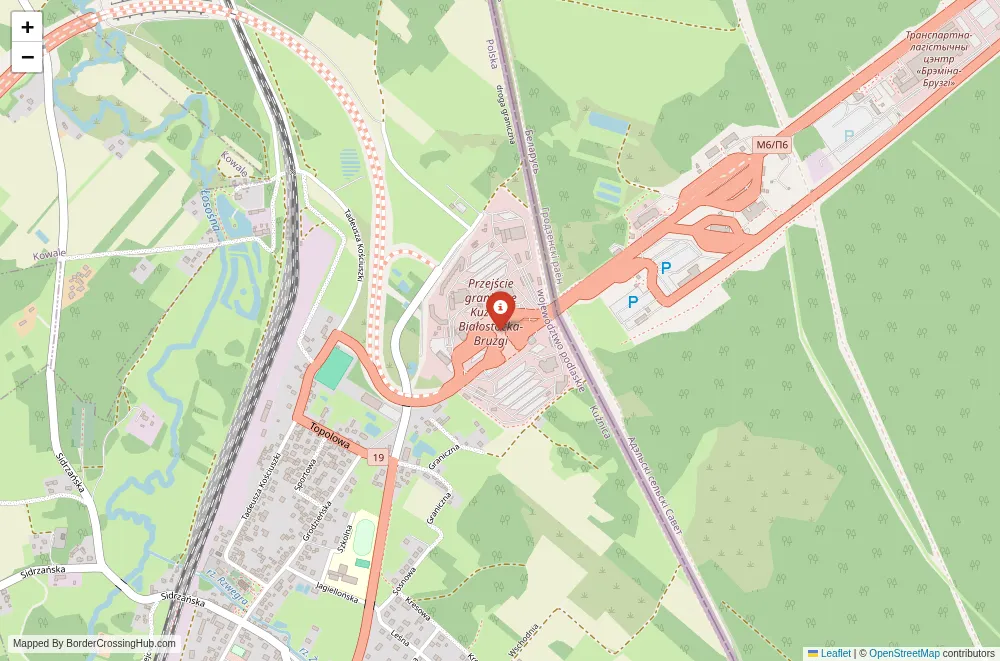
Approximate Border Location
Wait Times
Cars 60-240m; peaks 240-720m
Just crossed? Tap to report:
Operating Hours
24 hrs; delays common
Crossing Types
Cars,buses; freight; full controls
Border Type
Land crossing via road (E28 corridor)
Peak Times
Fri-Sun; holiday surges
Daily Crossings
4,000-18,000/day
Currency Exchange
BYN; PLN in Hrodna; some EUR; ATMs
Safety Information
Long queues; enhanced controls likely
Languages Spoken
Belarusian/Polish
Accessibility Features
Basic facilities; step-free varies
About Loyew & Kamianka
Monthly Update (March 2026):
As of 03/2026, the Loyew & Kamianka Border Crossing remains largely inactive for regular travel. Vehicles rarely appear at the checkpoint, and the crossing stays quiet most of the time. Border patrol presence is more noticeable than actual traffic. The situation can shift depending on regional security conditions.
No Cell Service at the Border? No Problem.
Don’t get caught scrambling for paperwork when you lose signal. Download the complete Europe Transit Guide directly to your device and access every critical detail, fast-track strategy, and border rule – 100% offline.
The Loyew-Kamianka border crossing spans the Dnieper River, linking the Belarusian town of Loyew (Loev) in Gomel Region directly to Kamianka (Kamyanka) on the Ukrainian side in Chernihiv Oblast, operating historically as a seasonal river-based point for passenger movement.
Alternative Names
You may see it referred to as Loev-Kamianka, Лоев-Каменка, Loiev-Kamyanka, or simply the Loyew river checkpoint.
Current Status and Safety Note
As of February 2026, all border crossings between Belarus and Ukraine, including this one, remain closed. Wikipedia and other sources confirm full closure of Belarus-Ukraine land and river points since at least October 30, 2024, with no reopenings reported for Loyew-Kamianka. The Ukrainian State Border Guard Service lists it as a river transport checkpoint with past local hours (8:00 a.m. to 8:00 p.m., extended in summer), but operations have halted amid ongoing geopolitical realities tied to the Russia-Ukraine conflict and Belarus’s involvement. The region carries significant risks due to military proximity, potential hybrid threats, and restricted access zones. Foreign travelers should not attempt to approach or cross here; check dpsu.gov.ua (Ukraine) and gpk.gov.by (Belarus) for any updates, plus your government’s advisories. The area is not safe for casual border tourism.
Historical Background
This river crossing emerged post-Soviet independence as a simplified point for local traffic across the Dnieper, facilitating passenger ferries or boats between the two rural areas. Loyew sits on the Belarusian bank with a small port history, while Kamianka serves as the Ukrainian counterpart. It functioned seasonally, with ice crossings possible in winter when the river froze solidly enough. In the early 2000s and 2010s, it supported limited passenger lines, including occasional boat services from April onward, reflecting bilateral agreements for simplified local propusk (passage). The Dnieper has long acted as a natural divider and connector in the region, with Loyew’s location tying into older trade routes along the river.
Geopolitical and Economic Role
Primarily a local river link, it enabled short-distance movement for residents in the Gomel and Chernihiv border zones, with minor economic ties through small trade or family visits rather than major commerce. For foreign visitors, it offered an unusual river-based option in quieter northern stretches, far from busier western points. Geopolitical shifts since 2022, including Belarus’s alignment in the Russia-Ukraine war, led to complete shutdowns across the frontier, turning this once-functional point into a dormant river segment amid fortified and monitored borders.
Operating Hours and Wait Times
When previously active, it ran limited local hours: typically 8:00 a.m. to 8:00 p.m. (or daylight-adjusted in summer for river conditions). Waits stayed minimal due to low volume and seasonal boat schedules. Current closure means no operations, hours, or queues exist.
Crossing Procedures
This served as a river transport point, mainly for passengers via ferry or boat; no vehicle or pedestrian land options. You approached by water from Loyew (Belarus) or Kamianka (Ukraine).
Both sides conducted passport and customs checks at river terminals. Most Western nationalities required visas for Belarus (e-visa possible), while Ukraine allowed visa-free short stays for many. Officials verified documents, travel purpose, and any goods. The process took 30-60 minutes when running, with seasonal adjustments for ice or navigation. Freight stayed absent; it focused on people.
Transportation Options
Reach Loyew by road from Gomel (about 1-2 hours rural drive) or local buses. On the Ukrainian side, Kamianka connects to Chernihiv or nearby villages. When open, boat services linked the shores directly. Roads to the ports remain rural and paved in parts, passing farmland and river views. Private cars got you to the terminal, but crossing relied on scheduled water transport. No rail or major highways cross here.
Scams and Warnings
Low traffic historically meant few scams, though informal boat operators might have charged extras or offered poor rates in peak seasons. With full closure and regional instability, attempting any approach risks detention, military encounters, or hazards in restricted zones. Belarus-Ukraine border areas see ongoing monitoring; unofficial crossings invite severe consequences. No recent traveler reports exist due to inaccessibility—avoid entirely.
Nearby Attractions and Side Trips
Loyew features a quiet riverside town with local history and Dnieper scenery. Nearby Belarusian Gomel offers parks, palaces, and museums. On the Ukrainian side, Chernihiv holds ancient churches, fortifications, and old-town charm. The river valley provides peaceful landscapes, though access remains limited by closures.
Seasonal Factors and Weather
River operations depended on navigation: open in warmer months, possible ice crossings in deep winter freezes. Summer extended hours for longer daylight; winter limited or shifted to foot/ice paths. Closures now override seasonal patterns, with cold adding risks in any hypothetical future use.
Practical Tips
Monitor official border services sites regularly for potential changes. Carry relevant currencies if reopening occurs. Use offline maps for rural approaches. Prepare alternative routes, as this point stays unreliable. Focus on safer regional travel options elsewhere.
Final Notes on This River Crossing
With the Belarus-Ukraine frontier fully closed, Loyew-Kamianka remains inaccessible; rely on current official sources and avoid the area for safety. It once provided a straightforward river link in a rural setting, but conditions dictate other paths for now. Safe travels.
No reviews yet.