
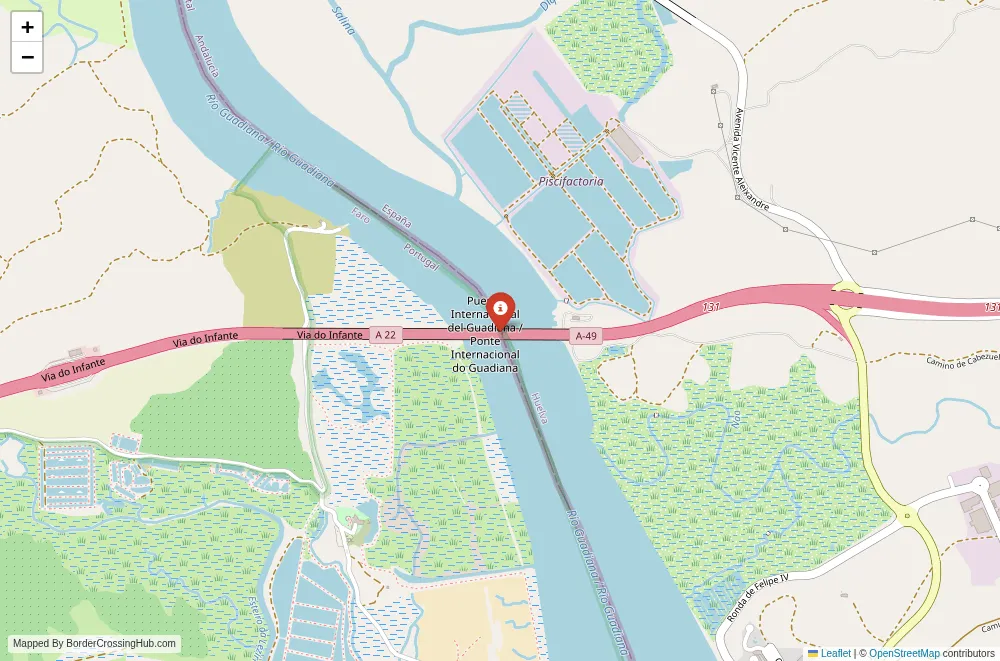
Approximate Border Location
Wait Times
Cars 0-20m; peaks 30-120m summer
Just crossed? Tap to report:
Operating Hours
Open 24 hrs (12:00 AM-11:59 PM)
Crossing Types
Ped,cars,buses; highway bridges
Border Type
Land crossing via motorway bridge (A22/A49)
Peak Times
Fri-Sun 10:00 AM-06:00 PM; Jul-Aug
Daily Crossings
20,000-80,000/day
Currency Exchange
EUR only; ATMs both sides
Safety Information
Holiday traffic; watch lane merges
Languages Spoken
Spanish/Portuguese
Accessibility Features
Good sidewalks; accessible services
About Lower Guadiana International Bridge: Pomarão & El Granado
Monthly Update (March 2026):
As of 03/2026, the Lower Guadiana International Bridge: Pomarão & El Granado Border Crossing stays quiet and mostly stable. Cars move easily across the bridge with only a few vehicles at a time. Midday tends to be especially calm, while late afternoon brings a small wave of locals heading home. Weekend trips along the Guadiana valley sometimes add a bit more traffic.
No Cell Service at the Border? No Problem.
Don’t get caught scrambling for paperwork when you lose signal. Download the complete Europe Transit Guide directly to your device and access every critical detail, fast-track strategy, and border rule – 100% offline.
The Lower Guadiana International Bridge lets you cross the Chança River on a modest concrete structure, linking the quiet Portuguese riverside village of Pomarão directly to the small Spanish village of El Granado in a remote corner of the Guadiana valley.
Alternative Names
This crossing is often called the Lower Guadiana International Bridge, Ponte Internacional do Baixo Guadiana (Portuguese), Puente Internacional del Bajo Guadiana (Spanish), the Pomarão bridge, or the Pomarão-El Granado border crossing.
Current Status
Portugal and Spain share Schengen membership, so this border remains open with no permanent checkpoints, booths, or routine controls. You drive or walk across without any formal stop. Random police or customs checks by the Portuguese GNR or Spanish Guardia Civil can occur (typically focused on commercial vehicles or occasional alerts), but they are very rare on this low-traffic rural road and almost never affect private cars or tourists. The bridge operates normally with no major restrictions reported in recent years.
Historical Background
The Portugal-Spain border along the Guadiana and its tributaries dates to medieval treaties, with this area shaped by centuries of river trade and rural life. Pomarão grew as a small river port in the 19th century, linked to mining and agriculture. The modern bridge was built to improve connectivity in this isolated region. Construction began on April 16, 2008, and the bridge opened on February 26, 2009, after just ten months of work. It was funded mostly by European Regional Development funds, with contributions from the Mértola municipality and Huelva provincial authorities. The project dramatically shortened travel distances in the area.
Geopolitical and Economic Role
This minor crossing connects two sparsely populated rural communities in the Lower Guadiana valley. It mainly serves local residents for daily errands, farming, family visits, and occasional shopping across the border. The bridge reduces the road distance between Pomarão and El Granado from around 140 km (via longer detours) to just 12 km, supporting small-scale cross-border ties. Larger traffic and freight use more prominent routes farther south or north. The surrounding Guadiana Natural Park area benefits from improved access for tourism and nature conservation.
Visa Requirements for Foreign Visitors
Schengen rules apply to both sides. If your nationality qualifies for visa-free entry, you need only a valid passport or national ID. Most non-EU visitors receive 90 days in any 180-day period across the area. Carry your travel document at all times, though checks are extremely unlikely on this remote bridge.
Crossing Procedures Step by Step
By car or motorbike, follow the small local road from Pomarão (often linked to the EN 122 or similar routes) toward the river. You reach the bridge with no barriers or signs beyond basic markers. Drive across the short span; the road continues into El Granado on the Spanish side. Pedestrians and cyclists use the same road or narrow walkways if available; the crossing is quick and simple. No booths, forms, or officials are present routinely. The reverse direction follows the exact same process.
Typical Wait Times and Peak Periods
Wait times are zero on most days. You cross immediately. Traffic stays very light even on weekends or local holidays due to the remote location. Any minor pause would come only from an unlikely random patrol.
Operating Hours
The bridge remains open 24 hours a day, every day of the year, as a public road link.
Transportation Options to and From the Border
From Mértola or Beja (Portugal), take regional roads toward Pomarão. On the Spanish side, approach from El Granado or nearby Alosno/Huelva via provincial roads. Public buses serve Mértola or Huelva but do not cross directly here; you would need to walk or arrange a short taxi between the villages. Cycling or walking works well on the quiet lanes. The nearest train stations are distant (Beja in Portugal or Zafra in Spain).
Road Conditions and Scenery
The access roads are narrow, paved rural lanes in fair condition, with some winding sections. The bridge itself is a simple, functional concrete structure (about 140 meters long and 11 meters wide) with two lanes and pedestrian walkways. Views include the gentle Chança River valley, surrounding cork oak savannas, open plains, and distant hills typical of the Alentejo-Andalusia frontier. The landscape feels vast, quiet, and untouched.
Seasonal Variations and Weather Impacts
Summer brings hotter temperatures and dry conditions. Winter rain or occasional fog can make rural roads slippery, but the bridge stays passable. No seasonal closures occur.
Nearby Attractions
Pomarão is a tiny, peaceful riverside village with traditional houses and a historic mining/port legacy along the Guadiana. The nearby Guadiana Natural Park offers birdwatching (flamingos, herons), walking trails, and quiet nature. El Granado provides a similar rural Spanish feel with whitewashed houses. The wider area suits slow exploration of cork landscapes, megalithic sites, and the authentic rural border zone.
Common Scams and Warnings
No notable scams or issues exist at this isolated point. The main concerns are very limited services (few shops or fuel nearby), poor mobile signal in the countryside, and potential winter road conditions. Drive cautiously on narrow rural roads and keep a full tank.
Travel Tips and Preparation
Use offline maps or GPS, as signage is minimal and the road can feel unmarked. Carry your passport/ID and vehicle papers. Bring water, snacks, and layers for changeable weather. If cycling or walking, the river valley offers a serene experience. Combine the crossing with a visit to Mértola or the Guadiana Natural Park for more depth.
Cultural and Economic Significance
This bridge illustrates the quiet, enduring connection between rural Alentejo and western Andalusia. Local families and farmers cross freely for daily needs, maintaining shared agricultural traditions and river heritage in one of Europe’s least urbanized border areas.
Final Planning Advice
Check rural road conditions in winter. Bring your documents, take the quiet lane slowly, and appreciate the peaceful shift across the Chança River. This remote bridge gives you a genuine, low-key taste of the deep rural Portugal-Spain frontier. Safe travels.
No reviews yet.