
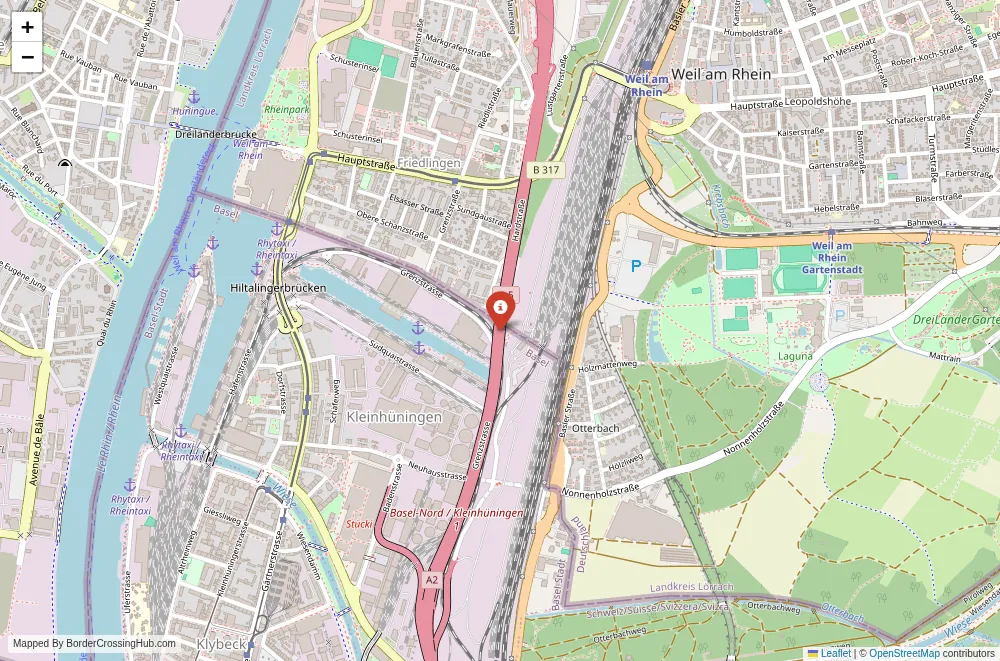
Approximate Border Location
Border Countries
- 🇩🇪Germany
- 🇨🇭Switzerland
Border Cities
- 🇩🇪Weil am Rhein
- 🇨🇭Basel
Wait Times
Cars 0-25m; peaks 30-120m w/ checks
Just crossed? Tap to report:
Operating Hours
Open 24 hrs (12:00 AM-11:59 PM)
Crossing Types
Ped,cars,buses; customs goods; checks possible
Border Type
Land crossing via motorway (A5/A2)
Peak Times
Sat 10:00 AM-06:00 PM; holiday travel
Daily Crossings
30,000-120,000/day
Currency Exchange
EUR; CHF in Basel/Weil; banks + ATMs
Safety Information
City traffic; occasional controls; watch queues
Languages Spoken
German
Accessibility Features
Step-free sidewalks; accessible transit
About Lörrach & Riehen
Monthly Update (March 2026):
As of 03/2026, the Lörrach & Riehen Border Crossing stays moderately busy with a steady local rhythm. Vehicles move through the city streets without much pause, though afternoon commuting can slow things slightly heading into Switzerland. Pedestrians cross frequently between neighborhoods. Work travel and shopping trips shape most of the traffic here.
No Cell Service at the Border? No Problem.
Don’t get caught scrambling for paperwork when you lose signal. Download the complete Europe Transit Guide directly to your device and access every critical detail, fast-track strategy, and border rule – 100% offline.
The Lörrach-Riehen crossing stands as one of the most frequently used local land links between Germany and Switzerland, where the Rhine valley town of Lörrach in Baden-Württemberg directly adjoins the Swiss municipality of Riehen in the canton of Basel-Stadt, allowing seamless daily movement across a border that often feels more like a neighborhood line than an international divide.
Location and Connections
You find this crossing where Lörrach (Germany) meets Riehen (Switzerland), with multiple points including road bridges over the Wiese River (Wiesental), pedestrian paths, and rail/tram links. The main road crossing follows German B317 or local streets into Swiss Route 2 or Riehen’s residential areas. Lörrach lies about 10 minutes north of Basel city center, while Riehen sits immediately south of Basel’s northern outskirts. From Basel, Riehen is a short tram or drive away; from Freiburg or the Black Forest, Lörrach is roughly 30 to 45 minutes south. Tram line 8 (Basel trinational S-Bahn network) extends from Basel into Lörrach, often crossing at points like Lörrach-Stetten to Riehen. Regional trains connect via Lörrach Hauptbahnhof to Basel Badischer Bahnhof (German-operated in Basel). Buses and cycling paths along the Wiese supplement options. The area forms part of the Basel trinational conurbation (Switzerland, Germany, France), drawing commuters, shoppers, and day-trippers.
Alternative Names
It appears as the Lörrach-Riehen border crossing, Lörrach-Stetten–Riehen Grenzübergang, or Wiese Valley crossings near Lörrach/Riehen.
Historical Background
The border here traces the High Rhine’s course, shaped by medieval trade and 19th-century Swiss-Baden treaties. Lörrach and Riehen grew as twin settlements in the Wiesental valley, with the Wiese River defining the line in places. Post-WWII, customs formalities persisted until Schengen in 2008 (Switzerland’s entry). The area preserves shared Alemannic heritage, with cross-border infrastructure like trams and paths reflecting integrated life. The crossing ties into Basel’s role as a commercial hub, with the nearby Dreiländereck (tripoint with France) adding geographic interest.
Geopolitical Context
Schengen since 2008 normally eliminates routine passport and customs checks for EU/Swiss citizens and visa-exempt travelers. Germany maintains temporary internal border controls due to migration, smuggling, and security. As of February 10, 2026, these extend at least through March 15, 2026, with Bundespolizei random spot inspections at land borders, including Switzerland crossings like Lörrach-Riehen. Switzerland occasionally increases checks for security or traffic, but no widespread temporary controls apply here. Spot checks focus on irregular migration or goods; this local crossing sees occasional enforcement, often lighter than motorways but with reports of delays during peaks. No permanent booths exist; controls are mobile or roadside. The border follows the Wiese or markers in town.
Practical Crossing Procedures
You drive, walk, cycle, or ride tram/train across roads, paths, or bridges with border markers or signs. On roads, proceed straight; pedestrians/trams use dedicated ways. Temporary German measures may prompt random stops (more likely on roads or rail) for ID checks, travel questions, or vehicle review. EU/Swiss citizens show passport or national ID. Non-EU nationals need valid passports, visas/Schengen entry if required, and proofs like accommodation. Carry vehicle insurance; Swiss vignette needed if continuing on highways (local Basel area often vignette-free short distances). Rail/tram passengers face rare onboard checks. Switzerland not in EU customs union means declare goods over allowances (shopping limits apply).
Typical Wait Times
Normal passage takes seconds to minutes. Random checks add variability: most clear quickly, but selected stops or peaks (weekends, holidays, commuter rushes) can cause 10 to 45 minute delays on roads or trams. Foot crossings or local paths often face no waits. Tram line 8 crossings stay smooth.
Operating Hours
Roads, paths, rail, and trams operate 24/7 year-round. Schengen removed fixed hours. Winter weather or rare events might slow access briefly, but crossings remain open.
Transportation Options and Road Conditions
Drive across local roads or bridges; tram line 8 runs from Basel into Lörrach/Riehen. Regional trains connect via Lörrach to Basel networks. Roads offer good pavement with urban traffic; bridges have lanes for cars/bikes. Scenery includes Rhine valley, meadows, and town views. Watch for cyclists, trams, or river traffic.
Scams and Warnings
Scams stay rare in this integrated border area. No common touts or fake services reported. Watch for parking fees or informal changers with poor rates. Carry ID for spot checks. The area feels safe and trinational; drive attentively near the Rhine.
Nearby Attractions
Lörrach offers the old town, market square, and access to the Black Forest. Riehen features the Fondation Beyeler art museum and Rhine paths. Basel provides the old town, Rhine promenades, and Kunstmuseum. Nearby Dreiländereck tripoint with France adds curiosity. The region suits historic walks, art, or cross-border cycling.
Seasonal Variations and Weather Impacts
Winter brings snow; roads clear quickly. Summer sees crowds and clear weather. Autumn offers foliage. Rain can slick paths, but closures stay rare.
Travel Tips and Preparation
Carry passport/ID for spot checks. Use cross-border transport apps. Pack layers for Rhine weather. Check police sites for control updates. Enjoy the seamless town feel.
Cultural and Economic Significance
The crossing supports binational life: shared commuting, shopping, and events. Basel and Lörrach/Riehen thrive on visitors drawn to the Rhine, museums, and border curiosities, tying Swiss-German economies.
Before You Cross
Verify spot check status and traffic from official sources near your travel date. With prep for rare stops and relaxed pace, you handle this Rhine valley crossing and explore the shared Lörrach-Riehen Basel area. Safe travels.
No reviews yet.