
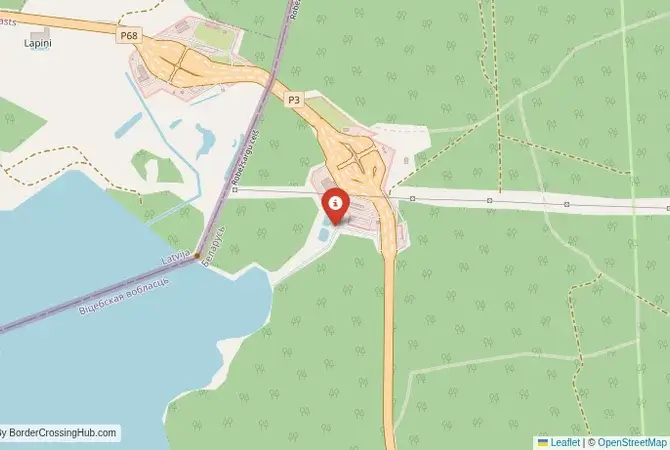
Approximate Border Location
Wait Times
10-50 min pedestrians/vehicles
Just crossed? Tap to report:
Operating Hours
6:00 AM-8:00 PM
Crossing Types
Pedestrians, vehicles
Border Type
Land crossing via road
Peak Times
7-10 AM
Daily Crossings
800-1500 travelers/vehicles
Currency Exchange
Near Lopyanishka (BYN, EUR)
Safety Information
Remote, rural risks
Languages Spoken
Belarusian/Latvian
Accessibility Features
Ramps, limited assistance
About Lopyanishka & Viciebskaja voblasć
Monthly Update (April 2026):
Long quiet stretches define most of the day, with occasional crossings. In April 2026, Lopyanishka & Viciebskaja voblasć Border Crossing is mostly stable and very lightly used. Processing can feel slow due to detailed checks. Weather and local movement patterns shape activity.
No Cell Service at the Border? No Problem.
Don’t get caught scrambling for paperwork when you lose signal. Download the complete South America Transit Guide directly to your device and access every critical detail, fast-track strategy, and border rule – 100% offline.
A Closed Gateway to the Land of Lakes
Important Note for Travelers: The political situation between Latvia and Belarus is extremely tense. Latvia has closed most of its border crossings with Belarus. This crossing at Silene has been closed and remains closed as of early 2026. This guide is provided for historical and informational purposes only. The border crossing connecting the Belarusian village of Urbany with Silene in Latvia was a major international checkpoint, serving as the primary route between the Belarusian capital, Minsk, and the Latvian city of Daugavpils. It was a journey into the heart of a breathtaking landscape of countless lakes and dense forests, a region often referred to as the “Belarusian Switzerland” and the “Land of Blue Lakes” in Latvia. This was a busy, 24/7 crossing, a vital artery for trade and tourism, but one that was always framed by the serene natural beauty of the Braslav Lakes National Park on the Belarusian side and the Augšdaugava Protected Landscape Area on the Latvian side.
Operational Details
This checkpoint connected the Viciebskaja voblasć (Vitebsk Region) of Belarus with Latvia’s Augšdaugava Municipality. It was a full-service international crossing, open to all passenger cars and commercial freight. It was located on the main highway linking the two regions and was the most heavily used crossing on the Latvia-Belarus border. Its closure has had a significant impact, redirecting all traffic to the single remaining open post at Pāternieki, which requires mandatory electronic queue reservation since October 2025.
A History of a Multicultural Borderland
The history of this region is one of a complex multicultural borderland, historically part of the Grand Duchy of Lithuania and the Polish-Lithuanian Commonwealth, and later the Russian Empire. It has long been home to a mix of Belarusian, Latvian (Latgalian), Polish, and Russian communities. The border established in the 20th century cut through this ethnically diverse landscape. The city of Daugavpils on the Latvian side is a prime example of this heritage, with its large Russian-speaking population and its history as a major military and industrial center of the Russian Empire. The crossing at Urbany-Silene was a key point for maintaining the family and cultural ties that span this modern border.
Former Border Procedure
The border crossing procedure, when it was operational, was a standard two-part process for entering the EU. Travelers would first complete exit formalities at the Belarusian checkpoint at Urbany. This was a large, multi-lane facility designed to handle significant traffic. After this, they would proceed to the Latvian checkpoint at Silene for a full EU and Schengen Area entry inspection by the State Border Guard (Valsts Robežsardze) and customs officials. A valid passport, a Schengen visa (if required), and vehicle documents were mandatory. As the main crossing, it frequently experienced long queues, especially for freight trucks, but also for passenger cars during holiday periods.
Gateway to Natural Parks
The main attraction of this route was the exceptional natural beauty of the region. On the Belarusian side, the crossing is on the edge of the Braslav Lakes National Park, a stunning area with over 300 lakes, popular for boating, fishing, and eco-tourism. The town of Braslav is the main tourist hub for the park. On the Latvian side, the Silene Nature Park and the wider Augšdaugava Protected Landscape Area offer similar scenery, with pristine lakes, forests, and the beautiful Daugava River valley. The crossing was the most direct gateway for Latvians to visit the Braslav Lakes and for Belarusians to explore the Latgale region.
Closure Due to Geopolitical Tensions
The closure of the Silene-Urbany crossing in September 2023 was a major step in the sealing of the Latvia-Belarus border. The Latvian government cited national security concerns, the risks of “hybrid warfare,” and the orchestrated migrant crisis by the Belarusian regime as the primary reasons for the closure. This move was coordinated with similar actions by Lithuania and Poland, creating a near-total closure of the EU’s land border with Belarus. The decision aimed to restrict the mobility of Belarusian officials and to enhance the security of the EU’s eastern flank, with no reopening as of early 2026 amid extended enhanced guarding.
Final Considerations
The Urbany and Silene border crossing was once a bustling gateway to a region of outstanding natural beauty, a vital link for the economies and people of the Latvian and Belarusian lake districts. Its closure has turned a major highway into a cul-de-sac, severing a key connection and leaving the modern, well-equipped checkpoint standing empty. It is a powerful symbol of the deep political chasm that has opened between Belarus and its EU neighbors, a silent testament to how quickly a bridge between nations can become a barrier.
No reviews yet.