
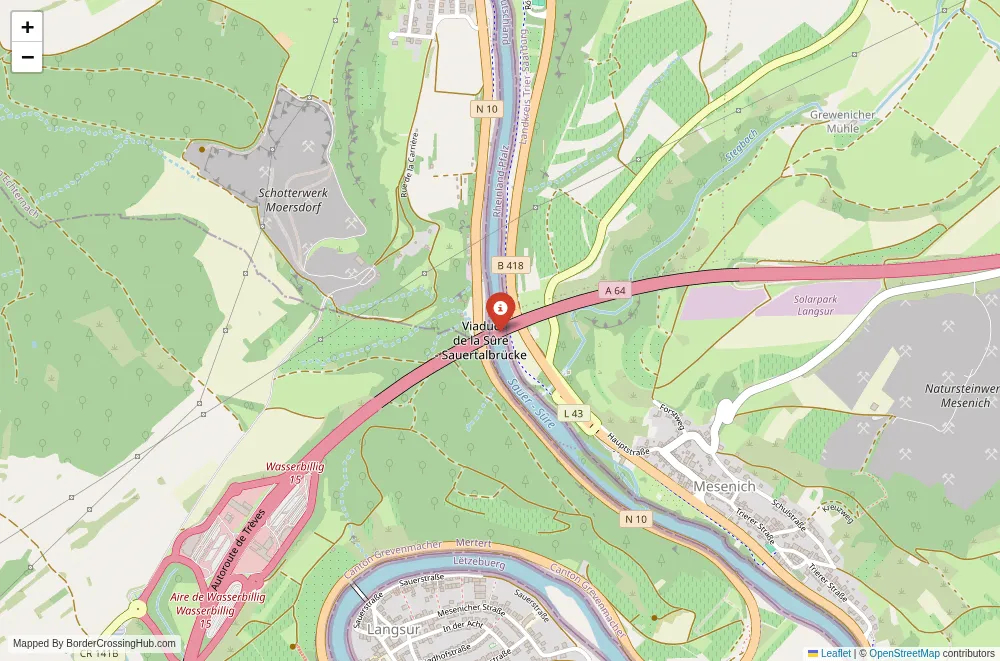
Approximate Border Location
Border Countries
- 🇱🇺Luxembourg
- 🇧🇪Belgium
Border Cities
- 🇱🇺Leithum
- 🇧🇪Stubach
Wait Times
Cars 0-5m; occasional checks 10-25m
Just crossed? Tap to report:
Operating Hours
Open 24 hrs (12:00 AM-11:59 PM)
Crossing Types
Ped,cars,bikes; rural road
Border Type
Land crossing via local road
Peak Times
10:00 AM-04:00 PM; weekends
Daily Crossings
120-700/day
Currency Exchange
EUR only; ATMs in St. Vith/Clervaux
Safety Information
Low risk; watch narrow lanes
Languages Spoken
French/German
Accessibility Features
No marked bays; uneven shoulders
About Leithum & Stubach
The Leithum-Stubach road lets you cross from Luxembourg into Belgium on a short, narrow rural lane, barely a kilometer from the village of Leithum to the tiny Belgian hamlet of Stubach.
Alternative Names
This point is often called the Leithum border crossing, the Leithum-Stubach grensovergang, or simply the road from Leithum to Stubach. It is sometimes grouped with the nearby Leithum-Oberhausen crossing as part of the northeastern Luxembourg frontier.
Current Status and Safety Note
Luxembourg and Belgium share full Schengen openness, so this crossing has no fixed controls, barriers, or booths. You pass through without any formal stop. Random police patrols or spot checks can happen in the wider border region for security or customs reasons, but they are very rare at this isolated spot and almost never target ordinary cars, cyclists, or walkers. The area remains extremely quiet and safe, with no known scams or issues for travelers.
Historical Background
The boundary here was set by the 1839 Treaty of London, which defined Luxembourg’s borders after Belgium gained independence. Leithum sits at the northeastern corner of Luxembourg, right where the 1839 line begins. The direct road to Stubach has existed since at least the 19th century, serving small farming communities. It lies close to the tripoint where Belgium, Luxembourg, and Germany meet, a few kilometers away along the Our River and smaller streams.
Geopolitical and Economic Role
This is a purely local crossing with minimal traffic. It connects the small Luxembourgish village of Leithum (part of the commune of Weiswampach) to Stubach in Belgium’s Burg-Reuland area. Residents use it for everyday errands, farming, or visits across the line. No significant trade or freight moves here; larger volumes go through nearby motorways or other points farther south.
Visa Requirements for Foreign Visitors
Both sides follow Schengen rules. If your passport allows visa-free entry, you cross freely with only valid ID or passport. Most non-EU nationalities get 90 days in any 180-day period. Keep your document handy, though checks are extremely unlikely on this back road.
Crossing Procedures Step by Step
From Leithum, take the small local road heading north (often a minor route like CR 336 or unmarked on some maps). The border arrives without warning: a simple stone marker or sign in the grass or hedge, and you enter Belgium. The lane continues straight to Stubach. No buildings, lights, or officials appear. Cyclists and pedestrians follow the same road or nearby paths. Returning to Luxembourg reverses the process exactly. The entire move takes under a minute.
Typical Wait Times and Peak Periods
You experience no wait at all. The road stays empty most of the time. Even during weekends or holidays, only occasional local cars or bikes pass. Any delay would come solely from an improbable random police vehicle.
Operating Hours
This public road crossing is open 24 hours a day, all year round.
Transportation Options to and From the Border
Leithum is reached via local roads from Troisvierges or Weiswampach in Luxembourg. On the Belgian side, Stubach connects to Burg-Reuland or nearby villages. Public buses serve Weiswampach or Burg-Reuland but do not run directly across this exact point. Most visitors arrive by car or bicycle. The quiet lanes suit cycling well for those exploring the area.
Road Conditions and Scenery
The road is narrow, paved, and maintained adequately for local use, though it may have some patches or gentle bends. You pass through open farmland, pastures, small patches of woodland, and gentle rolling hills typical of the Ardennes-Eifel foothills. The surroundings feel remote, green, and unspoiled, with few houses or signs of modern development.
Seasonal Variations and Weather Impacts
Winter can leave ice or light snow on the narrow surface, so drive or cycle cautiously. Summer brings comfortable conditions and longer daylight for exploration. Rain keeps the road wet but passable. No closures happen due to season.
Nearby Attractions
Leithum is a tiny, peaceful village with a small church and rural charm. Just across the border, Stubach sits near the Hohes Venn-Eifel nature park with peat bogs, moorlands, boardwalk trails, and wildlife. The Belgium-Germany-Luxembourg tripoint lies a short drive away, marked near the Our River and often paired with a symbolic Europa Monument. Hiking paths and quiet countryside make the area ideal for nature outings.
Common Scams and Warnings
No scams or negative traveler reports exist for this remote lane. The only practical concern is limited phone signal in the countryside and very few services if you have car trouble. Winter road conditions warrant extra care.
Travel Tips and Preparation
Download offline maps since signage is sparse and the road can feel unmarked. Carry your passport or ID and basic vehicle papers. Bring water and snacks, as no shops or facilities sit at the crossing. If biking, the quiet route offers a relaxed ride; watch for farm vehicles. Pair the crossing with a walk or drive to the tripoint or nature park trails.
Cultural and Economic Significance
This crossing reflects the deep integration of life in the Luxembourg-Belgium frontier. Farmers and families move freely for daily needs, ignoring a line drawn almost 200 years ago. The area preserves a traditional rural character where Luxembourgish, French, and German influences overlap quietly.
Final Planning Advice
Check winter road conditions if traveling in cold months. Bring your documents, go slowly on the narrow lane, and take in the serene rural shift from one country to another. This hidden corner gives you a pure taste of Europe’s open borders. Safe travels.
No reviews yet.