
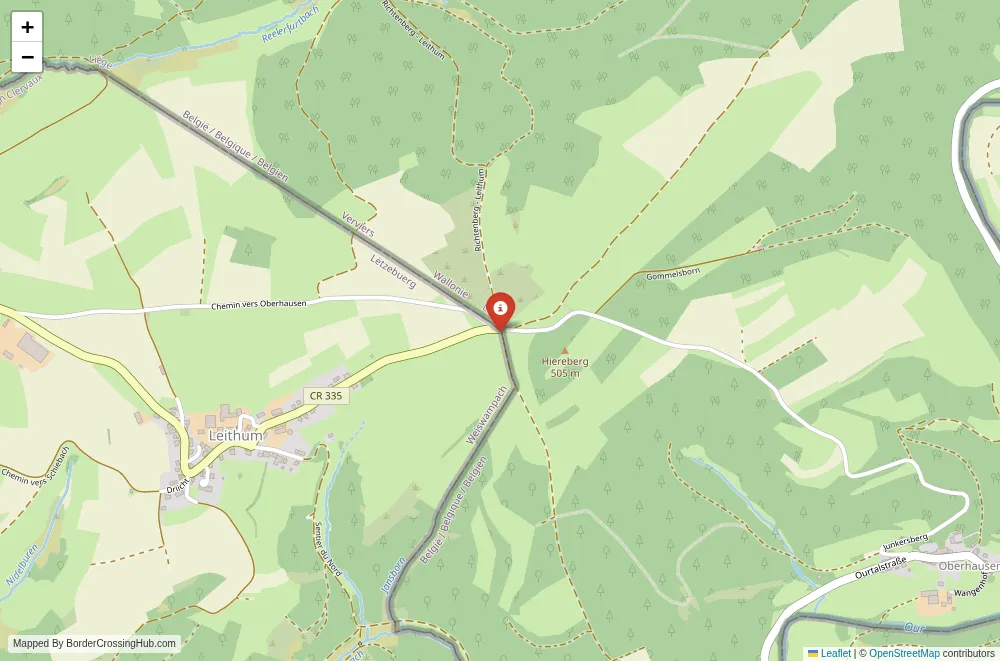
Approximate Border Location
Border Countries
- 🇱🇺Luxembourg
- 🇧🇪Belgium
Border Cities
- 🇱🇺Leithum
- 🇧🇪Oberhausen
Wait Times
Cars 0-5m; rare checks 10-30m
Just crossed? Tap to report:
Operating Hours
Open 24 hrs (12:00 AM-11:59 PM)
Crossing Types
Ped,cars,bikes; minor road
Border Type
Land crossing via rural road
Peak Times
Daytime 09:00 AM-05:00 PM; weekends
Daily Crossings
150-800/day
Currency Exchange
EUR only; ATMs in nearby villages
Safety Information
Quiet; limited lighting at night
Languages Spoken
French/German
Accessibility Features
Uneven verges; minimal ramps
About Leithum & Oberhausen
The Leithum-Oberhausen crossing offers one of the most rural and understated ways to move between Luxembourg and Belgium on quiet local roads near the country’s northeastern edge.
Alternative Names
You will see this referred to as the Leithum border crossing, the Molenbeersel-Leithum grens (in Dutch contexts), or simply the road from Leithum to Oberhausen (Belgium). It sometimes appears alongside the nearby Stubach connection in local descriptions.
Current Status and Safety Note
Luxembourg and Belgium share Schengen membership, so this crossing remains fully open with no permanent controls, booths, or queues. You drive or cycle across without stopping in normal circumstances. Random police or customs checks can occur anywhere in the border region due to broader European security measures, but they are infrequent at this tiny rural point and rarely affect ordinary travelers. The area feels peaceful and remote, with no reports of scams, touts, or significant safety concerns.
Historical Background
The border line here traces back to the 1839 Treaty of London, which fixed Luxembourg’s frontiers after Belgian independence from the Netherlands. Leithum sits right at the northeastern corner of Luxembourg in the canton of Diekirch (now part of the commune of Weiswampach). The road north from the village crosses directly into Belgium’s province of Liège, linking to small hamlets like Oberhausen and Stubach. This quiet frontier has stayed largely unchanged for nearly two centuries, serving local farmers and residents far from larger trade routes.
Geopolitical and Economic Role
As a minor local road, this point handles almost no international freight or heavy traffic. It supports daily life in the tri-border area where Luxembourg, Belgium, and Germany come close together. Residents cross for work, shopping, family visits, or to reach the nearby Hohes Venn-Eifel nature park in Belgium. The wider region benefits from open borders that allow seamless movement in a landscape of small villages and forests.
Visa Requirements for Foreign Visitors
Schengen rules govern both sides. If your nationality qualifies for visa-free entry, you need only a valid passport or national ID card. Most non-EU visitors receive 90 days within any 180-day period across the area. Carry your travel document at all times, as spot checks can take place anywhere along rural border roads.
Crossing Procedures Step by Step
You follow the small road out of Leithum (often marked CR 336 or similar) heading north. The border arrives without fanfare: a simple marker or sign in the hedge or verge, and you enter Belgium. The road continues toward Oberhausen (a tiny Belgian hamlet) and nearby Stubach. No buildings, barriers, or officials wait here. Cyclists and pedestrians use the same road or adjacent paths. The return trip reverses the process exactly. The whole transition takes seconds.
Typical Wait Times and Peak Periods
Wait times stay at zero most days. You pass through immediately. Even on weekends or holidays, traffic remains light due to the remote location. Any brief pause would come only from an unlikely random patrol.
Operating Hours
The crossing functions 24 hours a day, every day of the year, as an ordinary public road.
Transportation Options to and From the Border
Leithum lies along local roads from Weiswampach or Troisvierges in Luxembourg. From Belgium, approach via Oberhausen or nearby Burg-Reuland. Public transport options are limited; buses serve Weiswampach or Burg-Reuland, but no direct service crosses exactly here. Most people arrive by car or bicycle along regional routes. The area suits slow exploration by bike on quiet lanes.
Road Conditions and Scenery
The road is narrow, paved, and generally well-maintained but rural. Expect gentle curves through farmland, small woods, and open fields. The landscape features rolling hills, pastures, and occasional streams in the foothills of the Ardennes/Eifel. It feels remote and green, with few houses or traffic.
Seasonal Variations and Weather Impacts
Winter can bring ice or snow on narrow roads, so drive carefully. Summer offers pleasant conditions for cycling or walking. Rain makes surfaces wet but rarely impassable. No seasonal closures affect this point.
Nearby Attractions
Leithum itself remains a quiet village with basic amenities. In Luxembourg, nearby Weiswampach and Troisvierges provide access to hiking trails and small lakes. On the Belgian side, Oberhausen and Stubach sit close to the Hohes Venn-Eifel nature reserve with peat bogs, moorlands, and marked paths. The tripoint where Belgium, Germany, and Luxembourg meet lies a short distance away near the Our and Réibech rivers, offering a symbolic spot to stand in three countries at once.
Common Scams and Warnings
No notable scams or issues occur at this isolated crossing. The biggest practical concern involves weather-related road conditions in winter or very limited services if you break down. Random police stops focus on vehicles rather than pedestrians or cyclists.
Travel Tips and Preparation
Use offline maps or a GPS app, as signage is minimal and cell signal can fade in the countryside. Carry your passport/ID and vehicle documents. Pack water and snacks, since shops are scarce. If cycling, the quiet roads make for enjoyable rides; check for bike paths or shoulders. Combine the crossing with a hike in the nearby nature reserve for a fuller experience.
Cultural and Economic Significance
This point illustrates how small communities live across the Luxembourg-Belgium line with little regard for the frontier. Local agriculture, tourism, and cross-border routines sustain the area. It sits in a region where Luxembourgish, French, German, and Belgian influences blend quietly.
Final Planning Advice
Double-check road conditions in winter through local weather sources. Bring your documents, take it slow on the narrow lanes, and savor the peaceful rural shift between two countries. This understated crossing lets you experience the open borders of Europe at their simplest. Safe travels.
No reviews yet.