
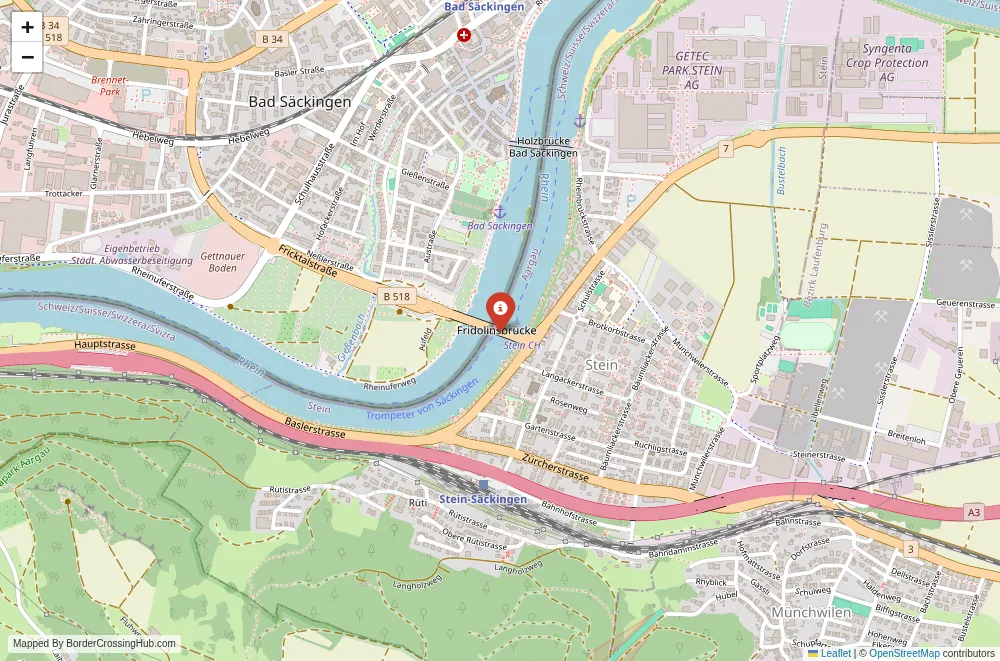
Approximate Border Location
Border Countries
- 🇩🇪Germany
- 🇨🇭Switzerland
Border Cities
- 🇩🇪Bad Säckingen
- 🇨🇭Stein
Wait Times
Cars 0-10m; peaks 15-45m commute
Just crossed? Tap to report:
Operating Hours
Open 24 hrs (12:00 AM-11:59 PM)
Crossing Types
Ped,cars,bikes; customs goods
Border Type
Land crossing via road bridge (Rhine)
Peak Times
06:30-09:00 AM; 04:00-06:30 PM
Daily Crossings
8,000-30,000/day
Currency Exchange
EUR; CHF in towns; ATMs
Safety Information
Low incident rate; occasional controls
Languages Spoken
German
Accessibility Features
Step-free sidewalks; some narrow paths
About Laufenburg & Laufenburg
Monthly Update (March 2026):
As of 03/2026, the Laufenburg & Laufenburg Border Crossing stays calm with a steady flow of local traffic. Cars cross the bridge easily between the two halves of the town, and delays are uncommon. Late afternoon can slow slightly with commuters heading home. Weekend visitors exploring the old town sometimes add a bit more movement.
No Cell Service at the Border? No Problem.
Don’t get caught scrambling for paperwork when you lose signal. Download the complete Europe Transit Guide directly to your device and access every critical detail, fast-track strategy, and border rule – 100% offline.
The Laufenburg crossing splits a single medieval town across the High Rhine, with the larger Swiss side in Aargau canton preserving the historic core and castle ruins while the smaller German portion in Baden-Württemberg lies opposite, joined by a central stone bridge that lets you step from one country to the other in under a minute.
Location and Connections
You reach this crossing where Laufenburg (Switzerland, Aargau canton) directly adjoins Laufenburg (Germany, Baden-Württemberg state), divided by the Rhine. The primary pedestrian and limited local vehicle crossing uses the historic Laufenbrücke (Laufen Bridge), a stone arch bridge in the town center carrying foot, bike, and occasional car traffic between the two halves. The bridge stands right in the old town, with the border marked at its midpoint. From the Swiss Laufenburg center, the bridge is immediate; from the German side, it’s equally central. Nearby Bad Säckingen (Germany) lies about 10 to 15 minutes west along the Rhine, and Schaffhausen (Switzerland) is roughly 30 minutes east. Regional trains connect Laufenburg stations (Swiss and German sides) to Basel or Waldshut-Tiengen. Buses serve cross-border routes, and cycling paths along the High Rhine make it popular for tours.
Alternative Names
It appears as the Laufenburg border crossing, Laufenbrücke crossing, Laufenburg (AG)-Laufenburg (Baden) Grenzübergang, or the Rhine bridge at Laufenburg.
Historical Background
Laufenburg formed as one settlement around the 13th century, with the Rhine as a vital trade route for salt, timber, and goods. The border emerged in the early 19th century through Swiss-Baden treaties, splitting the town but leaving its Alemannic roots intact. The stone bridge, rebuilt over centuries from earlier wooden versions, has long bridged the divide. Customs formalities persisted until Schengen in 2008 eased things for Switzerland. The Swiss side retains more medieval architecture (castle ruins, old streets, painted houses), while the German part offers quieter river views and a smaller historic quarter. The crossing reflects shared history despite the line, with the Rhine fostering close ties through commerce and culture.
Geopolitical Context
Schengen since 2008 normally removes routine passport and customs checks for EU/Swiss citizens and visa-exempt travelers. Germany maintains temporary internal border controls due to migration, smuggling, and security. As of February 10, 2026, these extend at least through March 15, 2026, with Bundespolizei random spot inspections at land borders, including Switzerland crossings like Laufenburg. Switzerland occasionally heightens checks for security or traffic, but no widespread temporary controls apply here. Spot checks focus on irregular migration or goods; this small bridge crossing sees very light or no enforcement compared to motorways. No permanent booths exist; the border is marked by a white line or signs on the bridge.
Practical Crossing Procedures
You walk or cycle across the Laufenbrücke, marked by a white line or sign at the midpoint. Cars are restricted on the old town bridge (use nearby local roads or the western bridge for vehicles). No booths or systematic queues exist under normal Schengen flow. Temporary German measures may prompt rare random stops (more likely on nearby roads) for ID checks or travel questions. EU/Swiss citizens show passport or national ID. Non-EU nationals need valid passports, visas/Schengen entry if required, and proofs like accommodation. No vehicle insurance or vignette applies to the bridge (pedestrian/cycle focus). Switzerland not in EU customs union means declare goods over allowances if shopping.
Typical Wait Times
You cross in under a minute on foot, with no delay. Random checks are extremely uncommon on this bridge, adding little time if they occur. Peak tourist weekends or events bring more walkers but rarely backups. The bridge handles light flow, keeping it smooth.
Operating Hours
The bridge operates 24 hours daily, year-round. Schengen removed fixed hours. Winter weather or rare maintenance might slow access briefly, but it stays passable.
Transportation Options and Road Conditions
Walk or cycle across the central bridge; drive nearby local roads for vehicles. Regional trains connect Laufenburg stations to Basel or Waldshut. Buses serve cross-border routes. The bridge features stone decking with arches, narrow for pedestrians/cyclists, but sturdy. Roads nearby offer good pavement. Scenery includes Rhine views, medieval buildings, and town squares. Watch for pedestrians, cyclists, or river traffic.
Scams and Warnings
Scams stay rare in this quiet twin-town area. No common touts or fake services reported. Watch for parking fees or informal changers with poor rates. Carry ID for spot checks. The setting feels safe and welcoming; watch footing on stone when wet.
Nearby Attractions
Swiss Laufenburg features the old town, castle ruins, Rhine paths, and salt spa heritage. German Laufenburg offers quieter river views and access to the Black Forest. Nearby Bad Säckingen (west) has the longest covered wooden bridge in Europe. The High Rhine offers cycling trails, Rhine Falls near Schaffhausen, and lake access toward Lake Constance. The area suits historic walks, river scenery, or border curiosities.
Seasonal Variations and Weather Impacts
Winter brings snow; bridge stays open but slippery. Summer sees crowds and clear weather. Autumn offers foliage and milder days. Rain can slick stone, but closures stay rare.
Travel Tips and Preparation
Carry passport/ID for spot checks. Use cross-border transport apps. Pack layers for Rhine weather. Check police sites for control updates. Enjoy the seamless town feel.
Cultural and Economic Significance
The crossing supports daily life and tourism in the split Laufenburg, linking Swiss and German communities through shared Rhine heritage. Medieval architecture, festivals, and cross-border shopping thrive on open movement.
Before You Cross
Verify spot check status and traffic from official sources near your travel date. With prep for rare stops and relaxed pace, you navigate this historic Rhine bridge crossing and explore the charming twin towns on both sides. Safe travels.
No reviews yet.