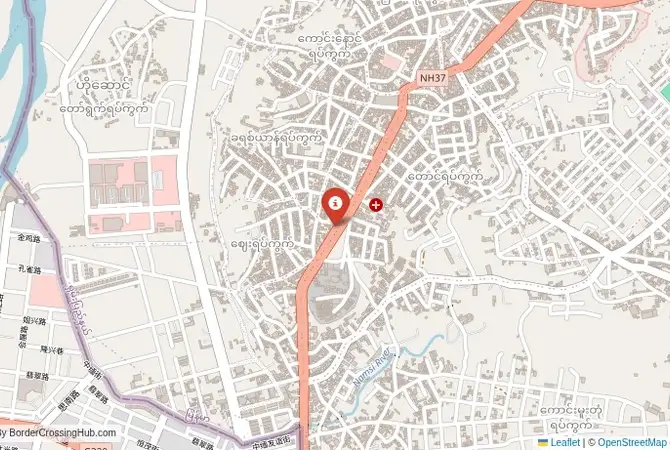
Monthly Update (September 2026):
Lashio & Ruili remains a highly problematic route for ordinary international travelers because of the conflict and security situation in northern Myanmar. Although Ruili remains a major China-Myanmar commercial gateway, the land route through Lashio is not a dependable tourist corridor, and access on the Myanmar side can change rapidly. There is no September development indicating a return to normal unrestricted passenger travel, so travelers should not plan an overland China-Myanmar itinerary around this crossing.
About this crossing
The Ruili-Muse Crossing: The Old Burma Road
The border crossing that connects the bustling Chinese city of Ruili in Yunnan Province with the chaotic Myanmar town of Muse in the northern Shan State is the most important and historically significant land gateway between the two nations. This is the route of the famous Burma Road, the legendary supply line built during World War II. In times of peace, this is the single largest channel for bilateral trade, a massive, 24-hour torrent of trucks, traders, and migrant workers. The border is a vibrant, sprawling, and often chaotic hub, a place where the modern, organized world of China meets the complex, semi-lawless frontier of northern Myanmar. The atmosphere is one of intense commerce, a heady mix of legal trade and vast illicit economies. For the traveler, crossing here (when possible) was a major adventure, a passage from the heart of Yunnan into the wild, beautiful, and conflict-ridden Shan hills, on a road steeped in history.
A History of War, Trade, and Drugs
The history of this border is a dramatic one. Its modern significance begins with the construction of the Burma Road in 1937-38, a monumental effort to supply the Chinese nationalist government in its war against Japan. After the communist victory in China and the independence of Burma, the border became a complex frontier. The northern Shan State became part of the Golden Triangle, a major center for opium production, and the Muse-Ruili crossing was a key route for the drug trade. It was also a battleground for the long-running civil war between the Burmese central government and various ethnic armies, particularly the Shan and Kachin. In the 1990s, with a series of ceasefire agreements and China's economic opening, legal trade boomed. The crossing was upgraded into a massive commercial port, and Ruili was transformed into a major city, its economy almost entirely dependent on cross-border trade. It is a border that has been defined by war, opium, jade, and, more recently, massive volumes of legitimate commerce.
Nearby Border Crossings



The Border Crossing Procedure (In Times of Stability)
The following describes the procedure when the border is open and safe for travelers. This is not the current situation. Overland travel for foreigners at this crossing has always been highly restricted and has generally required a pre-arranged tour with a licensed guide and special permits. The Process: Independent travel was not possible. A traveler would need to work with a tour agency that could arrange the necessary permits from the Myanmar authorities. You would be met by your guide on one side of the border and handed over to another guide on the other. The process would be a full-day affair. Exiting China (Ruili): You would go to the large Chinese immigration and customs building. The exit process would be formal and efficient, involving a passport check and customs scan. Entering Myanmar (Muse): You would then walk across the bridge to the Myanmar side. The town of Muse is a chaotic border market. The immigration process would be handled by your guide, who would present your passport, your pre-arranged visa, and your special travel permits to the officials. The process could be slow and bureaucratic. Once cleared, you would begin the long and dangerous overland journey.
Route, Onward Travel, and The Current Conflict
The road from Muse leads south to the city of Lashio, the capital of the northern Shan State. This is the old Burma Road. The journey is a spectacular one, through high mountains and deep gorges, including the famous Goteik Viaduct. However, this entire region is currently a major battlefield. In late 2023, a powerful alliance of ethnic armies launched a massive offensive ("Operation 1027") and captured vast amounts of territory from the military junta, including many of the key towns and border crossings in the northern Shan State, including the Muse-Ruili gate. The area has seen intense fighting, airstrikes, and a complete breakdown of security. The road is not safe to travel, and the border is not functioning as a normal international gateway. There is no viable or safe way for a traveler to journey overland from this border into the interior of Myanmar. Limited trade and passenger flows (over 5 million crossings in 2025) have resumed under controlled conditions, but foreigners remain barred.
Final Contextual Note: A Gateway Engulfed by War
The Ruili-Muse crossing is a place of immense historical and economic importance. It is the heart of the China-Myanmar relationship. However, it is also a gateway that leads directly into one of Asia's most complex and violent civil wars. The recent escalation of the conflict has made this border completely inaccessible and extremely dangerous. It is a powerful reminder that even the most vital economic arteries can be severed by conflict. For the foreseeable future, the story of the Burma Road will be one of war, not of travel. Any overland journey into Myanmar is not possible at this time, and travelers must rely on air travel to the few cities that remain relatively safe.
View all border crossings between China and MyanmarPractical information
Fuel
China: <1 km - Myanmar: <1 km
Currency
Exchange near Ruili (CNY, MMK)
Safety information
Unsafe due to active conflict; travel advised against
Connectivity
Wi-Fi at checkpoints, 4G
Have you crossed here?
Help other travelers by sharing your experience, wait times, and any updates.