
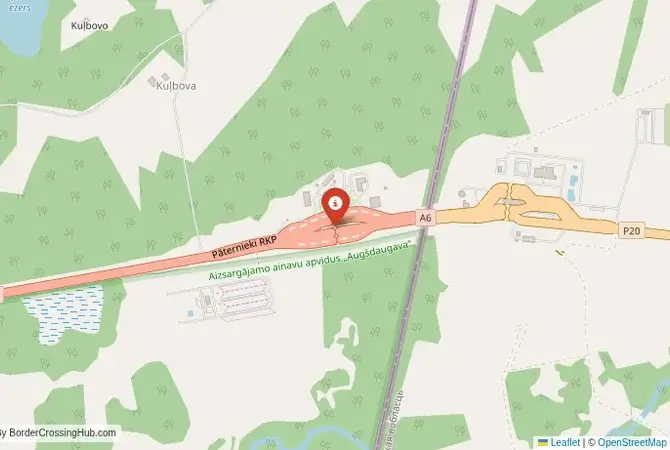
Approximate Border Location
Wait Times
10-45 min pedestrians/vehicles
Just crossed? Tap to report:
Operating Hours
6:00 AM-8:00 PM
Crossing Types
Pedestrians, vehicles
Border Type
Land crossing via road
Peak Times
7-10 AM
Daily Crossings
800-1500 travelers/vehicles
Currency Exchange
Near Kul’bovo (BYN, EUR)
Safety Information
Remote, rural area
Languages Spoken
Belarusian/Latvian
Accessibility Features
Ramps, limited assistance
About Kul’bovo, Viciebskaja voblasć & Piedrujas pagasts
Monthly Update (April 2026):
Traffic stays sparse, with only a few vehicles passing through each hour. Through April 2026, Kul’bovo, Viciebskaja voblasć & Piedrujas pagasts Border Crossing is mostly stable and quiet. Checks are steady but not fast. Regional conditions and travel needs influence flow.
No Cell Service at the Border? No Problem.
Don’t get caught scrambling for paperwork when you lose signal. Download the complete South America Transit Guide directly to your device and access every critical detail, fast-track strategy, and border rule – 100% offline.
A Closed Crossing on the Daugava
Important Note for Travelers: The political situation between Latvia and Belarus is extremely tense. Latvia has closed most of its border crossings with Belarus. This crossing at Piedruja has been closed and remains closed as of early 2026. This guide is provided for historical and informational purposes only. The border crossing connecting the Latvian village of Piedruja with Grigorovshchina (near the locality of Kul’bovo) in Belarus was a journey into one of the most scenic and historically rich borderlands in the Baltics. This checkpoint is situated on the Daugava River (known as the Western Dvina in Belarus), which has served as a major trade route and cultural highway for over a thousand years. To cross here was to travel through the heart of the historic Latgale region, a land of blue lakes, rolling hills, and a unique cultural identity. It was a secondary, local crossing, a quiet passage through a landscape that felt far removed from the main centers of power.
Operational Details
This checkpoint connected Latvia’s Krāslava Municipality with the Viciebskaja voblasć (Vitebsk Region) of Belarus. It was a smaller crossing with limited hours, intended primarily for local traffic and passenger cars. The crossing itself is a bridge over the majestic Daugava River, offering beautiful views of the river valley. Its closure has severed a long-standing local connection and funneled all traffic to the single remaining checkpoint at Pāternieki, which requires electronic queue reservation for crossing.
Historical Context
The history of this region is a complex tapestry of Livonian, Polish-Lithuanian, and Russian influences. The Latgale region of Latvia is distinct from the rest of the country, known for its strong Catholic faith and its unique Latgalian dialect. The Daugava River was a key route for Viking traders on their way to the Byzantine Empire, and later for the Hanseatic League. The city of Krāslava on the Latvian side was the seat of the powerful Plater noble family, and their magnificent 18th-century palace and church complex still dominate the town’s skyline. The border drawn here after World War I divided a region that had shared a long and complex history.
Former Border Procedure
The border crossing procedure, when it was operational, was a standard two-part process for entering the EU. Travelers would first complete exit formalities at the Belarusian checkpoint at Grigorovshchina. This involved checks by border guards and customs officials. After crossing the Daugava bridge, they would arrive at the Latvian checkpoint at Piedruja for a full EU and Schengen Area entry inspection by the State Border Guard (Valsts Robežsardze). A valid passport and, if required, a Schengen visa were necessary. Vehicle registration and international insurance were also checked. As a smaller crossing, the process was generally quicker than at the major international posts, but it was still subject to thorough security protocols.
Natural Beauty of the Region
The main attraction of this route was the stunning natural beauty of the “Daugavas Loki” (Bends of the Daugava) Nature Park on the Latvian side. The river here carves a series of dramatic, scenic bends through the landscape, creating breathtaking vistas from viewpoints like the Priedaine observation tower. The city of Krāslava is a charming destination with its rich history and beautiful baroque architecture. On the Belarusian side, the crossing leads into the lake-filled region of Vitebsk, known as the “Belarusian Switzerland.” The area is dotted with pristine lakes and forests, popular for recreation. The nearest major Belarusian town is Verkhnyadzvinsk (Drissa).
Closure Due to Geopolitical Tensions
The closure of this crossing, along with others on the Latvia-Belarus border, is a direct consequence of the deteriorating political situation following the 2020 Belarusian presidential election and Belarus’s role in facilitating the 2021 migrant crisis and its support for the 2022 Russian invasion of Ukraine. Latvia, along with Poland and Lithuania, has cited security concerns and the “hybrid warfare” tactics of the Belarusian regime as the reasons for closing the borders and fortifying the frontier, with enhanced guarding extended into 2026 and technical infrastructure completion targeted by end-2026.
Final Considerations
The Piedruja and Grigorovshchina border crossing was once a scenic and peaceful gateway to the beautiful Latgale and Vitebsk regions. It was a bridge that connected not just two countries, but two parts of a shared river valley ecosystem. Its closure is a stark illustration of how regional geopolitics can sever local connections and turn a tranquil river crossing into a closed and fortified frontier. The silent bridge at Piedruja now stands as a poignant symbol of the deep and growing divide between Belarus and its European neighbors.
No reviews yet.