
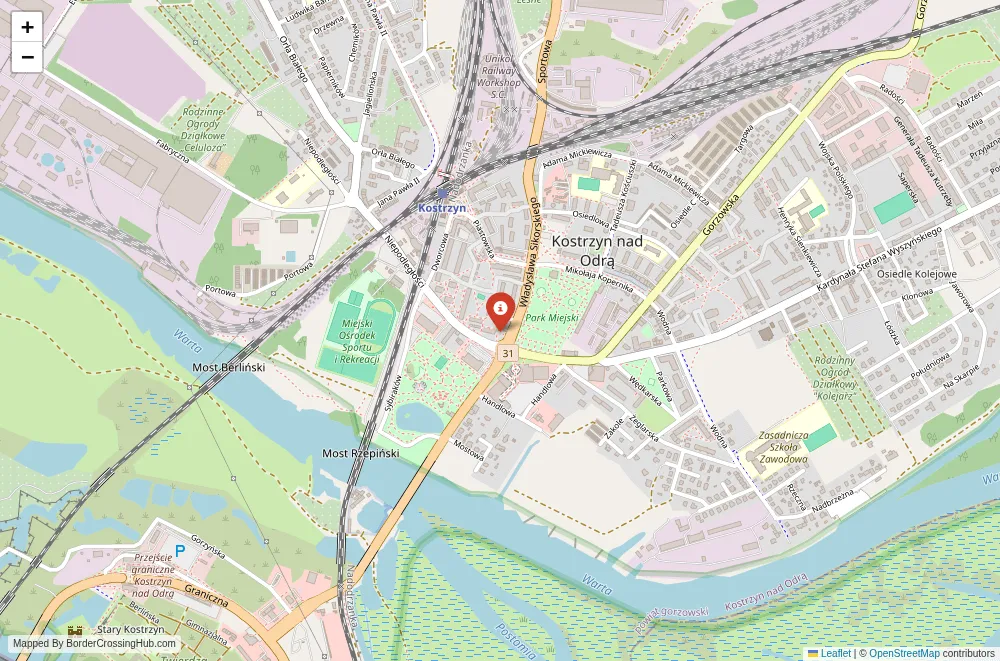
Approximate Border Location
Wait Times
Cars 0-20m; peaks 30-90m events
Just crossed? Tap to report:
Operating Hours
Open 24 hrs (12:00 AM-11:59 PM)
Crossing Types
Ped,cars,bikes; rail bridge nearby
Border Type
Land crossing via road bridge (Oder)
Peak Times
Festivals; Fri-Sun 10:00 AM-08:00 PM
Daily Crossings
5,000-22,000/day
Safety Information
Traffic near bridges; occasional controls
Languages Spoken
German/Polish
Accessibility Features
Step-free pavements; station access varies
About Kostrzyn nad Odrą & Küstrin‑Kietz
Monthly Update (May 2026):
The Kostrzyn nad Odrą & Küstrin‑Kietz Border Crossing is feeling a bit variable this May 2026, largely due to ongoing work on the bridge. Traffic tends to stack up on the German side during peak hours, which can stretch the wait for those trying to get into Poland. It’s a busy link, and a sudden spike in freight trucks can make the flow much less predictable.
Location and Basic Connections
You arrive at this crossing where the Polish town of Kostrzyn nad Odrą in Lubusz Voivodeship meets the German village of Küstrin-Kietz in Brandenburg. It sits on the Oder River, with the main road crossing on Bundesstraße 1 and Droga krajowa 22, plus a prominent rail bridge for passenger trains. Foreign visitors cross here when traveling between western Poland (Szczecin or Gorzów Wielkopolski areas) and eastern Germany (Frankfurt an der Oder or Berlin), or to visit the historic fortifications and ruins on the Polish side. Alternative names include the Kostrzyn Küstrin border or Oder River crossing at Küstrin-Kietz. As a Schengen internal point, it normally has no fixed checks, but temporary controls remain active on both sides as of February 2026.
Historical Background and Geopolitical Role
The border follows the Oder-Neisse line fixed after World War II in 1945, shifting Küstrin (the pre-war German name) so the historic core fell to Poland while Küstrin-Kietz stayed German. The town suffered near-total destruction in 1945 during fierce fighting as the Red Army established a bridgehead and pushed toward Berlin; Allied bombings and ground battles leveled about 95 percent of buildings, including factories and the old center. Post-war, ethnic Germans left, Poles resettled, and the ruined old town center was largely cleared, leaving foundations and fortifications. The rail bridge over the Oder, rebuilt after the war, connects lines from Berlin to Kostrzyn and beyond. A new modern rail bridge opened in 2024, replacing an older structure with a network arch design spanning 130 meters, symbolizing renewed ties. The crossing supports regional rail and road traffic in this Oder-Warta area, once a key battleground now focused on cross-border cooperation.
Current Status and Safety Considerations
Germany continues temporary checks at all land borders with Poland until at least March 15 2026, due to irregular migration levels, smuggling networks, asylum system pressures, and broader security concerns from conflicts like Ukraine and the Middle East. Poland extends controls on its German border until April 4 2026, citing migratory spillover from Belarus routes, increased illegal crossings on the Polish-German side, and threats to public order. At this mid-sized crossing, expect random police stops for ID verification on roads or near the rail station rather than permanent booths. Travelers report these as occasional and brief here, with no long queues typical of larger points like Słubice. The area has low crime, focused on rail commuters and tourists visiting ruins or the river, with no frequent scams or issues noted. Carry your passport or national ID at all times for any check.
Signal can be a coin toss at borders, and the last thing you want is to be stuck at the gate hunting for info. We’ve pulled all our research for this region into one simple eBook that works 100% offline. It keeps everything you need in one spot so you can stay focused on the trip. Grab the guide here.
Operating Hours and Wait Times
Roads and the rail link operate around the clock with no routine barriers under Schengen rules. Temporary controls bring sporadic interruptions: most passages occur without stop, while a random check adds 5 to 20 minutes for document review or questions. Rail services face occasional onboard or station verifications but no major disruptions. This crossing sees moderate traffic from locals and regional trains, avoiding the heavy delays of motorway points. Peak commuter hours or weekends might see slightly more police activity near the bridge. Weather rarely closes access, though river fog or winter conditions can affect driving or walking.
Visa Requirements for Foreign Visitors
Schengen standards apply: EU/EEA/Swiss citizens travel freely with valid ID or passport. Non-EU nationals get visa exemptions for up to 90 days in any 180-day period if eligible, or hold a Schengen visa. The Entry/Exit System registers non-EU travelers at external borders but not routinely here; spot checks may confirm your documents or stay details. Present your passport during any control, plus proof of accommodation, funds, or onward travel if requested. No fees occur at this crossing.
Crossing Procedures Step by Step
You approach on the main road from either side or via train to Kostrzyn or Küstrin-Kietz stations. Normally, drive, cycle, or walk across the bridge as the river marks the line and signs switch languages. If police run a control, expect a roadside or bridge stop for ID presentation and basic travel questions. Provide documents promptly; the process wraps up fast amid local flow. Rail passengers cross without standard stops, though infrequent checks happen. Pedestrians use sidewalks on the road bridge or nearby paths. The shift feels immediate, with river views and industrial remnants on both sides.
Transportation Options and Road Details
Regional trains run frequently from Berlin-Lichtenberg to Küstrin-Kietz and onward to Kostrzyn, with connections deeper into Poland. Local buses link nearby towns. Driving uses paved secondary roads like B1/DK22, passing flat farmland, riverbanks, and occasional warehouses. Scenery includes the wide Oder, old fortifications, and open fields. Traffic remains manageable compared to highways. Cycling suits the flat terrain with some paths along the river.
Nearby Attractions and Practical Tips
Explore the ruins and fortifications of old Küstrin on the Polish side, including bastions and a small free museum near the former center, plus a seasonal paid one in Filip Bastion. The river offers walks or views of the new rail bridge. Carry ID due to controls. Euros work on both sides, zloty useful in Poland; cards accepted widely. Pack for changeable weather near the river. Visit the old center ruins on foot from the rail station for a sense of the town’s past. Cross in daylight for safer exploration.
Cultural and Economic Significance
The crossing links communities with intertwined rail and river histories, once divided by war now connected through daily commutes and tourism. Local trade involves goods and services, with the rail bridge boosting passenger links. Shared wartime legacy appears in museums and memorials, while bilingual elements reflect Polish-German reconciliation efforts.
Final Planning Notes
Check official EU or national sources for the latest on temporary controls before your trip, keep ID ready, and allow flexibility for random checks. This historic river crossing offers insight into a border shaped by conflict and renewal when you prepare accordingly.
No reviews yet.