Monthly Update (September 2026):
Kéked & Košice remains a minor Slovakia-Hungary border connection with no significant September closure identified. The surrounding northeastern Slovakia road network has some ongoing local works, but no major September restriction has been identified at this frontier. Slovakia's official road-restriction register continues to list several local road works elsewhere in the Košice region during September. For travelers, the crossing itself should remain relatively quiet, with local approach roads the more likely source of delays.
About this crossing
Operational Details
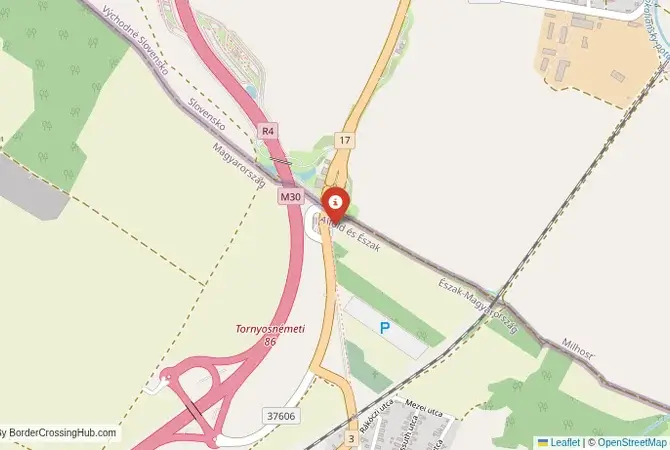
This checkpoint connects Slovakia's Košice Region with Hungary's Borsod-Abaúj-Zemplén County. It is a regional road, open 24/7, and used almost exclusively by local traffic and tourists. The road was built specifically to create this new crossing point, linking two villages that were geographically close but practically distant for many years. Traffic flows freely, and the only signs of the border are the standard blue EU signs. The crossing is not intended for heavy freight traffic, which preserves its peaceful, rural character and protects the local road infrastructure.
A History of a Divided Land
The history of this crossing is the history of the historic Abaúj County of the Kingdom of Hungary. It has always been a region of beautiful nature, small villages, and a number of noble estates. The border, established after World War I, divided the region, leaving a smaller part in Czechoslovakia (now Slovakia) and the larger part in Hungary. This division separated villages from their traditional market towns and agricultural lands, forcing residents to make long detours to the few official crossing points. The opening of the new road and crossing at Kéked in the post-Schengen era was a deliberate act to reverse this historical separation and improve the quality of life for the local population.
Nearby Border Crossings

The Seamless Border Procedure
Today, there is no border procedure for travelers. You simply drive along the modern, well-maintained road through the wooded hills. There are no passport checks and no customs inspections. This is the reality of the Schengen Area. However, it is important to remember that both Hungarian and Slovak police and customs authorities can and do perform random checks on vehicles anywhere in their territory. You are still required to carry a valid passport or national ID card with you at all times. The open border has allowed for the development of cross-border hiking and cycling trails.
The Surrounding Region: Slovakia Side
On the Slovak side, the crossing is a gateway to the eastern part of the Košice region. The nearby village of Slanská Huta is a small, rural settlement. The road provides a good connection to the major city of Košice, the second-largest city in Slovakia and a European Capital of Culture in 2013. Košice has a magnificent Gothic cathedral (St. Elisabeth's), a beautifully preserved historic main street, and a vibrant cultural scene. The Slanské Vrchy mountains offer excellent hiking opportunities.
The Surrounding Region: Hungary Side
On the Hungarian side, the village of Kéked is home to a beautiful, restored medieval manor house, the Melczer Mansion. The crossing is a gateway to the Zemplén Mountains, a beautiful range of hills known for its castles, hiking trails, and narrow-gauge forest railways. The magnificent Füzér Castle, perched dramatically on a volcanic cone, is a short drive away. The historic town of Hollóháza is famous for its porcelain manufactory. The crossing also provides access to the Hungarian part of the Tokaj wine region, a UNESCO World Heritage site.
Practical Travel Information
Practical planning for this route is very simple. The most important thing is to have the required motorway vignettes if your journey involves motorways in either country. Both Slovakia and Hungary use an electronic vignette system, which must be purchased online in advance. The official currencies are the Euro (EUR) in Slovakia and the Hungarian Forint (HUF) in Hungary. Services are available in the larger towns on both sides of the border. The road is modern and in excellent condition, but it is a rural route, so do not expect to find large service stations.
Final Considerations
The Košice region–Kéked border crossing is a shining example of the positive impact of European integration at the local level. It is a modern link that has restored an old connection. It offers a quiet and efficient passage through a region rich in history, nature, and castles. It is a border crossing that is not about division, but about connection, a testament to the power of modern infrastructure to improve the daily lives of people in border communities and to heal the divisions of the past.
View all border crossings between Slovakia and HungaryPractical information
Fuel
Slovakia: 2 km - Hungary: 2 km
Currency
Limited near Košice (EUR, HUF)
Safety information
Low crime, rural roads
Connectivity
4G/5G mobile signal
Have you crossed here?
Help other travelers by sharing your experience, wait times, and any updates.