Monthly Update (September 2026):
Kleinwalsertal & Oberstdorf remains an unusual Austrian enclave route, with the crossing effectively connecting the Kleinwalsertal valley to Germany without a conventional Austrian road connection to the rest of the country. Germany's temporary Austrian-border controls continue through September 15, so travelers entering Germany can still be checked. No major September disruption has been reported for the mountain route itself.
About this crossing
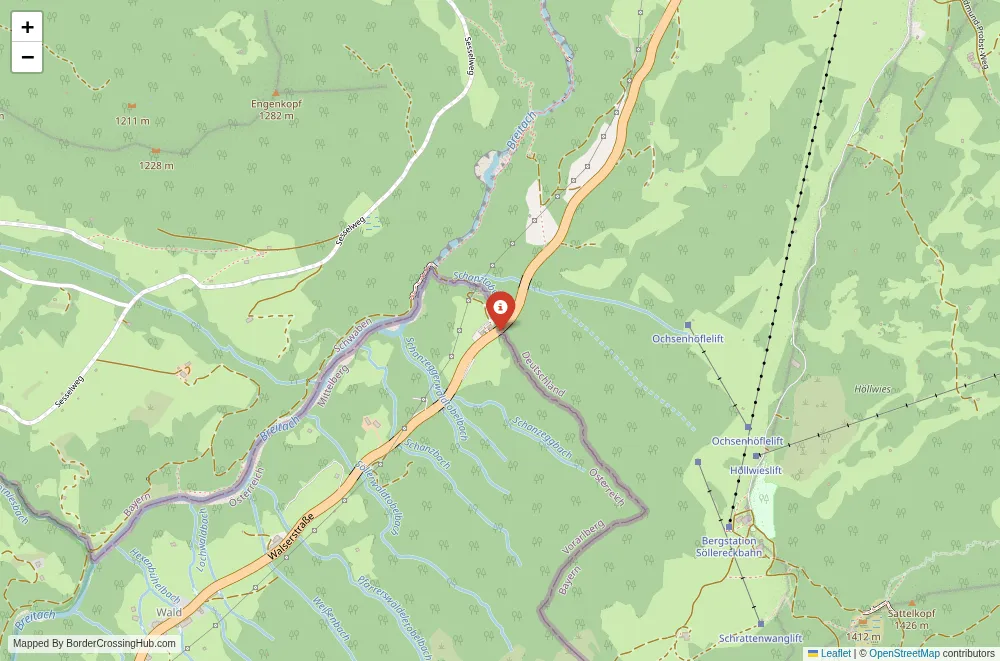
Location and Connections
You enter Kleinwalsertal along the L201 (Kleinwalsertalstraße) from Oberstdorf in Bavaria, Germany, where the road crosses into Austrian territory near Walserschanz or the Schanztobel bridge. Oberstdorf sits about 10 to 15 minutes north of the line. Kleinwalsertal includes the villages of Riezlern, Hirschegg, Mittelberg, and Baad, stretching deeper into the valley. From the crossing, continue south to reach these settlements. Cars, buses, motorcycles, cyclists, and pedestrians use the route; no rail line crosses here (Oberstdorf serves as the nearest train station). The valley connects to the Oberstdorf/Kleinwalsertal ski region, sharing slopes like Fellhorn and Kanzelwand with German areas.
Alternative Names
It appears as Kleinwalsertal-Oberstdorf border crossing, Walserschanz crossing, or the Oberstdorf-Kleinwalsertal entry point.
Nearby Border Crossings



Historical Background
Walser settlers from Switzerland colonized the valley in the 13th century, establishing communities that retained distinct dialects and customs. The 1844 Bavarian-Austrian border treaty assigned Kleinwalsertal to Austria despite its encirclement by German territory. No direct road to Vorarlberg exists due to the rugged Allgäu Alps, so all access funnels through Germany. Customs ties with Bavaria persisted until Austria's EU entry in 1995, easing formalities. Schengen in the late 1990s removed routine checks, though the valley's isolation shaped its economy around tourism and cross-border ties.
Geopolitical Context
Schengen since the late 1990s normally allows free passage with no routine controls for EU citizens or visa-exempt travelers. Germany and Austria have no active temporary border controls on this Bavaria-Vorarlberg segment as of February 10, 2026 (unlike Austria's eastern borders with Czechia, Slovakia, Hungary, and Slovenia, extended to June 2026 for migration reasons). Random spot checks remain possible but occur infrequently here due to low traffic and the valley's tourist focus. The border follows natural features like streams and ridges, with the road crossing marked simply.
Practical Crossing Procedures
You drive straight across the local road, passing a border sign or marker. No booths or regular stops exist. In rare spot checks, police may request ID or ask basic travel questions. EU citizens show passport or national ID. Non-EU nationals carry valid passports, visas/residence permits if required, and supporting documents like accommodation proof. Vehicles need insurance; no vignette applies to this non-motorway route. Pedestrians and cyclists cross easily.
Typical Wait Times
You cross in seconds under normal conditions. Any random checks add 5 to 15 minutes at most. Traffic stays moderate, with ski season or summer weekends bringing more vehicles but rarely significant backups.
Operating Hours
The road remains open 24 hours daily, year-round. Schengen eliminated fixed schedules. Winter snow can slow the climb temporarily, but plowing keeps it accessible.
Transportation Options and Road Conditions
Drive your car from Oberstdorf for flexibility; regional buses connect Oberstdorf station to Riezlern, Hirschegg, Mittelberg, and Baad. The road climbs steadily from Oberstdorf with good pavement, curves through valleys, and elevation gains to around 1,100 meters. Views feature alpine meadows, forests, and peaks. Watch for cyclists, buses, or wildlife on rural sections.
Scams & Warnings
Scams stay rare at this tourist-oriented crossing. No common touts or fake services reported. Shops in Kleinwalsertal sell Austrian goods, sometimes drawing Germans for price differences. The valley feels safe and family-friendly; drive cautiously on winding mountain roads in wet or icy conditions.
Nearby Attractions
Kleinwalsertal offers ski slopes (Fellhorn, Ifen, Heuberg), hiking trails, and village charm in Riezlern, Hirschegg, and Mittelberg. Oberstdorf provides the Nebelhorn cable car, ski jumps, and Allgäu access. The shared Oberstdorf/Kleinwalsertal ski region totals 130 kilometers of pistes. Nearby Baad adds thermal springs and nature walks. The area suits winter sports, summer hiking, or those exploring alpine culture.
Seasonal Variations and Weather Impacts
Winter snow December to March requires winter tires; ski season increases traffic. Summer brings hikers and clear roads. Autumn foliage colors the valleys with moderate crowds. Rain or fog can slick curves, but weather closures remain uncommon.
Travel Tips and Preparation
Carry passport or ID for possible spot checks. Refuel in Oberstdorf or Kleinwalsertal. Offline maps help in hilly areas with variable signal. Pack layers for elevation changes. Check weather and lift status before departure. Use marked trails for hikes.
Cultural and Economic Significance
The crossing supports tourism linking Bavarian Allgäu with Austrian Vorarlberg, with shared ski areas and trails drawing visitors year-round. The valley's isolation fosters unique Walser traditions in dialect, customs, and community life, while cross-border cooperation boosts local economies through skiing, hiking, and events.
Before You Cross
Confirm road and weather conditions from official sources near your travel time. With prep for mountain driving and awareness of rare checks, you manage this scenic valley entry and explore the alpine world on both sides. Safe travels.
View all border crossings between Austria and GermanyPractical information
Fuel
Austria: None - Germany: ~4 km
Currency
EUR only; ATMs in Oberstdorf/Hirschegg
Safety information
Avalanche/snow controls possible
Connectivity
Wi-Fi points; 4G
Have you crossed here?
Help other travelers by sharing your experience, wait times, and any updates.