
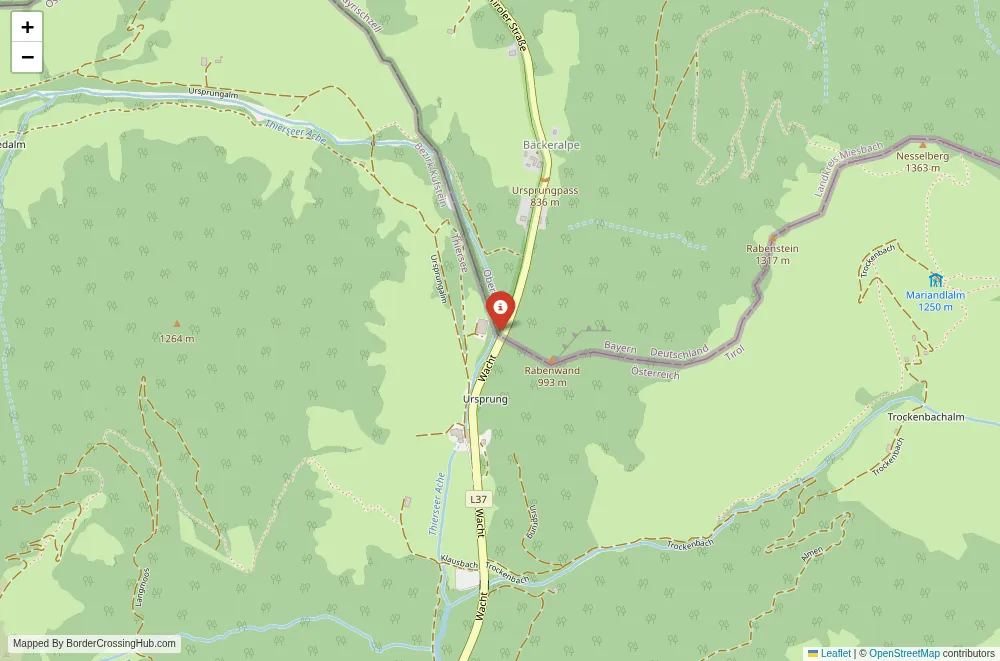
Approximate Border Location
Wait Times
Cars 0-15m; peaks 20-75m summer
Just crossed? Tap to report:
Operating Hours
Open 24 hrs (12:00 AM-11:59 PM)
Crossing Types
Ped,cars,bikes; mountain road
Border Type
Land crossing via alpine road pass
Peak Times
10:00 AM-04:00 PM; weekends; Jul-Aug
Daily Crossings
800-4,000/day
Currency Exchange
EUR only; ATMs in Bayrischzell/Thiersee
Safety Information
Narrow road; snow/ice in season
Languages Spoken
German
Accessibility Features
Paved pullouts; limited curb cuts
About Kiefersfelden & Kufstein
Monthly Update (March 2026):
As of 03/2026, the Kiefersfelden & Kufstein Border Crossing stays busy but fairly predictable. Vehicles move steadily along the highway corridor, though traffic sometimes stacks up on the German side during peak travel hours. Freight trucks mix with passenger cars throughout the day. Holiday weekends and heavy commuter traffic can stretch waits.
No Cell Service at the Border? No Problem.
Don’t get caught scrambling for paperwork when you lose signal. Download the complete Europe Transit Guide directly to your device and access every critical detail, fast-track strategy, and border rule – 100% offline.
The Kiefersfelden-Kufstein crossing channels heavy traffic across one of the busiest land borders in the Alps, where the German A93 Autobahn meets the Austrian A12 Inntal Autobahn along the Inn River valley, linking Bavaria directly to Tyrol and serving as a vital corridor for commuters, tourists heading to ski resorts, and freight moving between southern Germany and northern Italy.
Location and Connections
You arrive at this point where Kiefersfelden in Bavaria, Germany, adjoins Kufstein in Tyrol, Austria. The crossing follows the A93 (Germany) transitioning to the A12 Inntal Autobahn (Austria), with the actual border line near the Kufstein Nord exit area. From Rosenheim or Munich in Germany, Kiefersfelden lies about 30 to 45 minutes south on the A93. On the Austrian side, Kufstein sits immediately after the line, with Innsbruck roughly 45 minutes further west or Wörgl/Salzburg east. Cars, trucks, buses, and motorcycles dominate; cyclists and pedestrians rarely use the motorway setup. The route carries significant commuter flow from Kufstein to Bavarian towns and serves as a key entry for winter sports travelers to Tirol resorts.
Alternative Names
It appears as the Kiefersfelden-Kufstein border crossing, Kufstein-Kiefersfelden Grenzübergang, or the A93/A12 Inntal Autobahn crossing at Kufstein Nord.
Historical Background
The border here traces older Bavarian-Tyrolean divisions shaped by salt trade and territorial pacts. In March 1938, German troops crossed at this point during the Anschluss annexation of Austria, with historic photos showing motorized units passing customs buildings. Post-WWII, the border stayed open under Austrian neutrality, with customs formalities until Schengen in 1997-1998. The modern motorway link opened in stages during the 1970s-1980s, boosting trade and tourism. The crossing gained notoriety in the 1980s for protests and blockades related to nuclear issues at Wackersdorf, when Bavarian authorities briefly restricted Austrian entry. Today it handles year-round flow, with occasional queues from winter traffic or checks.
Geopolitical Context
Schengen since the late 1990s normally eliminates routine controls for EU citizens and visa-exempt travelers. Germany maintains temporary internal border checks on its land borders, including with Austria, due to migration, smuggling, and security concerns. As of February 10, 2026, these extend at least through March 15, 2026, with Bundespolizei conducting random spot inspections at crossings like Kiefersfelden-Kufstein. Austria’s own checks focus on eastern borders (extended to June 2026 for Czechia, Slovakia, Hungary, Slovenia), but the Germany-Austria segment sees German-led spot activity. No permanent booths operate; checks happen roadside or in pullouts. Queues have reached kilometers during peak winter traffic combined with inspections. Check German Federal Police or Austrian ASFINAG sites for real-time updates.
Practical Crossing Procedures
You drive straight through the motorway with a border sign marking the shift. Under current temporary measures, German police may pull you over shortly after entering Germany (or Austria depending on direction) for passport/ID checks, travel purpose questions, or vehicle inspection. EU citizens show passport or national ID. Non-EU nationals need valid passports, visas/residence permits if applicable, and proofs like accommodation or funds. Carry vehicle insurance and Austrian vignette (digital or sticker) for A12 onward (toll-free short stretch from Kiefersfelden to Kufstein-Süd). Trucks face customs rules for goods. Pedestrians and cyclists rarely cross here due to motorway design.
Typical Wait Times
Normal flow means seconds to cross. Spot checks add variability: many vehicles clear quickly, but selected stops or peak-hour buildup can stretch to 30 to 90 minutes, as seen in January 2026 reports with kilometer-long queues at Kufstein node from winter traffic and random inspections. Commuters and freight operators report delays impacting work or deliveries. Off-peak or early mornings often pass faster.
Operating Hours
The motorway runs 24/7 year-round. Schengen removed fixed hours. Winter snow or rare incidents might cause short disruptions, but the crossing stays open.
Transportation Options and Road Conditions
Drive on the A93/A12 for speed; regional trains connect Kufstein to Rosenheim/Munich indirectly. Buses serve cross-border routes. The motorway offers high-standard lanes with good pavement, though curves and valley terrain appear near the line. Views include Inn River, mountains, and Kufstein fortress. Watch for trucks, holiday traffic, or weather slowdowns.
Scams and Warnings
Scams stay minimal at this major motorway point. No widespread touts or fake services reported. Border-area fuel stations or shops occasionally have poor rates. Keep valuables secure during any police stop. Aggressive driving from heavy truck flow occurs; maintain distance. Winter queues from checks and snow create frustration for commuters.
Nearby Attractions
Kufstein features its historic fortress with panoramic views and the Inn River promenade. Kiefersfelden offers quiet Bavarian village life near Zahmer Kaiser mountains. Nearby Rosenheim adds old town charm. The route leads to Tirol ski areas or Berchtesgaden farther east. The area suits those combining city breaks in Salzburg (nearby) with alpine exploration.
Seasonal Variations and Weather Impacts
Winter snow December to March demands winter tires; queues spike from holiday traffic and checks. Summer sees tourist flow with clearer roads. Autumn brings foliage with moderate crowds. Rain or fog rarely closes the motorway.
Travel Tips and Preparation
Carry passport/ID for spot checks. Buy Austrian vignette online beforehand. Refuel before border for options. Use traffic apps for real-time queues. Pack snacks for potential delays. Check police/ASFINAG for updates.
Cultural and Economic Significance
The crossing supports massive cross-border commerce, tourism, and commuting in the Inn Valley. It ties Bavarian and Tyrolean economies through trade, skiing, and daily life, despite occasional checks disrupting flow.
Before You Cross
Verify current check status and traffic from official sources right before travel. With prep for possible stops and solid driving, you manage this key alpine motorway crossing and continue through the Inn Valley. Safe travels.
No reviews yet.