
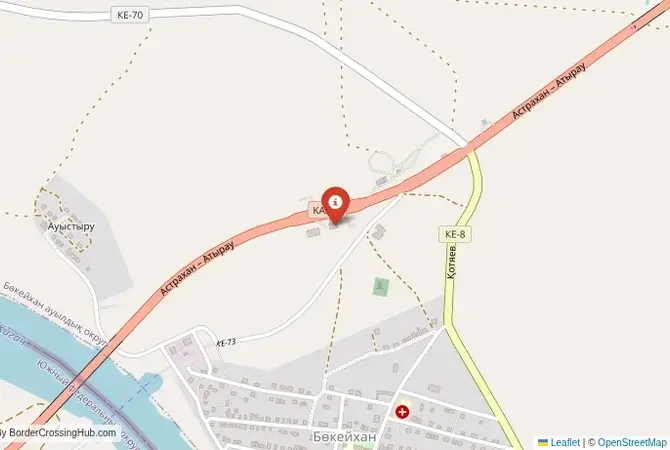
Approximate Border Location
Border Countries
- 🇰🇿Kazakhstan
- 🇷🇺Russia
Border Cities
- 🇷🇺Karaozek (RUS)
- 🇰🇿Kurmangazy (KAZ)
Wait Times
30–60 min usual
Just crossed? Tap to report:
Operating Hours
Open 24 hours
Crossing Types
Pedestrians, vehicles, commercial
Border Type
Land crossing via road
Peak Times
7:00–10:00 AM, weekends
Daily Crossings
5,800–6,200 crossings
Currency Exchange
Exchange near Kurmangazy (KZT, RUB)
Safety Information
Safe, traffic moderate
Languages Spoken
Kazakh, Russian
Accessibility Features
Ramps, elevators
About Karaozek (RUS) & Kurmangazy (KAZ)
Monthly Update (March 2026):
As of 03/2026, the Karaozek & Kurmangazy Border Crossing runs quietly with mostly regional traffic. Cars pass through routine document checks with short pauses. Early mornings tend to move fastest. Local travel and seasonal trade shape the pace.
No Cell Service at the Border? No Problem.
Don’t get caught scrambling for paperwork when you lose signal. Download the complete Asia Transit Guide directly to your device and access every critical detail, fast-track strategy, and border rule – 100% offline.
The Kurmangazy Crossing: The Lower Volga Route
The border crossing at Kurmangazy in Kazakhstan, which connects to the Russian post of Karaozek, is the southernmost major highway crossing between the two countries. It is situated on the main A-27 highway, the primary route connecting the western Kazakh city of Atyrau with the Russian city of Astrakhan. This is a crossing of major strategic and economic importance, a vital link in the transport corridor that connects Central Asia to the Caucasus and Eastern Europe via the Lower Volga region. The landscape here is the vast, flat, and semi-arid Caspian Depression. Your experience at this border will be one of immense open spaces, a constant stream of long-haul trucks, and the formal, professional procedures of two closely-allied nations. This is a workhorse border, a place of commerce and transit on a grand scale.
A History of Steppe Empires and Soviet Infrastructure
The region between the Ural and Volga rivers has been a crossroads of nomadic peoples for millennia, part of the great Eurasian Steppe that was the domain of the Scythians, Mongols, and various Turkic khanates. The modern border is a Soviet legacy, an administrative line that became an international frontier in 1991. For both Kazakhstan and Russia, ensuring the smooth operation of this border is a top priority. It is a key piece of infrastructure within the Eurasian Economic Union (EAEU), a trade bloc that includes both countries. This membership means that customs procedures for commercial goods are streamlined, although passport and immigration checks for individuals remain in full effect. The crossing has been modernized over the years to support this, facilitating the trade in grain, livestock, and industrial goods that forms the backbone of the local economy. It is a border that reflects both a deep shared history and the practical realities of modern economic partnership.
The Border Crossing Procedure: A Formal Two-Stage Process
The crossing consists of two large, separate facilities, one in each country. Despite the alliance between the two nations, the checks are thorough and professional. The process can take anywhere from one to three hours, with potential delays caused by queues of trucks or shift changes for the border guards.Exiting Kazakhstan (Kurmangazy): You will arrive at the Kazakh border post, a substantial complex. You will drive to a passport control booth. The officer will take your passport and the white migration card you received when you entered Kazakhstan. It is essential that you have this card; losing it can cause significant delays. After your passport is stamped, you will proceed to a customs inspection. This is usually a straightforward process for tourists, involving a check of your vehicle and luggage before you are cleared to proceed.Entering Russia (Karaozek): After leaving the Kazakh post, you will drive across a short neutral zone to the Russian facility. This is also a large and modern complex. You will first go to a passport control booth. You must have a valid Russian visa obtained in advance from a Russian embassy or consulate; Russia does not offer visas on arrival at land borders. The officer will inspect your passport and visa carefully before stamping it. You will also be required to fill out a two-part Russian migration card; one part is kept by the officer, and the other is returned to you. You must keep this second part with your passport for the duration of your stay in Russia. After immigration, you will move to the customs area. You will need to complete a customs declaration for your vehicle if you are driving. Russian customs officials may conduct a thorough inspection of your car and belongings. Be prepared to answer questions about your itinerary and the purpose of your visit.
Route, Landscape, and Travel Considerations
The crossing is on the A-27 highway (which becomes the E40 European route). The road quality can be variable. While major sections are well-maintained, be prepared for stretches of rough pavement, especially on the Kazakh side, due to the heavy freight traffic and extreme continental climate. The landscape is exceptionally flat and open, part of the vast steppe that stretches to the horizon. Services like fuel stations and restaurants are sparse, so it is wise to be well-stocked with fuel, water, and snacks. For those driving a private vehicle, you must have your vehicle registration, a valid international driving permit, and your “Green Card” international vehicle insurance. Ensure your insurance explicitly covers both Kazakhstan and Russia.
Final Planning Advice for the Caspian Route
The Kurmangazy-Karaozek crossing is the main southern artery between Kazakhstan and Russia. It is a professional and predictable, if sometimes slow, border. The most critical piece of preparation for any non-Kazakh/Russian citizen is securing your Russian visa well in advance of your trip. Without it, you will be turned away. For all travelers, keeping your Kazakh migration card safe is paramount for a smooth exit from Kazakhstan. For drivers, having all your vehicle documents and insurance in perfect order is essential. This crossing is a gateway to the fascinating city of Astrakhan, with its historic Kremlin, and the unique ecosystem of the Volga Delta. By being prepared for a formal, bureaucratic process and the long drives involved, you can successfully navigate this important Eurasian crossroads with confidence.
No reviews yet.