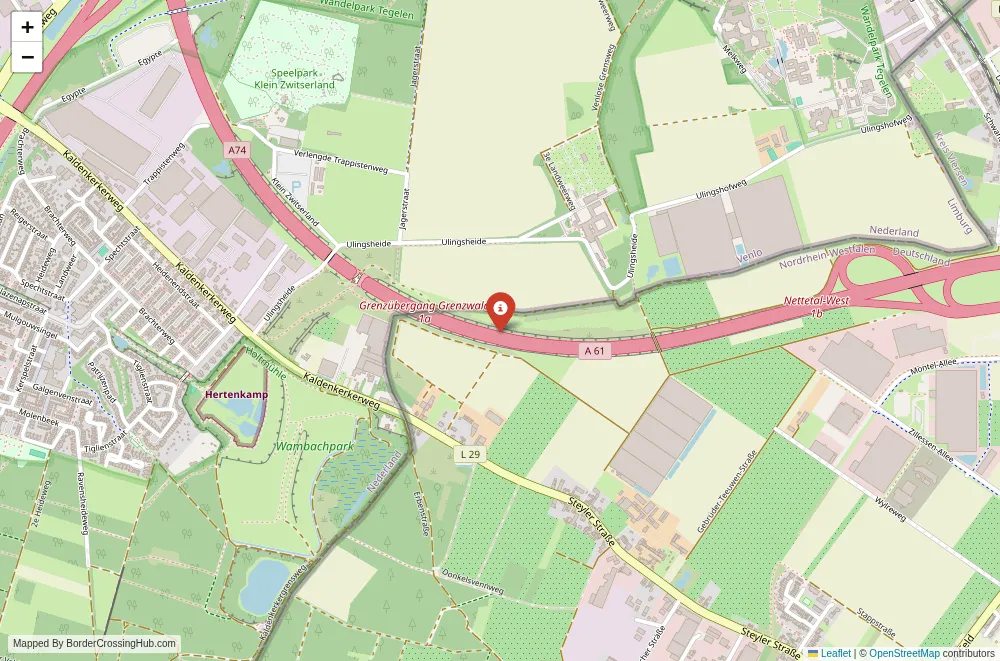
Approximate Border Location
Border Countries
- 🇩🇪Germany
- 🇳🇱Netherlands
Border Cities
- 🇩🇪Kaldenkirchen
- 🇳🇱Venlo
Wait Times
Cars 0-20m; peaks 30-150m at checks
Just crossed? Tap to report:
Operating Hours
Open 24 hrs (12:00 AM-11:59 PM)
Crossing Types
Cars,buses,trucks; A61/A67 corridor
Border Type
Land crossing via motorway (A61/A67)
Peak Times
Mon-Fri 02:00-07:00 PM; holidays
Daily Crossings
35,000-120,000/day
Currency Exchange
EUR only; ATMs at services
Safety Information
Queues during checks; heavy truck traffic
Languages Spoken
Dutch/German
Accessibility Features
Accessible rest areas; step-free toilets
About Kaldenkirchen & Venlo
The Kaldenkirchen-Venlo border offers one of the quickest and most convenient rail and road crossings between Germany and the Netherlands, connecting the German town of Kaldenkirchen directly to the Dutch city of Venlo in just a few minutes by train or a short drive.
Alternative Names
You will see this referred to as the Kaldenkirchen-Venlo grensovergang, the Kaldenkirchen (DB) – Venlo (NS) border, or simply the Venlo-Kaldenkirchen crossing. Rail timetables often list it as the Venlo frontier point.
Current Status and Safety Note
Germany and the Netherlands are Schengen countries, so this border normally has no permanent checkpoints or routine passport controls. You cross freely by train, car, bus, bike, or foot under typical conditions. Both countries have temporary random spot checks in place: Germany at Dutch borders until mid-March 2026, and the Netherlands at German borders until June 2026. These are intelligence-based, selective, and infrequent on this corridor, but they can lead to brief document requests or vehicle stops. The area feels everyday and integrated, with locals commuting constantly. No widespread scams or serious traveler problems are reported here.
Historical Background
The border line dates to 19th-century Dutch-Prussian treaties. Kaldenkirchen grew as a border town tied to Venlo through trade and rail. The rail link has carried passenger services for decades, with the modern regional connection strengthening after Schengen and regional cooperation. The crossing sits in the Lower Rhine area, where Dutch and German communities have long mixed through industry, retail, and daily life.
Geopolitical and Economic Role
This point forms part of the Euregio Rhine-Waal and supports close cross-border ties. Venlo draws German shoppers for its city center and amenities, while Kaldenkirchen attracts Dutch visitors for fuel and groceries. The rail line connects to broader networks toward Mönchengladbach, Düsseldorf, and Eindhoven, making it useful for regional commuters and tourists. Road traffic uses the B221/N556 corridor.
Visa Requirements for Foreign Visitors
Schengen rules cover both sides. If your nationality qualifies for visa-free entry, you need only a valid passport or national ID. Most non-EU visitors get 90 days in any 180-day period across the area. Carry your travel document at all times, as random spot checks can happen anywhere in the border zone.
Crossing Procedures Step by Step
By rail, take the RE13 (Eurobahn) or similar regional train; it stops at Kaldenkirchen (Germany) and reaches Venlo (Netherlands) in about 4 minutes with no border formalities on board. For car or bike, follow the B221 (Germany) from Kaldenkirchen; it becomes the N556 (Netherlands) toward Venlo with no booth or stop. Pedestrians and cyclists use the same roads or parallel paths; the transition is unmarked. No forms or officials appear routinely. The reverse direction works the same way.
Typical Wait Times and Peak Periods
Rail crossings follow timetable stops with almost no wait beyond the train schedule. Road crossings take seconds. Morning and evening commuter hours see busier trains and some road traffic. Shopping weekends increase flows, especially Dutch visitors heading to Kaldenkirchen.
Operating Hours
Roads stay open 24 hours a day. Regional trains run roughly hourly during the day (early morning to late evening), with reduced night service.
Transportation Options to and From the Border
The RE13 train connects Venlo directly to Kaldenkirchen (and onward to Mönchengladbach, Düsseldorf, or Hamm). Buses serve both towns and cross locally. Drive via B221/N556 from Venlo center or Kaldenkirchen. Cycling follows quiet parallel roads. Venlo station offers good onward Dutch rail links to Eindhoven, Roermond, and beyond.
Road Conditions and Scenery
The main road is paved and in good condition, with smooth transitions. Smaller routes pass through suburban areas, light industry, and flat Lower Rhine farmland. The landscape stays open with fields, occasional trees, and urban edges near both towns.
Seasonal Variations and Weather Impacts
Summer brings more leisure traffic and pleasant walking conditions. Winter can add rain, fog, or light snow, but roads remain reliable. No seasonal closures affect the crossing.
Nearby Attractions
Venlo provides a lively city center with the Markt square, Limburgs Museum (regional history and art), Maas River promenade, and cozy cafes. Kaldenkirchen offers a quieter German town feel with shops popular for cross-border bargains. Nearby, the Maasduinen National Park gives trails and nature, while Arcen (short drive) has castle gardens and thermal baths.
Common Scams and Warnings
Serious scams are rare. Some shoppers note price differences or crowded parking at cross-border outlets. Random spot checks target vehicles and rarely impact tourists. Normal urban precautions apply in busier areas.
Travel Tips and Preparation
Check train times via NS, Eurobahn, or DB apps. Carry your passport/ID and vehicle papers if driving. Bring cash or card for quick shopping. The short train ride makes this one of the easiest ways to hop over for a day trip or shopping. Use offline maps for local roads or paths.
Cultural and Economic Significance
This crossing keeps Venlo and Kaldenkirchen tightly linked, with shared shopping habits, commuter patterns, and regional tourism. It shows how open borders sustain everyday cross-border life in the Lower Rhine area.
Final Planning Advice
Check current spot-check status through official Marechaussee or Bundespolizei sources if driving. Bring your documents, hop on the train or drive the short stretch, and enjoy the quick shift from German border town to Dutch city center. This simple crossing makes exploring both sides effortless. Safe travels.
No reviews yet.