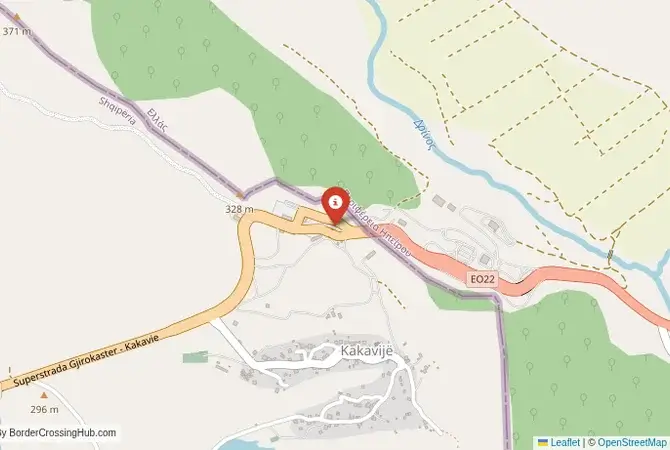
Monthly Update (September 2026):
Kakavijë & Ktismata remains the main Albania-Greece crossing in the Gjirokastër corridor and has seen unusually heavy traffic around the end of August. Albanian police reported that more than 5,400 people and 2,000 vehicles passed through the checkpoint between 08:00 and 16:00 during the late-August surge, requiring additional processing counters on both sides. By September 4, reported passenger waits had fallen to roughly 5–15 minutes, suggesting that the summer-return backlog has largely cleared. Travelers should nevertheless expect occasional spikes, particularly around weekends and holiday periods.
About this crossing
Operational Details
This checkpoint connects Albania's Gjirokastër County with the Ioannina regional unit of Greece. It is a full-service international crossing, open to all passenger cars, buses, and commercial freight. The facility is large and has been modernized to handle the heavy volume of traffic. The crossing is particularly busy during the summer months and holiday periods, when many Albanians working in Greece return home to visit family. The queues, especially on the Greek side entering Albania, can be very long during these times, often lasting for many hours.
A History of a Contested Border
The history of this region is the history of Epirus, a land that has been a cultural and political entity since antiquity. The region has a large, indigenous Greek minority on the Albanian side and a history of Albanian-speaking communities on the Greek side. The modern border, established in the early 20th century, divided this historically integrated region. During the Cold War, this was a heavily fortified and almost completely sealed border, a hard frontier between a NATO member (Greece) and an isolated communist state (Albania). The opening of the border after 1991 led to a massive wave of Albanian migration to Greece, and this crossing became the main conduit for that historic movement of people.
Nearby Border Crossings
Border Crossing Procedure
The border crossing procedure is a rigorous and often slow process, reflecting its status as a primary entry point into the EU and the Schengen Area. You will first complete exit formalities at the Albanian checkpoint at Kakavijë. After a short drive through a neutral zone, you will arrive at the Greek checkpoint at Ktismata for a full EU/Schengen entry inspection by the Hellenic Police and customs authorities. You will need a valid passport, a Schengen visa (if required for your nationality), vehicle registration, and international insurance (Green Card). Customs inspections can be very thorough, particularly for goods like tobacco. The meticulous checks required for entry into the Schengen Area can lead to significant delays.
The Surrounding Region: Albania Side
On the Albanian side, the crossing is the gateway to the magnificent city of Gjirokastër, a UNESCO World Heritage site. Gjirokastër is famous for its unique Ottoman-era stone houses, its massive castle which overlooks the city, and its history as the birthplace of both the former Albanian dictator, Enver Hoxha, and the world-renowned writer, Ismail Kadare. The city is a major tourist destination. The crossing also provides access to the beautiful Ionian coast of Albania, including the popular resort of Saranda and the ancient Roman ruins of Butrint, another UNESCO site.
The Surrounding Region: Greece Side
On the Greek side, the crossing is in the mountainous region of Epirus. The nearby city of Ioannina is the regional capital, a beautiful city situated on the shores of Lake Pamvotida, with its own fortified old town and a picturesque island. The region is famous for the stunning stone arch bridges and traditional stone villages of the Zagori region, as well as the Vikos Gorge, one of the deepest canyons in the world. The crossing is also a gateway to the port of Igoumenitsa, with ferry connections to Italy and the Ionian islands.
Practical Travel Information
Practical planning is essential for this route. Be prepared for potentially long wait times, especially during peak seasons. The official currencies are the Albanian Lek (ALL) in Albania and the Euro (EUR) in Greece. Currency exchange facilities are available at the border. Ensure your vehicle's Green Card insurance is valid for Greece. The roads on both sides are main highways and are well-maintained. To avoid the worst of the summer queues, try to cross very early in the morning or late at night.
Final Considerations
The Kakavijë–Ktismata border crossing is the main economic and social artery between southern Albania and northwestern Greece. It is a busy, functional checkpoint that serves as a gateway to the spectacular historical and natural treasures of the Epirus region on both sides of the border. The journey through it is a direct encounter with the meticulous procedures of the Schengen border. It is a crossing that is defined by the constant movement of people, a powerful symbol of the modern migration patterns and the deep, if complex, relationship between Albania and Greece.
View all border crossings between Albania and GreecePractical information
Fuel
Albania: 1 km - Greece: 1 km
Currency
Available nearby (ALL, EUR)
Safety information
Very busy crossing
Connectivity
4G/5G, checkpoint Wi-Fi
Have you crossed here?
Help other travelers by sharing your experience, wait times, and any updates.