
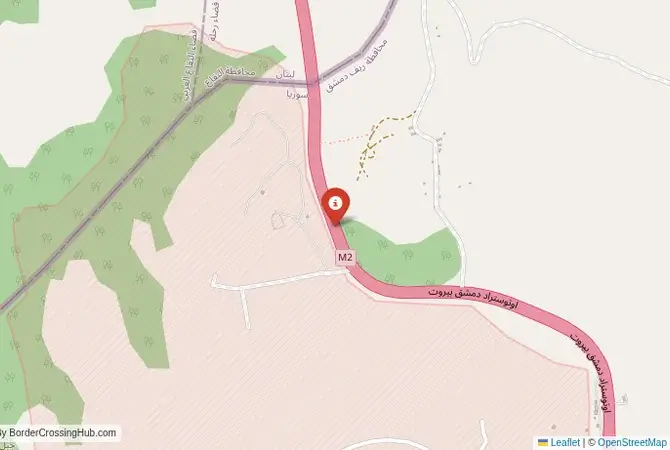
Approximate Border Location
Wait Times
30-120 min congested
Just crossed? Tap to report:
Operating Hours
Open 12:00 AM – 11:59 PM
Crossing Types
Pedestrians, vehicles, commercial
Border Type
Land crossing via road
Peak Times
7:00-10:00 AM, weekends
Daily Crossings
3500-4500 daily
Currency Exchange
Nearby exchange; SYP, LBP
Safety Information
High volume; security screening
Languages Spoken
Arabic/Arabic
Accessibility Features
Ramps, elevators
About Jdeidat Yabous & Masnaa
Monthly Update (March 2026):
As of 03/2026, the Jdeidat Yabous & Masnaa Border Crossing remains the main road link between Syria and Lebanon. Cars, buses, and trucks stack up for passport and customs checks, especially midday. The Lebanese side often moves a bit slower. Regional travel and freight shipments shape the flow.
No Cell Service at the Border? No Problem.
Don’t get caught scrambling for paperwork when you lose signal. Download the complete Asia Transit Guide directly to your device and access every critical detail, fast-track strategy, and border rule – 100% offline.
The Main Damascus-Beirut Highway
Important Note for Travelers: The security situation in Syria is extremely volatile and dangerous. The country has been in a state of civil war for over a decade. Travel to Syria is extremely dangerous and strongly discouraged. This guide is provided for historical and informational purposes only. The border crossing connecting Jdeidat Yabous in Syria with Masnaa in Lebanon is the most important and busiest checkpoint between the two nations. This is the main highway that links the two ancient capital cities, Damascus and Beirut. It is a massive, 24/7 international facility, a critical artery for trade, travel, and the deep, complex, and often turbulent relationship between the two countries. To cross here is to travel a route of immense historical weight, a passage through the Anti-Lebanon mountains that has been a strategic corridor for millennia. It is a crossing defined by its vital importance to both economies and the constant flow of people in a region shaped by politics, conflict, and deep cultural ties.
Operational Details
This checkpoint connects the Rif Dimashq Governorate of Syria with the Beqaa Governorate of Lebanon. It is a full-service international crossing, open to all passenger cars, buses, and commercial freight. The facility is large on both sides, but it is often overwhelmed by the sheer volume of traffic. The crossing is a vital lifeline for Lebanon, which relies heavily on goods transiting through Syria. It is also the primary route for Syrians traveling to and from Lebanon for work, family visits, or to access services. The queues can be extremely long, and the procedures slow and bureaucratic.
A History of a Complex Relationship
The history of this crossing is the history of the complex relationship between Syria and Lebanon. For centuries, both were part of the Ottoman Empire. The modern border was established by the French Mandate after World War I. For decades, Syria did not fully recognize Lebanon’s sovereignty and maintained a heavy political and military influence, including a long military presence during the Lebanese Civil War. The border has always been a sensitive point, a place of both deep integration and political tension. The Syrian Civil War has added another layer of complexity, with a massive flow of Syrian refugees into Lebanon and the involvement of the Lebanese group Hezbollah in the Syrian conflict.
The Border Crossing Procedure
The border crossing procedure is a complex, multi-stage, and often very slow process. You will need a valid passport and visas for both countries, which must be obtained in advance. You will first complete exit formalities at one country’s checkpoint, which involves multiple stops for passport control, customs, and security checks. You will then proceed to the other country’s checkpoint for their entry inspection. The checks are very thorough on both sides. Be prepared for a long, bureaucratic, and potentially stressful experience. The process can take many hours.
The Surrounding Region: Syria Side
On the Syrian side, the crossing is the gateway to the capital city, Damascus. Damascus is one of the oldest continuously inhabited cities in the world, a UNESCO World Heritage site with a magnificent Umayyad Mosque, a bustling old city with covered souqs, and a rich history. However, the city and its surroundings have been heavily affected by the civil war. The security situation is extremely volatile.
The Surrounding Region: Lebanon Side
On the Lebanese side, the crossing is in the beautiful and fertile Beqaa Valley, the agricultural heartland of Lebanon. The valley is famous for its wine production, with numerous world-class wineries. It is also home to the magnificent Roman ruins of Baalbek, a UNESCO World Heritage site with some of the largest and best-preserved Roman temples in the world. The nearby town of Anjar has the ruins of an 8th-century Umayyad city. The road from the border leads directly to the capital city, Beirut.
Practical Travel Information
Travel on this route is not possible for independent tourists. The entire region is a high-risk security zone. The official currencies are the Syrian Pound (SYP) in Syria and the Lebanese Pound (LBP) in Lebanon, though the US Dollar is widely used in Lebanon due to a severe economic crisis. Any travel would have to be part of an official, heavily guarded convoy or delegation. The risks of kidnapping, terrorism, and being caught in crossfire are extremely high.
Final Considerations
The Jdeidat Yabous–Masnaa border crossing is the most vital artery between Syria and Lebanon. It is a place of immense economic importance and deep historical complexity. It is a lifeline that operates under the constant shadow of war and political instability. It is a border that is a testament to the resilience of the people and the traders who continue to use it despite the immense challenges. It is a journey through a beautiful and historic land, but one that is fraught with danger, a powerful symbol of the tragic and enduring conflicts of the modern Middle East.
No reviews yet.