Monthly Update (October 2026):
Ipiales & Tulcán is receiving particular attention this month because Colombian and Ecuadorian human-rights authorities carried out a joint monitoring mission along the Rumichaca corridor on October 5. They highlighted changing migration patterns, transnational crime and pressure on local institutions, making the wider border environment more complicated than a simple tourism crossing. Rumichaca itself remains the principal international crossing between Colombia and Ecuador.
Driving there, or sending a driver? Send them this guide.
For reports and websites
Cite this page
Border Crossing Hub (2026). Ipiales & Tulcán Border Crossing. Updated October 2026. https://bordercrossinghub.com/ipiales-tulcan-border-crossing/<a href="https://bordercrossinghub.com/ipiales-tulcan-border-crossing/">Ipiales & Tulcán Border Crossing (Border Crossing Hub)</a>Put this crossing's card on your website
Free. It updates on its own when our information changes.
<iframe data-bch-card src="https://bordercrossinghub.com/ipiales-tulcan-border-crossing/?bch_view=card" width="100%" height="980" scrolling="no" style="border:0;max-width:480px;display:block" loading="lazy" title="Ipiales & Tulcán border crossing information"></iframe>
<p style="font-size:12px;margin:4px 0 0">Crossing information: <a href="https://bordercrossinghub.com/ipiales-tulcan-border-crossing/">Border Crossing Hub</a></p>
<script src="https://bordercrossinghub.com/?bch_embed_js=1" async></script>Paste it where you want the card. The last line (a script) only adjusts the height and can be left out.
About this crossing
Operational Details
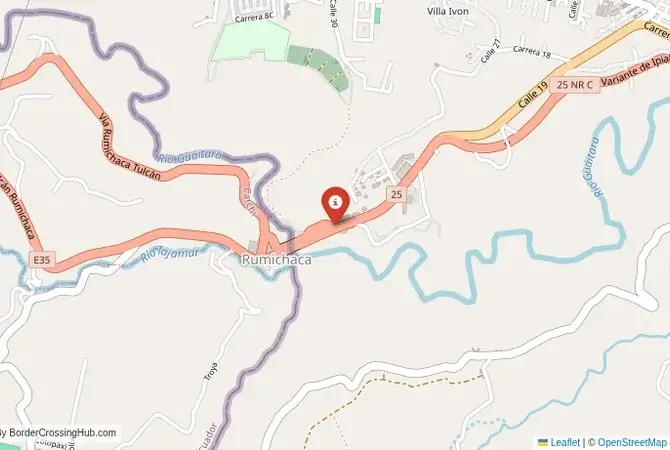
This checkpoint connects the Nariño Department of Colombia with the Carchi Province of Ecuador. It is a major international crossing, open 24/7 to all passenger cars, buses, and commercial freight. The facility is large and modern, with the immigration and customs offices of both countries located in close proximity on either side of the Rumichaca bridge over the Carchi/Guáitara River. The crossing is a critical part of the Pan-American Highway and is constantly busy with a flow of trucks, buses, and travelers moving between the two Andean nations.
A History of a Sacred Place
The history of this crossing is dominated by the story of the Las Lajas Sanctuary. According to legend, in the 18th century, a local woman and her deaf-mute daughter were caught in a storm and saw an apparition of the Virgin Mary in the gorge. The daughter was miraculously cured. A shrine was built on the site, and over the centuries, it was expanded into the magnificent neo-Gothic basilica that stands today, built on a bridge that spans the canyon. The church has become one of the most important pilgrimage sites in South America. The modern border crossing, just a few hundred meters away, has grown up in the shadow of this sacred place.
Nearby Border Crossings



Border Crossing Procedure
The border crossing procedure is a standard two-part process. You must first get your exit stamp from the Colombian immigration office (Migración Colombia). You then walk or drive across the bridge to the Ecuadorian immigration office for your entry stamp. The two offices are on opposite sides of the gorge. You will need a valid passport. Many nationalities can enter both countries visa-free for short stays, but it is essential to check the specific requirements for your nationality in advance. Vehicle registration and international insurance are also necessary. The process can involve long queues, especially for those on international buses.
The Surrounding Region: Colombia Side
On the Colombian side, the main attraction is the stunning Las Lajas Sanctuary. The church is a breathtaking sight, a fairytale-like structure rising from the bottom of a deep green canyon. It is a must-see for any traveler in the region. The nearby city of Ipiales is a bustling commercial center. The region is known for its beautiful Andean scenery and its agricultural products, particularly potatoes. The Laguna de la Cocha, a beautiful high-altitude lake, is also in this region.
The Surrounding Region: Ecuador Side
On the Ecuadorian side, the city of Tulcán is famous for its unique and extraordinary topiary cemetery. The municipal cemetery has been decorated with hundreds of intricately clipped cypress hedges, sculpted into a vast array of figures, from animals to pre-Columbian motifs. It is a surreal and beautiful work of art. The city is the gateway to the northern Ecuadorian Andes, a region of volcanoes, crater lakes, and traditional indigenous markets, such as the famous market in Otavalo.
Practical Travel Information
Practical planning for this route is straightforward. The Pan-American Highway is well-maintained. The official currencies are the Colombian Peso (COP) in Colombia and the US Dollar (USD) in Ecuador. Currency exchange facilities are widely available at the border. Be prepared for a significant change in climate, as the weather can be cool and rainy at this high altitude. The border is a popular place for money changers and taxi drivers; it is wise to be cautious and to agree on prices in advance.
Final Considerations
The Ipiales–Tulcán border crossing is a journey through a landscape of dramatic scenery and profound faith. It is a busy, functional checkpoint that serves as a vital link between Colombia and Ecuador, but it is elevated by the presence of the miraculous Las Lajas Sanctuary. It is a border that is a destination in itself. For the traveler, it is a gateway to the unique attractions of both southern Colombia and northern Ecuador, a passage that is both a practical necessity and a memorable experience.
View all border crossings between Colombia and EcuadorHeading to Ipiales & Tulcán? Take this with you.
One page with the hours, waits, emergency numbers and coordinates. Works without signal.
Practical information
Fuel
Colombia: 500 m - Ecuador: 500 m
Currency
Available near Ipiales (COP, USD)
Safety information
Generally safe, beware touts
Connectivity
Wi-Fi at checkpoints, 4G/5G
Have you crossed here?
Help other travelers by sharing your experience, wait times, and any updates.