
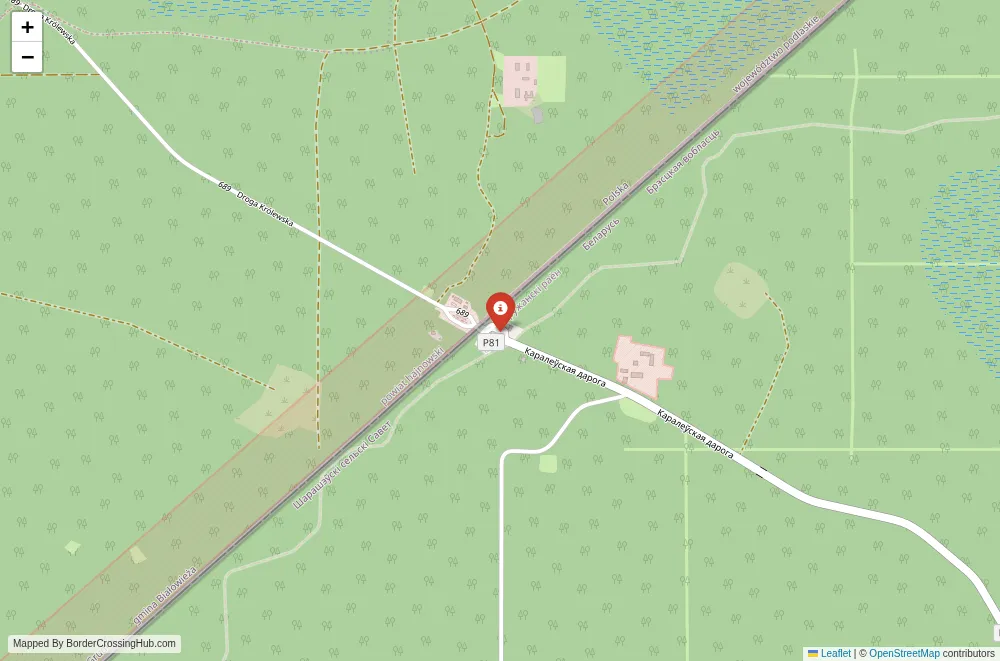
Approximate Border Location
Wait Times
Cars 30-180m; peaks 180-480m seasonal
Just crossed? Tap to report:
Operating Hours
08:00 AM-08:00 PM
Crossing Types
Ped,cars; limited hours; full controls
Border Type
Land crossing via local forest road
Peak Times
10:00 AM-03:00 PM; summer
Daily Crossings
200-1,200/day
Currency Exchange
BYN; PLN in Hrodna/Białystok; ATMs
Safety Information
Remote forest area; limited services
Languages Spoken
Belarusian/Polish
Accessibility Features
Unpaved sections; limited accessibility
About Hrodna & Kuźnica Białostocka
Monthly Update (March 2026):
As of 03/2026, the Hrodna & Kuźnica Białostocka Border Crossing stays mostly closed to regular traffic. The area sees little day-to-day movement beyond controlled or official crossings. Vehicles rarely approach the checkpoint under current restrictions. Any change tends to depend on broader political decisions rather than daily traffic patterns.
No Cell Service at the Border? No Problem.
Don’t get caught scrambling for paperwork when you lose signal. Download the complete Europe Transit Guide directly to your device and access every critical detail, fast-track strategy, and border rule – 100% offline.
The Kuźnica Białostocka–Bruzgi border crossing links northeastern Poland’s Podlaskie Voivodeship near the small town of Kuźnica directly to Belarus’s Hrodna (Grodno) region at Bruzgi, forming one of the primary road connections in this stretch of the Poland-Belarus frontier and historically carrying significant passenger and limited freight traffic between the two countries.
Alternative Names
Travelers refer to it as Kuźnica Białostocka on the Polish side, Bruzgi on the Belarusian side, Kuźnica-Bruzgi, Kuznica-Bialostokskaya, or simply Kuźnica in many border discussions and maps.
Current Status and Safety Note
As of February 2026, the crossing operates under ongoing restrictions following a partial reopening for passenger cars on November 17, 2025. It remains one of the few active Poland-Belarus road points, though buses face exclusions in certain periods and freight capacity stays limited compared to dedicated truck crossings like Bobrowniki. Recent Polish Border Guard reports show periodic queue buildups, with over 1,100 vehicles waiting at various points in early January 2026, and temporary suspensions still possible at short notice due to security reviews every 30 days. The entire frontier carries elevated risks from hybrid threats, engineered migration attempts, fortified barriers including razor wire and cameras, and a restricted buffer zone extending up to several kilometers in places. Foreign visitors should monitor granica.gov.pl for Polish updates and gpk.gov.by for Belarusian information, alongside embassy travel warnings from your home country. Avoid any unofficial approaches to the border or green zones, as patrols enforce strict controls and pushbacks remain documented.
Historical Background
This checkpoint took shape in the aftermath of the Soviet Union’s dissolution during the 1990s, when Poland and Belarus established formal border infrastructure along their shared line. Traffic grew steadily through the 2000s as Poland joined the European Union in 2004, improving road access and encouraging cross-border exchanges. The crossing handled daily passenger flows, local trade, and some tourism until late 2021, when Poland closed it unilaterally amid a sudden migrant crisis involving thousands attempting irregular entries, with accusations that Belarus facilitated the movement as a hybrid tactic. The point stayed shut for several years, reopening partially in September 2025 for select rail and freight before full passenger vehicle access resumed in November. The surrounding region carries layers of older history, from Polish administration in the interwar period through Soviet-era divisions to the present geopolitical divide.
Geopolitical and Economic Role
When running at fuller capacity, Kuźnica Białostocka–Bruzgi channeled passenger movement and modest freight, supporting trade in everyday consumer goods, agricultural products, and construction materials between western Belarus and eastern Poland. It helped distribute traffic away from the heavily used Terespol-Brest crossing further south. For foreign visitors, it once provided a convenient overland route from Warsaw or Białystok toward Hrodna and onward to Minsk, appealing to those exploring regional history or rural landscapes. Recent reopenings respond partly to economic pressures on both sides, yet persistent security concerns limit volumes and keep the crossing vulnerable to sudden restrictions, reflecting broader tensions in EU-Belarus relations.
Operating Hours and Wait Times
The checkpoint generally functions around the clock or with extended daily hours (often starting at 6:00 a.m. and running until 10:00 p.m. or later during post-reopening phases). Passenger processing times fluctuate widely depending on daily volume. Off-peak periods see waits under an hour for cars, while weekends, holidays, or after regional events push lines to several hours, especially on the Belarus exit side heading into Poland. Recent observations note occasional long queues building quickly when traffic spikes. Freight lanes exist but handle reduced throughput compared to specialized crossings.
Crossing Procedures
You cross exclusively by vehicle, with passenger cars forming the main traffic; buses and certain trucks face ongoing exclusions or separate rules. Pedestrians cannot use this point. Approach from the Polish side at Kuźnica or the Belarusian side at Bruzgi along the main connecting roads. Both countries conduct standard passport control, customs declarations, and vehicle inspections.
Citizens of EU and Schengen countries enter Poland without a visa for short stays. Belarus requires visas for most foreign nationalities, though an electronic visa remains available online for many, with processing times typically short if applied in advance. Rules change periodically, so confirm eligibility before travel. Vehicle requirements include valid insurance covering both territories, often satisfied with a Green Card policy. Officials ask about travel purpose, duration, accommodation, and any goods carried, performing thorough document checks and occasional secondary inspections including luggage or vehicle searches. The entire procedure usually takes between 30 minutes and two hours, depending on queue length and scrutiny level.
Transportation Options
From Poland, reach Kuźnica by car or bus from Białystok, roughly one hour on good roads through rolling Podlasie countryside dotted with small villages and farmland. Longer drives from Warsaw take three to four hours. On the Belarusian side, Bruzgi lies a short distance from Hrodna city center, with onward connections to Minsk via highway. Rural roads leading to both checkpoints stay paved and generally well-maintained, though watch for slower farm traffic or occasional potholes in less-traveled sections. Private vehicles offer the most control over timing and flexibility. Public buses serve nearby towns on both sides, and shared taxis operate in Hrodna and Białystok areas, though cross-border services remain limited or nonexistent due to restrictions.
Scams and Warnings
This crossing attracts relatively few classic tourist scams compared to southern or more tourist-heavy borders, but queues create opportunities for minor issues. Informal money changers near approaches often give unfavorable rates, and local taxi drivers might quote inflated fares for short rides to towns. In periods of tension, travelers have reported isolated incidents of vehicle tampering or harassment in nearby villages stemming from local frustrations over border policies. With the militarized setup, attempting to bypass official lanes or enter restricted buffer zones carries serious risks of detention, fines, or pushback. Ignore anyone offering to speed up processing for cash or directing you off designated paths. Keep belongings secure during waits and remain polite but firm with officials.
Nearby Attractions and Side Trips
The Polish side near Kuźnica sits close to Białystok, a city with a vibrant mix of historic architecture, colorful markets, Orthodox churches, and museums covering regional history. The surrounding Podlasie region features wooden folk architecture, peaceful forests, and small villages worth exploring for a taste of rural Poland. On the Belarusian side, Hrodno rewards visitors with one of the best-preserved old towns in the country, including medieval castles, riverside promenades, numerous churches, and lively pedestrian streets filled with cafes. The route between the two sides passes through flat agricultural landscapes, offering quiet drives with occasional glimpses of traditional wooden houses and fields.
Seasonal Factors and Weather
Winter brings snow and ice that can slow rural roads and extend processing times during any queues. Summer heat makes waiting in lines less comfortable, especially without shade at the checkpoints. Spring and autumn generally provide the most predictable conditions, with milder temperatures and fewer weather-related disruptions. Security or political developments influence operations far more than seasonal weather patterns in this region.
Practical Tips
Check official border websites every day before departure, as status can shift quickly. Apply for a Belarus e-visa well in advance if required, and carry printed confirmations along with hotel bookings or itineraries. Stock euros, Polish złoty, or Belarusian rubles for small expenses, since card acceptance varies in rural areas. Fill your tank in larger towns beforehand, as fuel stations thin out near the frontier. Begin your journey early in the day to avoid peak-hour crowds and potential longer waits. Keep digital and physical copies of all documents, and double-check passport stamps and vehicle papers immediately after clearing both sides.
Final Notes on This Crossing
Stay vigilant with the latest information from official sources due to the border’s fluctuating status and underlying sensitivities. Prepare for variable wait times and restrictions, and approach Kuźnica Białostocka–Bruzgi as a functional but cautious option for passenger travel between Poland and Belarus when conditions remain stable. It connects the regions directly when open, offering access to interesting historical and cultural spots on both sides. Safe journeys.
No reviews yet.