
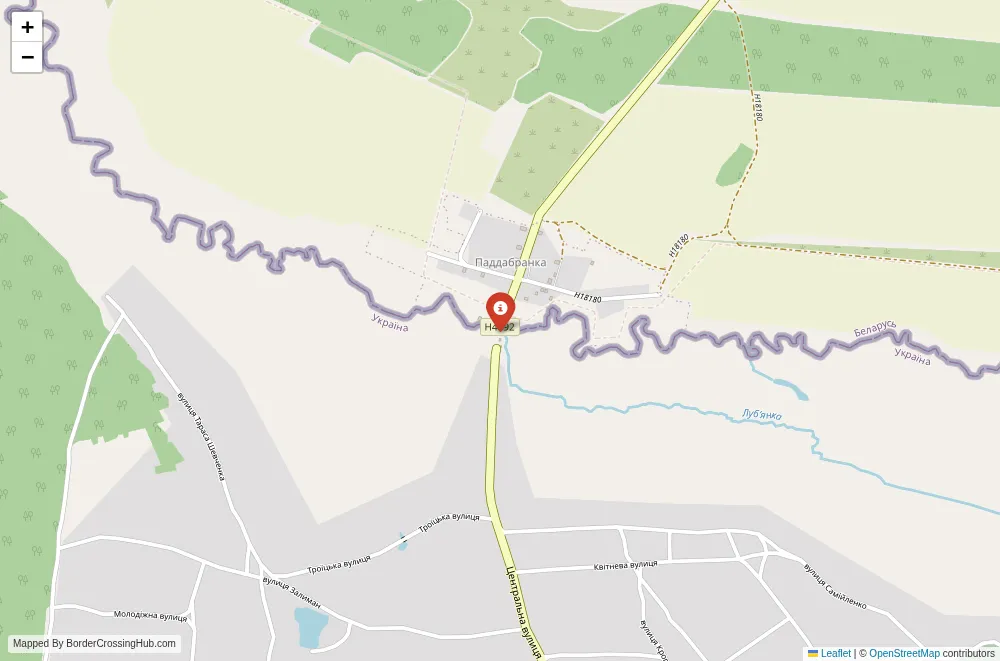
Approximate Border Location
Wait Times
Closed/very limited; delays 240-720m if open
Just crossed? Tap to report:
Operating Hours
Hours variable; confirm locally
Crossing Types
Ped,cars if permitted; full controls
Border Type
Land crossing via road (local)
Peak Times
N/A; restricted route
Daily Crossings
0-150/day
Currency Exchange
BYN; UAH; some EUR; ATMs scarce
Safety Information
High security; restrictions likely
Languages Spoken
Belarusian/Ukrainian
Accessibility Features
Basic; step-free varies
About Hlybotskaie & Ilmivka
Monthly Update (March 2026):
As of 03/2026, the Hlybotskaie & Ilmivka Border Crossing sees very limited movement. The checkpoint stays quiet with only occasional authorized crossings rather than routine traffic. Roads on both sides remain mostly empty. Any change in activity usually follows broader regional developments rather than daily travel demand.
No Cell Service at the Border? No Problem.
Don’t get caught scrambling for paperwork when you lose signal. Download the complete Europe Transit Guide directly to your device and access every critical detail, fast-track strategy, and border rule – 100% offline.
The Hlybotskaie-Ilmivka border crossing (also referred to as Hlybotske-Ilmivka, Глибоцьке-Ільмівка, or Glibotske-Ilmovka) remains one of the most obscure and localized points on the entire Belarus-Ukraine border, functioning in the past as a simplified passage for residents in a deeply rural corner of the Polesia region.
Location and Basic Connections
You reach this crossing in a secluded part of the frontier where Gomel oblast in Belarus meets an area tied to Chernihiv oblast in Ukraine. Hlybotskaie sits on the Belarusian side as a small settlement or locality, while Ilmivka (Ilmovka) lies opposite in Ukraine. A narrow road or village street connects the two spots, restricted to light vehicles up to 3.5 tons and pedestrians. No significant highways lead here; the only ways in involve winding secondary tracks through thick forests, bogs, and agricultural fields characteristic of Polesia. Before restrictions took hold, it served almost entirely local people for quick trips to see relatives, buy supplies, or handle personal matters across the line. Foreign visitors had little reason to use it even then.
Historical Background
This section of the 1,084 km border largely follows lines established in the Soviet era, when administrative divisions separated what had been a relatively fluid cultural zone. In Polesia, with its shared marshes, rivers, and woodlands, communities developed close ties through intermarriage, common dialects blending Belarusian and Ukrainian elements, and overlapping traditions like folk customs tied to seasonal agriculture and fishing. Simplified local crossings such as Hlybotskaie-Ilmivka arose specifically to accommodate that daily reality, allowing residents with border-area registration to pass without full international formalities. A sign from earlier years at Ilmivka displayed rules in both Ukrainian and Russian, underscoring the practical, low-key nature of the point. The full-scale invasion in 2022 ended that era completely. Belarus’s support for military operations into northern Ukraine led to the rapid militarization of the frontier, closing all crossings and turning rural passages into guarded perimeters.
Current Status and Safety Warnings
As of early 2026, every land border crossing between Belarus and Ukraine stays closed to civilian use, Hlybotskaie-Ilmivka included. Official sources from Ukraine’s State Border Guard Service list it as inactive, with no passenger or vehicle traffic permitted for locals or foreigners. The border features reinforced patrols, engineering barriers, surveillance, and in some sections new outposts built by Belarusian authorities. The dangers go well beyond administrative hurdles. Parts of the frontier near former conflict zones retain risks from landmines and unexploded remnants. Unauthorized approaches trigger responses from armed border units on both sides, often resulting in detention, substantial fines, deportation, or more serious escalation. Foreign nationals receive extra checks and face heightened suspicion; attempting to get close without explicit permission can lead to arrest or expulsion. Rumors in online discussions about unofficial routes or “quiet” local paths almost never prove accurate and frequently endanger those who follow them. Before any movement near this region, consult your own government’s current travel advisory, check announcements from Ukraine’s border service, and review Belarusian state border committee information. The consistent recommendation remains to avoid the area entirely.
Operating Hours and Wait Times
During its operational period as a local simplified crossing, it limited activity to daytime hours, typically 8:00 a.m. to 8:00 p.m., with processing kept brief for approved residents. Waits stayed short, usually under ten minutes, since crowds never formed at such a minor point. Those operational details have no application today; the crossing holds no public function.
Visa Requirements for Foreign Visitors
When the point functioned, Belarus granted visa-free stays to citizens of many countries at land borders, often up to 30 days, while Ukraine offered visa-on-arrival or e-visa options for most visitors. Simplified local crossings demanded proof of residency in border zones or special invitations, effectively barring casual tourists. With indefinite closure, visa provisions lose all relevance here. Any effort to cross illegally exposes individuals to grave legal consequences independent of nationality.
Crossing Procedures Step by Step
In earlier times the routine stayed uncomplicated. From the Belarusian side at Hlybotskaie, you presented documents at a modest checkpoint for exit clearance, crossed the short connecting road or path (often just a few hundred meters), and completed entry formalities at the Ukrainian post in Ilmivka. Facilities included basic booths with minimal infrastructure, no elaborate buildings, bridges, or extensive queues. Travelers carried their own belongings throughout. Civilian processing has ceased entirely; the location now falls under military jurisdiction.
Transportation Options
Public transport options never existed for this remote spot. From larger centers in Gomel oblast or Chernihiv oblast, people relied on private vehicles, taxis to village edges, or local arrangements for the final stretch on foot or by informal ride. Arranging access proved challenging without personal connections in the area. Today’s security measures block most approach roads, making even theoretical transport irrelevant.
Road Conditions and Scenery
Paths leading to the crossing consist of unpaved gravel or dirt tracks that degrade rapidly with rain, turning to mud in spring and fall or freezing solid in winter. The Polesia landscape surrounds everything: extensive pine and birch forests, peat bogs, narrow rivers, and patches of farmland dotted with isolated homesteads. The terrain remains flat, heavily wooded, and serene in appearance, though the isolation adds to its remoteness. Summer brings dense greenery and swarms of insects from the wetlands, while winter blankets paths in snow.
Nearby Attractions
No notable tourist sites exist at or immediately near the crossing. Ilmivka and Hlybotskaie comprise typical small rural settlements focused on local agriculture and daily life. Deeper into Chernihiv oblast, older wooden churches, historical villages, or natural reserves appear, but border zone restrictions prevent straightforward visits. The Belarusian Gomel region side holds comparable quiet countryside with occasional historical markers, yet the fortified frontier blocks exploration.
Seasonal Variations and Weather Impacts
Weather exerts strong influence on rural access here. Heavy winter snow buries tracks and isolates hamlets for days. Spring melt creates deep mud, summer thunderstorms flood low-lying paths, and marshes amplify mosquito presence in warmer periods. Political and security decisions far outweigh seasonal factors; any potential reopening or continued closure stems from state-level choices rather than forecasts.
Practical Travel Tips
Refrain from attempting to visit or approach this crossing. If your interest centers on border geography, history, or regional studies, draw from official maps, government archives, satellite imagery, and verified reports instead of on-site efforts. When in northern Ukraine or southern Belarus for other reasons, observe all security protocols rigorously, maintain distance from restricted border areas, keep identification documents accessible, and avoid photographing military installations or checkpoints.
Cultural and Economic Role
Prior to closure, the point played a modest but meaningful part in sustaining village networks across the border. Relatives crossed for family events, seasonal farm help, or exchanges of home-produced goods like vegetables, dairy, or firewood. It embodied the longstanding cultural continuity in Polesia, where national lines overlaid older communal patterns of language use, folklore, and mutual support. Economically its contribution remained limited to supporting household-level needs rather than generating broader trade flows.
Final Note on This Obscure Border Point
Hlybotskaie-Ilmivka persists as little more than a historical notation on border documentation, sealed off and monitored amid persistent regional tensions. Exclude it from any active travel planning and monitor credible official updates in case circumstances evolve over time. Proceed thoughtfully on your future routes.
No reviews yet.