
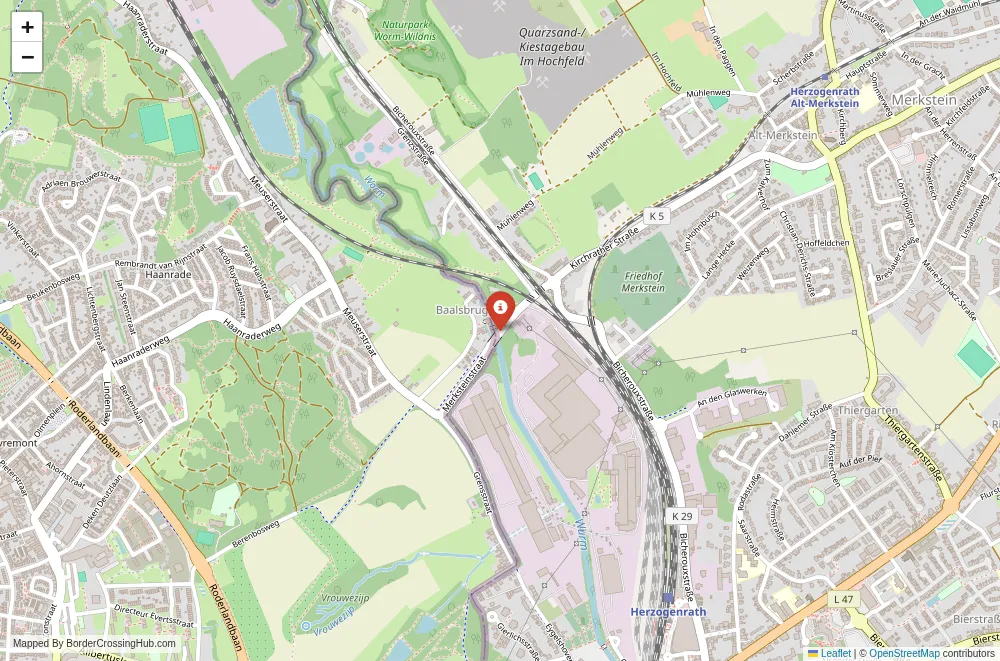
Approximate Border Location
Border Countries
- 🇩🇪Germany
- 🇳🇱Netherlands
Border Cities
- 🇩🇪Herzogenrath
- 🇳🇱Landgraaf
Wait Times
Cars 0-10m; peaks 15-45m commute
Just crossed? Tap to report:
Operating Hours
Open 24 hrs (12:00 AM-11:59 PM)
Crossing Types
Ped,cars,bikes,buses; local roads
Border Type
Land crossing via local road
Peak Times
07:00-09:00 AM; 04:00-06:30 PM
Daily Crossings
30,000-110,000/day
Currency Exchange
EUR only; ATMs common
Safety Information
Urban junctions; periodic checks
Languages Spoken
Dutch/German
Accessibility Features
Step-free routes; accessible transit
About Herzogenrath & Landgraaf
The Herzogenrath-Landgraaf border gives you one of the most integrated crossings in Europe, where the German town of Herzogenrath and the Dutch town of Kerkrade function practically as a single urban area split by an invisible line.
Alternative Names
This point is frequently called the Herzogenrath-Kerkrade grensovergang, the Eurode border, or the Nieuwstraat/Neustraße crossing. Rail users refer to it as the Herzogenrath DB – Landgraaf NS border or part of the Sittard–Herzogenrath line.
Current Status and Safety Note
Germany and the Netherlands are Schengen countries, so this border has no permanent checkpoints, booths, or routine controls. You drive, walk, cycle, or take the train across without stopping under normal conditions. Both countries maintain temporary random spot checks at various borders for migration and security reasons; these can happen on roads or rail but remain infrequent and targeted here. The area feels completely safe and everyday-normal, with locals crossing constantly for shopping, work, or errands. No significant scams or traveler issues are reported in this highly integrated zone.
Historical Background
The border was drawn in 1815 at the Congress of Vienna, splitting what had been a single mining and industrial community. Families ended up divided, with some houses having front doors in one country and back doors in the other. The main street (Nieuwstraat in Kerkrade / Neustraße in Herzogenrath) became the frontier line. After World War II, cooperation grew, and Schengen removed physical barriers. The rail link reopened and electrified in stages (with Landgraaf-Herzogenrath works completed around 2018-2019), supporting modern cross-border services like the Drielandentrein.
Geopolitical and Economic Role
This crossing sits in the heart of the Euregio Meuse-Rhine, where Dutch, German, and Belgian influences blend closely. Herzogenrath and Kerkrade form the binational “Eurode” area, with shared services, joint projects, and daily cross-border routines. The road and rail links support commuters, shoppers (Dutch often head to Germany for cheaper fuel and goods), and regional tourism. The rail line connects to Aachen and Heerlen, forming part of the Three Countries Train route.
Visa Requirements for Foreign Visitors
Schengen rules apply to both sides. If your nationality qualifies for visa-free entry, you cross with just a valid passport or national ID. Most non-EU visitors receive 90 days in any 180-day period across the area. Carry your travel document, as random spot checks can occur anywhere in the border zone.
Crossing Procedures Step by Step
By car or bike, follow roads like the L240 (Germany) or N299/N281 (Netherlands); the border runs down the middle of streets such as Nieuwstraat/Neustraße with no markings or stops. Signs and road markings change language and style subtly. For rail, regional RE18 (Arriva) or similar trains stop at Herzogenrath (Germany) and then cross to Landgraaf, Eygelshoven Markt, Heerlen, or beyond; no border formalities take place on board. Pedestrians and cyclists walk or ride across the same streets or parallel paths. No booths, forms, or officials wait. The reverse direction is identical.
Typical Wait Times and Peak Periods
Wait times are zero in practice. You cross instantly. Shopping weekends, rush hours, and events in Kerkrade or Aachen bring more traffic on roads and trains, but no queues form at the border itself. Random spot checks add only brief pauses if they occur.
Operating Hours
Roads and paths remain open 24 hours a day. Regional trains run roughly every 15-30 minutes during the day, with reduced evening and night service.
Transportation Options to and From the Border
Drive via local roads from Aachen (Germany) or Heerlen/Kerkrade (Netherlands). Regional trains (RE18 or similar) connect Herzogenrath directly to Landgraaf (8-10 minutes) and onward to Heerlen, Maastricht, or Aachen. Buses serve both towns. Cycling works well on quiet streets and regional paths. The area is compact enough to explore on foot.
Road Conditions and Scenery
Roads are narrow urban streets or decent regional routes with good surfaces. The border zone shows typical town scenery: houses, shops, roundabouts, and bike lanes. The line often runs through the middle of roads, with one lane in each country. The surrounding area features gentle hills, former mining landscapes, and green spaces.
Seasonal Variations and Weather Impacts
No seasonal closures occur. Winter brings possible rain or light snow, but roads stay passable. Summer sees more leisure traffic and pleasant conditions for walking or cycling.
Nearby Attractions
Kerkrade offers a relaxed Dutch town feel with shops, cafes, and access to GaiaZOO. Herzogenrath provides German-style services and proximity to Aachen’s historic center, cathedral, and thermal baths. The nearby Drielandenpunt (Vaals tripoint) is a short drive away for the three-country marker. Cross-border walking or cycling routes let you explore both sides easily.
Common Scams and Warnings
No notable scams exist in this everyday area. Some shoppers mention price differences or crowded parking at cross-border outlets. Random spot checks focus on vehicles and rarely affect tourists. Normal urban precautions apply.
Travel Tips and Preparation
Use navigation apps to follow local roads or rail timetables via NS, Arriva, or DB. Carry your passport/ID and vehicle papers. Bring cash or card for shopping. If walking the main street, note the subtle country switch (Dutch signs often cheaper). Combine with a visit to Aachen or Heerlen for a fuller day.
Cultural and Economic Significance
This border demonstrates how deeply Schengen integration can erase frontiers in daily life. Residents treat the line as irrelevant, with shared schools, shops, and family ties. The Eurode concept promotes cooperation, and the rail service strengthens regional mobility in the tri-country area.
Final Planning Advice
Check current train timetables or any spot-check notices if driving. Bring your documents, step across the street, and experience one of Europe’s most seamless and symbolic borders. This spot turns a simple walk into a quick hop between two countries. Safe travels.
No reviews yet.