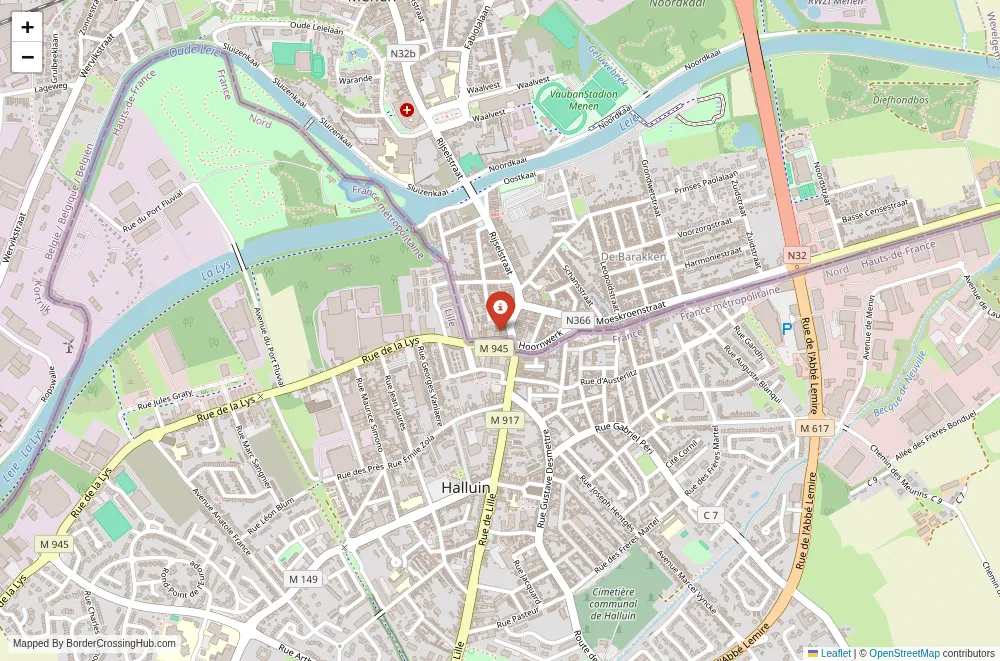
Monthly Update (September 2026):
Halluin & Menen remains a busy urban France-Belgium crossing serving the Lille area, with no significant September border closure identified. There are no current temporary internal border controls specifically on the Belgium-France land border, so normal weekday traffic is the main source of potential delays. September's return to regular school and commuter schedules can make the approaches noticeably busier during morning and afternoon peaks.
About this crossing
Location and Basic Connections
You find this crossing linking Halluin in northern France's Nord department to Menen in Belgium's West Flanders province. It occupies a position in the Métropole Européenne de Lille area, near Kortrijk and Lille, along local roads and close to major highways such as the E17. Foreign visitors pass here when traveling between northern French cities and Belgian hubs like Ghent, Kortrijk, or Brussels, or for cross-border errands in the conurbation. Alternative names include the Halluin-Menen border. As a Schengen internal point, it normally features open flow, though temporary controls persist into 2026 due to security extensions across France and Belgium.
Historical Background and Geopolitical Role
The boundary traces medieval divisions between French and Flemish territories, formalized after Belgium's 1830 independence through the Treaty of London in 1839. The Leie River frequently served as a natural divider in places. The area industrialized in the 19th and 20th centuries with textile mills and factories that often straddled the line, fostering shared economic growth and worker movement. World War I brought devastation nearby in Flanders fields, while World War II saw tactical importance due to rail and road links. Schengen since 1995 erased routine barriers, turning it into a fluid economic corridor in one of Europe's most interconnected border zones. Agreements like cross-border healthcare pacts and joint economic initiatives extend cooperation into daily services for residents on both sides.
Nearby Border Crossings


Current Status and Safety Considerations
France continues temporary internal border controls with Belgium until at least April 30 2026, driven by persistent threats from jihadist activities, rising antisemitic incidents, criminal smuggling networks, and migration pressures near northern frontiers. Belgium extends targeted internal checks on motorways, buses, selected trains, and some flights until July 31 2026, centered on security and migration enforcement. At urban crossings like this, police perform random stops for ID or vehicle verification rather than permanent setups. Travelers describe these as brief in busy city environments, with no frequent reports of border-specific problems. The zone has ordinary urban safety—watch for general precautions like securing valuables in crowded areas but no recurring scams noted at the crossing itself. Keep belongings secure and documents accessible.
Operating Hours and Wait Times
Open continuously as roads and paths, with no fixed stops normally. Controls introduce occasional interruptions: most passages take under a minute, but checks extend 5 to 20 minutes if selected. Urban traffic peaks during morning and evening commutes or weekends, slightly raising check likelihood near key routes. No long queues form like at external borders. Weather effects remain minimal, though urban congestion can compound any holdups during rain or fog.
Visa Requirements for Foreign Visitors
Standard Schengen entry: free for EU/EEA citizens with ID. Non-EU visitors use 90/180-day exemptions or visas. Carry passport during potential checks; EES biometrics apply externally but not here routinely. Provide travel details if questioned.
Crossing Procedures Step by Step
Drive, bike, or walk streets that blend seamlessly across the line, often marked by subtle signs or river bridges. No routine halt occurs. During controls, officers may stop you roadside or at points for ID check and questions. Cooperate briefly; process ends fast in urban flow. The shift from French to Belgian territory appears immediate, with language signs transitioning from French to Dutch/Flemish.
Transportation Options and Road Details
Local buses and trams connect Halluin to Menen and Lille quickly, with trains from Lille to Kortrijk nearby. Roads stay paved and busy, passing residential neighborhoods, commercial strips, and river glimpses along the Leie. Traffic flows steadily but thickens during rush hours. Cycling paths weave through parts of the zone, convenient for short cross-border hops. Scenery mixes urban buildings, river views, and occasional parks.
Nearby Attractions and Practical Tips
Menen features a historic town hall, textile heritage sites, and riverside walks; Halluin offers local markets and easy access to Lille's old town with its Flemish-influenced architecture and grand squares. Always carry ID due to possible checks. Euros and cards function interchangeably on both sides. Dress for changeable northern weather with layers for wind or rain. Shoppers cross frequently for price variations in groceries or goods. For drivers, note minor speed limit differences across the line. Avoid peak commute times if possible to minimize any traffic overlap with checks.
Cultural and Economic Significance
The crossing underpins deep integration where residents live, work, and shop across the line daily. Shared industrial past in textiles lingers in architecture and traditions, while bilingual signs and mixed dialects reflect Flemish-French influences. Cross-border commerce thrives in retail, services, and healthcare via dedicated pacts. It exemplifies Schengen's aim of seamless movement, adapted to current security realities through targeted rather than permanent checks.
Final Planning Notes
Prepare for possible ID checks, monitor updates on temporary controls through official sources, and factor in minor delays for random stops. This urban link makes exploring the Lille-Kortrijk area straightforward and convenient when you stay prepared.
View all border crossings between France and BelgiumPractical information
Fuel
France: <1 km - Belgium: <1 km
Currency
EUR only; ATMs and banks nearby
Safety information
Urban traffic; occasional controls
Connectivity
Wi-Fi points; 4G
Have you crossed here?
Help other travelers by sharing your experience, wait times, and any updates.