
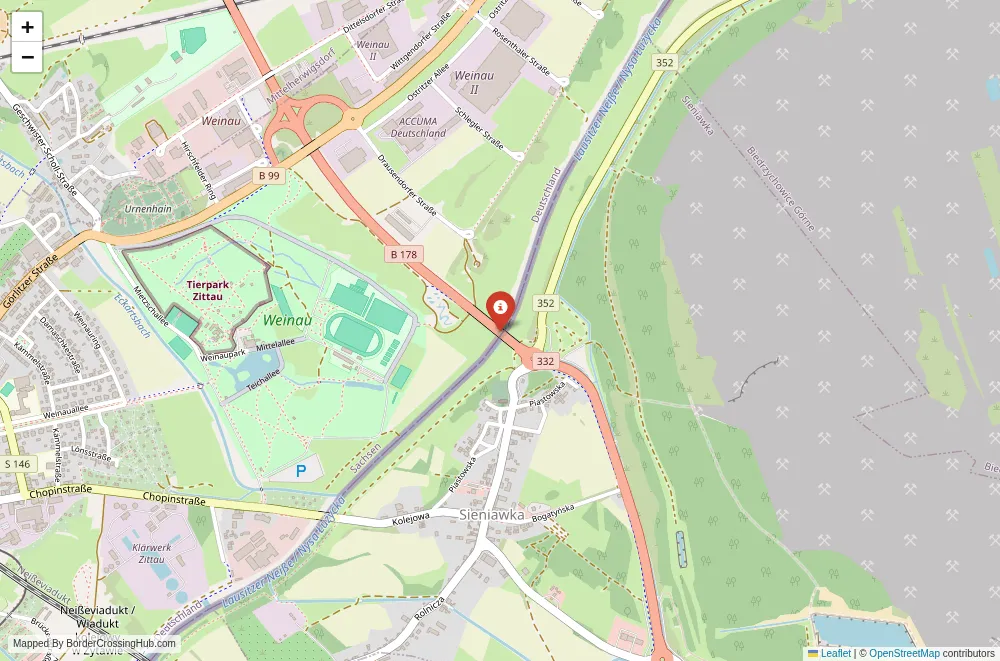
Approximate Border Location
Wait Times
Cars 0-10m; peaks 15-75m spot checks
Just crossed? Tap to report:
Operating Hours
Open 24 hrs (12:00 AM-11:59 PM)
Crossing Types
Ped,cars,bikes; river bridge
Border Type
Land crossing via road (local)
Peak Times
Weekends 10:00 AM-04:00 PM; summer
Daily Crossings
1,000-6,000/day
Currency Exchange
EUR; PLN in Zgorzelec; ATMs
Safety Information
Narrow bridge; slow traffic during works
Languages Spoken
German/Polish
Accessibility Features
Basic step-free; narrow sidewalks
About Gumieńce & Tantow
Monthly Update (March 2026):
As of 03/2026, the Gumieńce & Tantow Border Crossing stays fairly active with cars moving between Szczecin and nearby German towns. Traffic rolls through without checks most of the day. Weekday mornings feel busiest with commuters. Cross-border work and shopping shape the flow.
No Cell Service at the Border? No Problem.
Don’t get caught scrambling for paperwork when you lose signal. Download the complete Europe Transit Guide directly to your device and access every critical detail, fast-track strategy, and border rule – 100% offline.
Gumieńce connects Poland to Germany as a railway border crossing along the Berlin–Szczecin line, where the line crosses the Oder-Neisse frontier in a rural stretch near the German village of Tantow.
Location and Basic Connections
You reach this crossing where the Polish railway station Szczecin Gumieńce (part of the Szczecin metropolitan area in West Pomeranian Voivodeship) meets the German border near Tantow in Mecklenburg-Vorpommern. It lies on the single-track electrified section of the Berlin–Szczecin railway (line 409 on the Polish side), roughly 3 km beyond the last German station at Tantow. Foreign visitors use it primarily by train when traveling between Berlin or Pasewalk in Germany and Szczecin or farther into Poland. Alternative names include the Szczecin Gumieńce-Tantow border crossing or Tantow-Szczecin Gumieńce railway border. As a Schengen internal point focused on rail, it normally has no fixed passenger checks, but temporary controls apply to land borders as of February 10 2026.
Historical Background and Geopolitical Role
The border follows the Oder-Neisse line established in 1945 after World War II, which set the postwar frontier between Germany and Poland. The Berlin–Szczecin railway dates to the 19th century as the Stettiner Bahn, a key link for passengers and freight. The crossing handled international traffic during the Cold War under strict East German and Polish controls. After reunification and Schengen in 2007, it became open for seamless rail travel, though freight dominates while passenger services remain regional. Modernization efforts on the Polish side (Szczecin Główny to Gumieńce to border) aim to improve speeds and capacity, with electrification and double-tracking plans progressing toward better cross-border connectivity in this Pomeranian corridor.
Current Status and Safety Considerations
Germany maintains temporary checks at all land borders with Poland until at least March 15 2026, due to irregular migration, smuggling networks, asylum system strains, and security concerns from global conflicts. Poland extends controls on its German border until April 4 2026, citing migratory spillover from Belarus routes, increased illegal crossings on the Polish-German side, and public security risks. For this rail-only crossing, checks occur sporadically via onboard or station verifications rather than routine stops at the border itself. Travelers report these as infrequent on regional trains, with most journeys unaffected. The area around Gumieńce and Tantow has low crime typical of rural rail zones, with no common scams or issues noted for passengers. Carry your passport or national ID at all times in case of any verification.
Operating Hours and Wait Times
The railway operates continuously with scheduled trains, no fixed hours for the border itself since it’s integrated into the line. Temporary controls add variability: most trains cross without interruption, while a random check might delay a service by 5 to 20 minutes for document inspection or questions. Regional passenger trains run several times daily in each direction, with freight more frequent. Waits at stations or on board stay minimal outside targeted operations. Peak commuter or holiday periods could see slightly more activity, though nothing like road border queues. Weather rarely affects rail here, but fog or winter conditions might cause minor timetable adjustments.
Visa Requirements for Foreign Visitors
Schengen rules apply fully: EU/EEA/Swiss citizens travel freely with valid ID or passport. Non-EU nationals qualify for visa exemptions up to 90 days in any 180-day period if eligible, or hold a Schengen visa. The Entry/Exit System registers non-EU travelers at external borders but not routinely on this internal rail line; spot checks may verify your status or documents. Present your passport during any control, along with proof of purpose, funds, accommodation, or onward travel if requested. No additional fees occur at this crossing.
Crossing Procedures Step by Step
You board a regional train in Germany (e.g., from Pasewalk or Tantow station) or Poland (from Szczecin Główny via Gumieńce). Normally, the train continues across the border without stopping, as the line flows seamlessly and language signs shift. If authorities conduct a control, police may board at a station or perform an onboard check for ID presentation and basic travel questions. Provide documents calmly; the process resolves quickly amid passenger flow. No separate pedestrian or vehicle options exist here—it’s rail-exclusive. The transition feels abrupt yet routine, with rural views of fields and woods continuing on both sides.
Transportation Options and Road Details
Regional trains (often operated by DB Regio or Polish carriers) connect Tantow to Szczecin Gumieńce and onward to Szczecin Główny, with several daily services for commuters and visitors. No direct road crossing exists at this exact point; nearby road borders like Lubieszyn-Linken or Kołbaskowo-Pomellen handle vehicles. The rail line stays single-track in parts but electrified, passing through flat Pomeranian countryside with farmland, small woods, and occasional industrial sidings. Scenery remains open and agricultural. For non-rail travel, use parallel roads or buses linking Szczecin to German towns.
Nearby Attractions and Practical Tips
Szczecin on the Polish side offers historic old town, Oder River waterfront, and museums; Tantow provides quiet rural access with proximity to Uckermark nature areas. Carry ID due to controls. Euros work on both sides, zloty useful in Poland; cards widely accepted on trains and in stations. Pack for northern weather with layers for cooler rail journeys. Check timetables ahead, as regional services vary seasonally. Use the train for an easy, scenic border hop without driving hassles.
Cultural and Economic Significance
The crossing underpins freight and regional passenger links in this Pomeranian corridor, supporting trade between Berlin and Szczecin ports. Shared rail heritage from the Stettiner Bahn era lingers, while cross-border commuting and tourism grow slowly. It exemplifies practical Schengen rail integration amid temporary security measures.
Final Planning Notes
Monitor official EU or national sites for updates on temporary controls close to your travel, keep ID accessible, and check train schedules for any rare disruptions. This rail-focused route provides a convenient, low-key way to cross between Poland and Germany when you stay prepared.
No reviews yet.