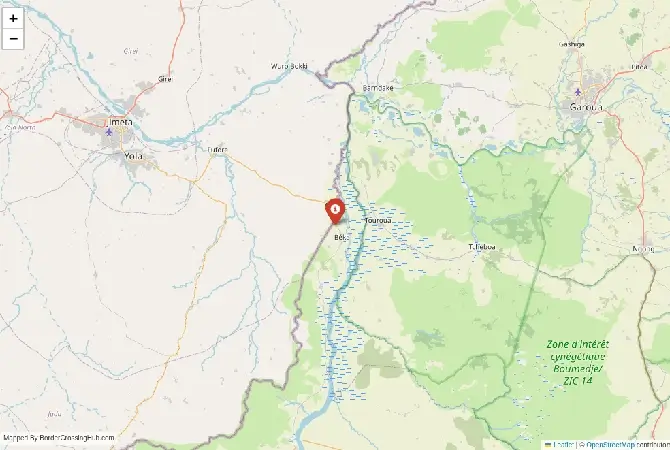
Monthly Update (September 2026):
Garoua and Ngurore remains a minor Nigeria-Cameroon crossing in the northern part of the Cameroon border, with no significant September closure identified. The route is considerably less important for international travelers than the main Ekok-Mfum corridor farther south. Security remains the main consideration in northern Nigeria and northern Cameroon, and conditions at smaller crossings can change with limited notice. Travelers should confirm that the crossing is operating for their nationality and type of traffic before setting out.
About this crossing
You will find that this is not a primary international crossing for most travelers, but it still plays a role in regional movement, particularly for trade and local travel.
Security Situation You Should Treat Seriously
This region requires careful attention. Northeastern Nigeria and northern Cameroon have both experienced security challenges linked to insurgent activity and regional instability.
Nearby Border Crossings




You should treat this crossing as high-risk unless you have current and reliable information from official sources. Military checkpoints, restricted movement, and sudden changes in accessibility are all possible.
Travel advisories often discourage non-essential travel in this المنطقة. You should strongly consider alternative crossings unless you have a specific reason and proper guidance.
Regional and Historical Context
The border here reflects long-standing connections between communities in northern Nigeria and Cameroon. Before modern borders were enforced, trade routes and migration patterns linked these areas closely.
Garoua developed as a major city and administrative center in northern Cameroon, while Ngurore serves more as a regional نقطة on the Nigerian side rather than a large urban center.
Movement across this border has traditionally been driven by trade, livestock, and family ties rather than large-scale international transit.
Border Facilities and Infrastructure
Facilities at this crossing are limited and not designed for heavy international traffic. You should expect small offices, minimal signage, and basic infrastructure.
Electricity and communication systems may not always be reliable. Much of the process is handled manually, including passport checks and record-keeping.
The layout may not be immediately clear, so you should be prepared to ask officials where to go to complete each step.
Operating Hours and Availability
Operating hours are generally limited to daylight, though exact times are not always clearly defined. Officials may not be present outside standard working hours.
Arriving early in the day is important. Late arrivals can lead to delays or the need to wait until the next day.
Unlike major crossings, there is little flexibility, and services depend heavily on staffing.
Visa Requirements and Documentation
You should prepare all documents before arriving.
For Nigeria, most travelers require a visa obtained in advance. Visa-on-arrival is not available at crossings like Ngurore.
For Cameroon, a visa is also required in advance for most nationalities.
A yellow fever vaccination certificate is mandatory for both countries and is commonly checked.
Carrying printed copies of all documents is strongly recommended.
Crossing Procedure and Wait Times
The process is straightforward but informal. You will exit one country and then complete entry procedures on the other side.
Wait times are generally short due to low traffic. On a typical day, you might complete the crossing in 20 to 40 minutes.
However, delays can occur if officials are unavailable or if additional security checks are required. The process depends more on staffing than on the number of travelers.
Road Conditions and Access Challenges
Reaching this crossing can be difficult. Roads in northeastern Nigeria and northern Cameroon vary in quality, with some sections unpaved or poorly maintained.
During the rainy season, certain routes can become muddy and hard to pass. In the dry season, dust and heat dominate.
Public transport options are very limited. Most travelers rely on private or arranged transport to reach the border.
Fuel stations and services are also scarce in some areas, so you should plan carefully.
Seasonal and Environmental Factors
Weather plays a major role in travel conditions. The rainy season can disrupt access due to poor road quality, while the dry season brings high temperatures and dusty conditions.
The surrounding landscape is largely savannah, with limited shade and services along the الطريق.
You should prepare for long stretches without facilities.
Scams & Warnings
While this is not a busy crossing, you should still remain cautious. Requests for unofficial payments can occur, particularly if officials assume you are unfamiliar with procedures.
You should remain polite but firm. Ask for receipts when fees are requested and avoid paying anything unclear.
Another issue is inconsistent information. Procedures may vary depending on who is on duty, so confirming each step is important.
Local Life and Cross-Border Movement
The crossing reflects the daily life of communities in this region. You may see traders, livestock movement, and families crossing for local reasons.
Garoua, being a larger city, brings more activity on the Cameroonian side, while Ngurore remains quieter and more rural.
Languages vary, with English common on the Nigerian side and French widely used in Cameroon.
Practical Tips for Travelers
You should carry enough water, food, and fuel, as services near the border are minimal.
Mobile network coverage may be weak or inconsistent. Having offline maps or written directions is useful.
Keeping your documents organized and accessible will help speed up the process.
Flexibility is essential, as delays and unexpected changes are always possible.
Final Thoughts
The Ngurore–Garoua crossing is a remote and lightly used route between Nigeria and Cameroon, shaped by regional conditions and limited infrastructure.
Closing Note
You should approach this crossing with caution and preparation. It is not a standard route for most travelers, and safer, more established crossings are usually the better option unless you have a clear reason to travel through this area.
View all border crossings between Nigeria and CameroonPractical information
Fuel
Nigeria: 2 km - Cameroon: 2 km
Currency
NGN,XAF informal
Safety information
Generally calm
Connectivity
2G/3G/4G cellular coverage
Have you crossed here?
Help other travelers by sharing your experience, wait times, and any updates.