
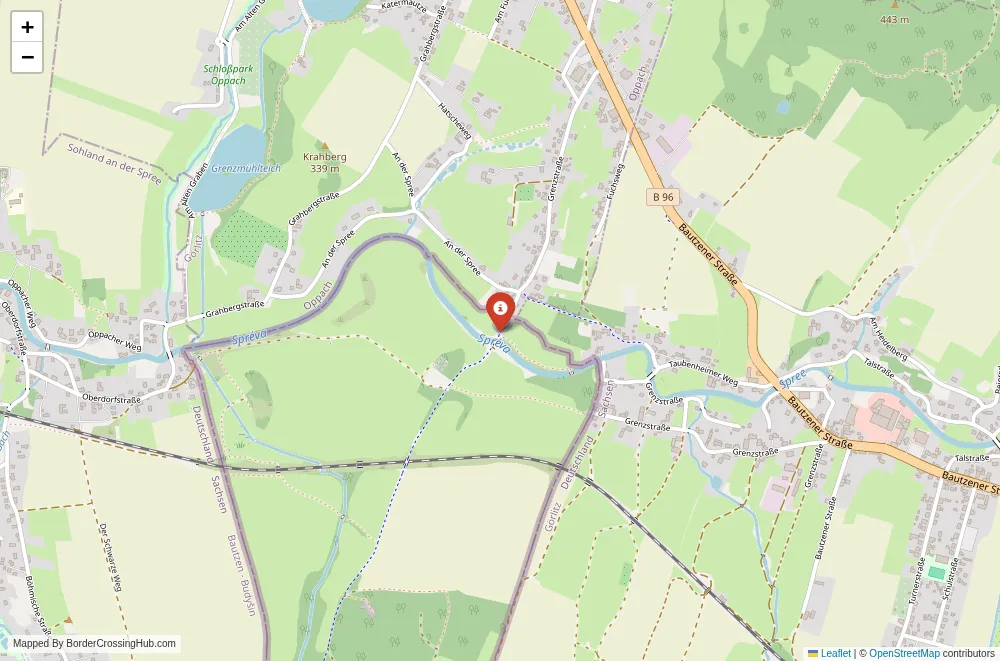
Approximate Border Location
Border Countries
Border Cities
- 🇨🇿Fukov
- 🇩🇪Oppach
Wait Times
Ped/bikes 0-10m; peaks 15-30m weekends
Just crossed? Tap to report:
Operating Hours
Open 24 hrs (12:00 AM-11:59 PM)
Crossing Types
Ped,bikes; no cars typical
Border Type
Land crossing via local road
Peak Times
11:00 AM-04:00 PM; summer Sundays
Daily Crossings
100-800/day
Currency Exchange
EUR; CZK in Rumburk; ATMs available
Safety Information
Remote path; limited lighting at night
Languages Spoken
German/Czech
Accessibility Features
Rough trail sections; no ramps
About Gaishof & Maxov
Monthly Update (March 2026):
As of 03/2026, the Gaishof & Maxov Border Crossing ticks along at an easy pace. Cars cross the rural road without delays, mostly locals traveling between nearby communities. The flow stays fairly even throughout the day. Seasonal tourism in the surrounding forests can bring a few more vehicles on weekends.
No Cell Service at the Border? No Problem.
Don’t get caught scrambling for paperwork when you lose signal. Download the complete Europe Transit Guide directly to your device and access every critical detail, fast-track strategy, and border rule – 100% offline.
Gaishof connects Germany to the Czech Republic in the Upper Palatinate region of Bavaria, where a small pedestrian and local road crossing links the German hamlet of Gaishof (part of Eschlkam municipality) to the Czech settlement of Maxov (part of Všeruby) across a rural forested stretch of the Bohemian Forest border.
Location and Basic Connections
You arrive at this crossing where Gaishof in Bavaria’s Cham district meets Maxov in the Plzeň Region. It lies along a minor road (German St 2159 extension or similar local path) in hilly woodland near the Upper Palatinate Forest. Foreign visitors cross here on foot, by bicycle, or occasionally by local vehicle when hiking cross-border trails, exploring the Bohemian Forest, or visiting nearby villages like Všeruby or Eschlkam. Alternative names include the Gaishof-Maxov border or Maxov-Gaishof crossing. As a Schengen internal point, it normally allows free movement with no fixed booths, but temporary controls remain active on the German side as of February 10 2026.
Historical Background and Geopolitical Role
The border follows the post-World War II Czech-German line set by the 1945 Potsdam Agreement. Gaishof and Maxov share a rural heritage in the Upper Palatinate and western Bohemia, with ties to forestry, agriculture, and local trade before the modern frontier divided them. The crossing appears in EU lists as a minor pedestrian-friendly point after Czechia’s Schengen entry in 2007, supporting hiking loops like those from Eschlkam to Všeruby via Gaishof-Maxov. It reflects the region’s quiet reintegration, with paths allowing seamless access to trails and small communities once separated by Cold War restrictions.
Current Status and Safety Considerations
Germany maintains temporary internal border controls with Czechia until at least March 15 2026, due to irregular migration, smuggling networks, asylum system pressures, and security concerns from global conflicts. These result in random spot checks on German approaches rather than permanent booths at minor crossings. Czechia does not impose routine reciprocal controls here. At this low-traffic rural path, checks are infrequent due to limited use, but police may stop pedestrians or cyclists for ID verification. The forested surroundings offer standard low crime, with no reported scams, aggressive touts, or border-specific problems. Carry your passport or national ID at all times to address any possible check.
Operating Hours and Wait Times
The path or road crossing operates continuously with no gates or fixed hours under Schengen rules. Temporary controls create occasional variability: most passages happen without notice, while a random stop lasts 5 to 20 minutes for document inspection or questions. This secluded point sees very few crossings, so delays remain negligible. Seasonal hikers or local outings might add minor activity on weekends. Weather in the Bohemian Forest foothills influences access, with winter snow or ice complicating paths and rain making them muddy.
Visa Requirements for Foreign Visitors
Schengen regulations cover entry: EU/EEA/Swiss citizens proceed freely with valid ID or passport. Non-EU nationals receive visa exemptions for up to 90 days within any 180-day period when eligible, or must hold a Schengen visa. The Entry/Exit System applies at external borders but not routinely at internal crossings like this; spot checks might confirm compliance. During a control, show your passport and provide details on accommodation, financial means, or travel plans if requested. No entry or exit fees apply here.
Crossing Procedures Step by Step
You approach via local paths or roads from Gaishof or Maxov, where the border often shows only through subtle signs, boundary stones, or the natural terrain shift. Normally, walk, cycle, or drive across as forests and hills continue without pause. Should German police perform a control, anticipate a roadside or path stop for ID submission and simple inquiries about your journey. Respond directly and the exchange ends rapidly in this sparse environment. Pedestrians and cyclists follow the same routes without dedicated facilities. The change appears minimal, with immediate rural scenery on both sides.
Transportation Options and Road Details
No major public transport directly serves this minor point: regional buses reach nearby Eschlkam or Všeruby. Driving uses secondary roads from Eschlkam leading to the border path. The route is paved but narrow, passing through wooded valleys and rolling hills. Scenery features dense forests, meadows, and distant Bohemian Forest vistas. Traffic remains extremely light, ideal for peaceful walks or bike rides. Cycling fits moderate terrain with trails connecting to regional networks.
Nearby Attractions and Practical Tips
Gaishof and Maxov offer quiet forest trails and proximity to the Upper Palatinate Forest and Bohemian Forest for hiking. Nearby Eschlkam provides local history and the Upper Palatinate Forest paths; Všeruby connects to Czech countryside and Domažlice. Carry ID due to controls. Euros work on both sides, Czech koruna useful on the Czech side; cards limited in remote areas. Pack layers for foothill weather, sturdy shoes for trails, and water for walks. Explore nearby paths or boundary markers on foot. Cross in daylight for safer navigation on smaller routes.
Cultural and Economic Significance
The crossing preserves subtle connections in this Upper Palatinate-western Bohemia borderland, where nature and rural life support limited cross-border exchanges. Historical German-Czech influences linger in place names and local traditions. It enables quiet tourism to trails and forested areas, representing Schengen’s low-key rural integration amid temporary security measures.
Final Planning Notes
Check official EU or national sources for the latest on temporary controls before travel, keep ID ready, and allow flexibility for any random check. This secluded forested path crossing provides a tranquil border experience between Germany and Czechia when you stay prepared.
No reviews yet.