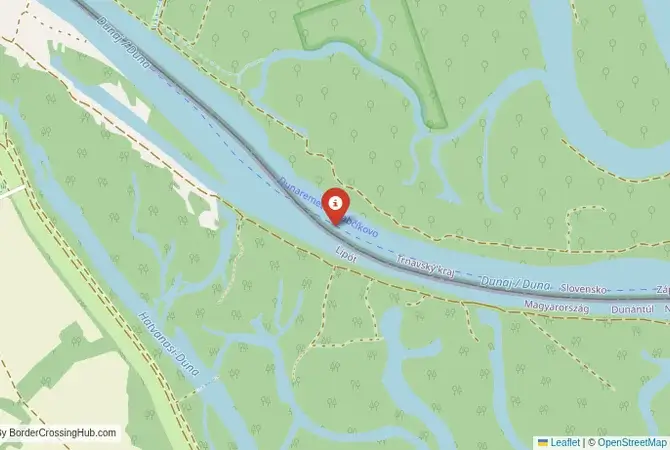
Monthly Update (September 2026):
Gabčíkovo & Lipót remains a small Danube crossing associated with the local ferry connection rather than a major road border. There is no significant September border restriction identified. The Gabčíkovo waterworks area is still operating for visitors, although a scheduled sightseeing boat trip was cancelled on September 3, showing that local river activities can change independently of the border crossing. Travelers using the ferry should verify the sailing schedule and river conditions before making the trip.
About this crossing
Operational Details
This ferry crossing connects Slovakia's Trnava Region with Hungary's Győr-Moson-Sopron County. Its operation is entirely dependent on the ferry schedule and the weather and river conditions. This is not a 24/7 facility. The ferry typically makes regular trips during daylight hours, especially in the summer tourist season. It is absolutely essential to check the latest official ferry schedule and its operational status before you travel, as services can be suspended due to high or low water levels, ice in winter, or technical issues. The ferry is small, carrying only a handful of cars per trip.
A History of the Gabčíkovo Dam
The history of this crossing is inextricably linked to the Gabčíkovo-Nagymaros Dams project. In the 1980s, Czechoslovakia diverted the main flow of the Danube into a new, concrete-lined power canal to feed the massive Gabčíkovo hydroelectric plant. This left the old riverbed, which forms the border, with a significantly reduced flow. The ferry at Gabčíkovo-Lipót crosses this "Old Danube." The dam project was the source of a major international dispute between Hungary and Czechoslovakia (and later Slovakia), which was eventually taken to the International Court of Justice. The ferry crossing is a journey through this complex and contested landscape, a place where ecology, engineering, and international politics meet.
Nearby Border Crossings



The Seamless Border Procedure
Today, there is no border procedure for travelers. You simply buy your ferry ticket and enjoy the short, scenic ride across the river. There are no passport checks and no customs inspections. This is the reality of the Schengen Area. The journey itself is the experience. The slow pace of the ferry allows you to appreciate the beauty of the floodplain forests and the rich birdlife of the region. It is a peaceful and relaxing way to cross the border.
The Surrounding Region: Slovakia Side
On the Slovak side, the crossing is near the town of Gabčíkovo, which is dominated by the massive locks of the hydroelectric dam. Watching large river cruise ships and barges being lifted or lowered in the locks is a fascinating sight. The area is part of the Žitný ostrov, the largest river island in Europe, a fertile agricultural region known for its thermal spas. The nearby city of Dunajská Streda is the cultural center of the Hungarian minority in this part of Slovakia.
The Surrounding Region: Hungary Side
On the Hungarian side, the crossing is in the Szigetköz region, a beautiful "inland delta" of the Danube with a maze of river branches, islands, and floodplain forests. It is a paradise for canoeing, kayaking, fishing, and cycling. The village of Lipót is famous for its large and popular thermal spa and water park. The beautiful baroque city of Győr is a short drive away. The entire region is known for its natural beauty and its opportunities for outdoor recreation.
Practical Travel Information
Practical planning for this route requires checking the ferry schedule in advance. The cost of the ferry is usually priced per vehicle and per passenger. Payment is typically required in the local currency (EUR in Slovakia, HUF in Hungary). The most important thing is to have the required motorway vignettes if your journey involves motorways in either country. Both Slovakia and Hungary use an electronic vignette system, which must be purchased online in advance. Services are available in the towns on both sides of the river.
Final Considerations
The Gabčíkovo–Lipót ferry crossing is a unique and charming way to cross the Danube. It offers a peaceful and scenic alternative to the busy motorway bridges. It is a journey that connects two of the most beautiful river landscapes in Central Europe, the Szigetköz and the Žitný ostrov. It is a border crossing that is not about speed, but about savoring the journey and experiencing the natural beauty of the Old Danube, a river that has been profoundly shaped by both nature and human ambition.
View all border crossings between Slovakia and HungaryPractical information
Fuel
Slovakia: ~5 km - Hungary: ~10 km
Currency
Limited nearby (EUR, HUF)
Safety information
River traffic caution
Connectivity
4G / 5G signal
Have you crossed here?
Help other travelers by sharing your experience, wait times, and any updates.