Monthly Update (October 2026):
Foz do Iguaçu & Puerto Iguazú enters October after a period of heavy rain and storms across the Triple Frontier at the end of September. Conditions improved at the start of the month, with cooler weather and less instability in Foz do Iguaçu, although the region can still see short periods of rain. For travelers crossing between the two tourism centers, weather rather than any new border restriction is the main recent variable.
Driving there, or sending a driver? Send them this guide.
For reports and websites
Cite this page
Border Crossing Hub (2026). Foz do Iguaçu & Puerto Iguazú Border Crossing. Updated October 2026. https://bordercrossinghub.com/foz-do-iguacu-puerto-iguazu-border-crossing/<a href="https://bordercrossinghub.com/foz-do-iguacu-puerto-iguazu-border-crossing/">Foz do Iguaçu & Puerto Iguazú Border Crossing (Border Crossing Hub)</a>Put this crossing's card on your website
Free. It updates on its own when our information changes.
<iframe data-bch-card src="https://bordercrossinghub.com/foz-do-iguacu-puerto-iguazu-border-crossing/?bch_view=card" width="100%" height="980" scrolling="no" style="border:0;max-width:480px;display:block" loading="lazy" title="Foz do Iguaçu & Puerto Iguazú border crossing information"></iframe>
<p style="font-size:12px;margin:4px 0 0">Crossing information: <a href="https://bordercrossinghub.com/foz-do-iguacu-puerto-iguazu-border-crossing/">Border Crossing Hub</a></p>
<script src="https://bordercrossinghub.com/?bch_embed_js=1" async></script>Paste it where you want the card. The last line (a script) only adjusts the height and can be left out.
About this crossing
Operational Details
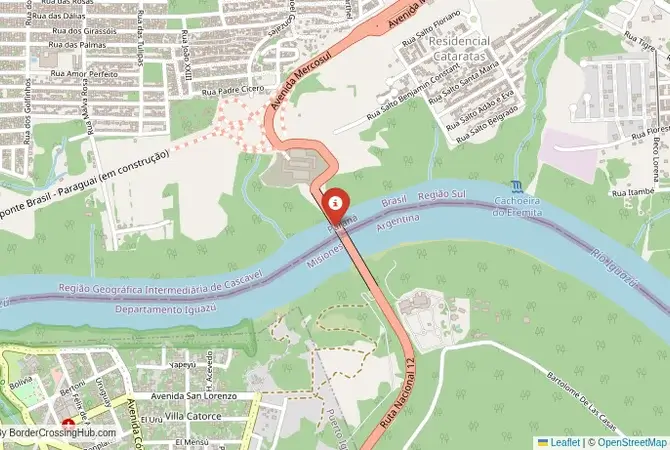
This checkpoint connects Brazil's Paraná state with the Misiones Province of Argentina. It is a major international crossing, open 24/7 to all passenger cars, buses, and commercial freight. The facility is large and modern, designed to handle the huge volume of tourist traffic that moves between the two sides of the falls. The bridge itself offers distant but beautiful views of the river canyon. While it is a major crossing, the procedures are generally well-organized and efficient, as both countries have a vested interest in facilitating the smooth flow of tourism, which is the lifeblood of the region. However, queues can still form, especially during peak tourist season (December-February) and on holidays, with occasional reinforcements of controls noted in late 2025.
A History of a Shared Wonder
The history of this region is the history of the Iguazú Falls. For centuries, this was the land of the indigenous Guaraní people, for whom the falls were a sacred place. The modern borders were established in the 19th century, dividing the falls between Brazil and Argentina. For decades, the area was remote and difficult to access. The development of tourism in the 20th century, and particularly the construction of the Fraternity Bridge in the 1980s, transformed the region into one of the most popular tourist destinations in the world. The bridge is a powerful symbol of the joint stewardship of this shared natural heritage, a testament to the peaceful and cooperative relationship between the two South American giants.
Nearby Border Crossings



Border Crossing Procedure
The border crossing procedure is a standard two-part process. You will first complete exit formalities at one country's checkpoint and then proceed across the bridge to the other country's checkpoint for entry inspection. You will need a valid passport or, for citizens of Mercosur countries, a national ID card. Vehicle registration and international insurance (Carta Verde) are also necessary. The immigration and customs offices are located in large, dedicated facilities at either end of the bridge. Many tour buses cross here, and the guides will typically handle the collection of passports to streamline the process. For independent travelers, the process is straightforward, but requires stops on both sides.
The Surrounding Region: Brazil Side
On the Brazilian side, the city of Foz do Iguaçu is a major tourist hub. The main attraction is the Iguaçu National Park, which offers the famous panoramic view of the falls. A long walkway takes visitors to a platform at the very edge of the "Devil's Throat" (Garganta do Diabo), an incredible and deafeningly loud experience. The Brazilian side is also home to the Parque das Aves, a magnificent bird park, and the massive Itaipu Dam, the second-largest hydroelectric plant in the world, which offers impressive tours.
The Surrounding Region: Argentina Side
On the Argentine side, the town of Puerto Iguazú is smaller and has a more relaxed atmosphere than its Brazilian counterpart. The main attraction is the Iguazú National Park, which offers a very different and more intimate experience of the falls. A network of walkways allows visitors to get up close to the individual cataracts, and a small train takes you to the top of the Devil's Throat, where you can stand directly above the plunging water. The park offers a more immersive and visceral experience of the power of the falls. The tri-border landmark, where you can see all three countries, is also on the Argentine side.
Practical Travel Information
Practical planning for this route is straightforward. The main road is well-maintained. The official currencies are the Brazilian Real (BRL) in Brazil and the Argentine Peso (ARS) in Argentina. Many businesses in the tourist areas may accept US Dollars. It is essential to visit both sides of the falls to get the full experience: the panoramic view from Brazil and the up-close experience from Argentina. Be prepared to spend a full day on each side. Taxis and public buses run frequently between the two towns and the national parks.
Final Considerations
The Foz do Iguaçu–Puerto Iguazú border crossing is a journey through a natural paradise. It is a busy, efficient checkpoint that is the gateway to one of the Seven Natural Wonders of the World. It offers a passage through a shared landscape of incredible beauty and power. For the traveler, it is an essential and unforgettable part of the Iguazú experience, a bridge that connects not just two countries, but two different and equally spectacular perspectives on the magnificent falls.
View all border crossings between Brazil and ArgentinaHeading to Foz do Iguaçu & Puerto Iguazú? Take this with you.
One page with the hours, waits, emergency numbers and coordinates. Works without signal.
Practical information
Fuel
Brazil: 500 m - Argentina: 500 m
Currency
Nearby BRL/ARS
Safety information
Tourist crowds; minor scams
Connectivity
Wi-Fi; 4G/5G
Have you crossed here?
Help other travelers by sharing your experience, wait times, and any updates.