
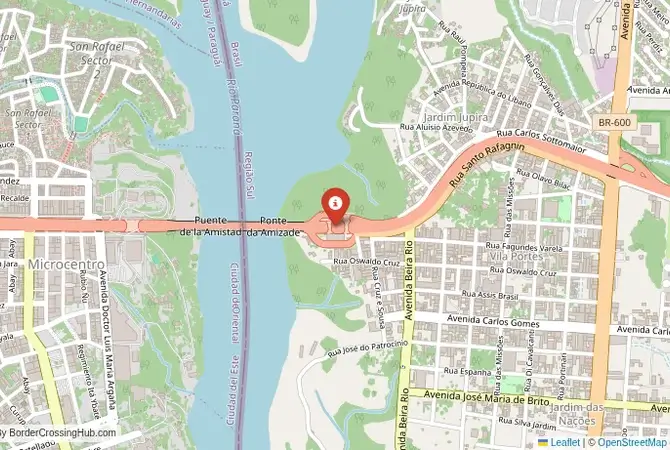
Approximate Border Location
Wait Times
15–60 min heavy flow
Just crossed? Tap to report:
Operating Hours
24 hours
Crossing Types
Pedestrians; vehicles; cargo
Border Type
Land crossing via bridge
Peak Times
08–11 AM; weekends
Daily Crossings
25k–35k/day
Currency Exchange
Exchanges BRL/PYG
Safety Information
Crowded; pickpocketing risk
Languages Spoken
Portuguese, Spanish, Guarani
Accessibility Features
Ramps; elevators
About Ciudad del Este & Foz do Iguaçu
Monthly Update (February 2026):
Traffic hums early and then thickens fast near the bridges at the Ciudad del Este & Foz do Iguaçu Border Crossing. February 2026 brings a familiar, variable pattern, with long vehicle lines forming toward Paraguay by late morning. Pedestrians usually move faster, especially outside shopping hours. Weekends and sales events are what really tip the balance.
The “Friendship Bridge” Crossing
The border crossing connecting the Brazilian city of Foz do Iguaçu with Ciudad del Este in Paraguay is one of the busiest, most chaotic, and most economically significant checkpoints in the world. This is not just a border; it is a journey across the iconic “Friendship Bridge” (Ponte da Amizade) over the Paraná River, a passage into a city that is essentially one giant, sprawling duty-free market. To cross here is to experience the raw, vibrant energy of South American commerce at its most intense. It is a crossing defined by the constant, overwhelming flow of shoppers, traders, and vehicles, a vital artery of the “Triple Frontier” where Brazil, Paraguay, and Argentina meet.
Operational Details
This checkpoint connects Brazil’s Paraná state with the Alto Paraná Department of Paraguay. It is a massive international crossing, open 24/7. The Friendship Bridge is a huge arch bridge that is a landmark in itself. The crossing is a scene of perpetual motion, with thousands of pedestrians, motorcycles, cars, vans, and trucks crossing every hour. The facilities on both sides are large but are often completely overwhelmed by the volume of traffic. The queues for vehicles can be extremely long, often lasting for many hours, and the pedestrian walkway is a river of people. A new bridge (Ponte da Integração to Presidente Franco) opened in late 2025 for gradual relief, initially for unloaded trucks, with full cargo access expected late 2026/early 2027.
A History of a Commercial Boomtown
The history of this crossing is the history of Ciudad del Este. The city was founded in the 1950s and grew exponentially with the construction of the massive Itaipu Dam nearby and the establishment of its duty-free zone. The Friendship Bridge, opened in 1965, was the catalyst that turned the city into a commercial mecca. For decades, it has been the engine of the Paraguayan economy, a place where Brazilians and Argentines flock to buy cheaper electronics, perfumes, clothing, and a vast array of other goods. The city has a reputation for being a “wild west” town, a center for both legitimate commerce and a huge informal and illicit economy.
The Unique Border Procedure
The border crossing procedure is unique and can be confusing. For a day trip of shopping in Ciudad del Este, most people (especially Brazilians and Paraguayans) cross the bridge without any immigration checks at all. The focus of the authorities is on customs control, particularly on the Brazilian side, for the goods being brought back. However, for foreign tourists or for anyone planning to travel further into either country, it is absolutely essential to seek out the immigration offices (located at the ends of the bridge) and get the proper entry and exit stamps. Failure to do so can result in significant fines and legal problems when you try to leave the country from another point. The apparent lack of control is deceptive.
The Surrounding Region: Brazil Side
On the Brazilian side, the city of Foz do Iguaçu is a major tourist hub. The main attraction is the magnificent Iguaçu Falls, a UNESCO World Heritage site, which offers a stunning panoramic view of the 275 separate cataracts. The Brazilian side is also home to the Parque das Aves, a magnificent bird park, and the Itaipu Dam, the second-largest hydroelectric plant in the world, which offers impressive tours. Foz do Iguaçu is a modern, well-organized city that serves as the base for exploring the entire tri-border region.
The Surrounding Region: Paraguay Side
On the Paraguayan side, Ciudad del Este is a city that is an experience in itself. The city center is a chaotic and vibrant bazaar, a maze of streets lined with huge shopping malls, small galleries, and countless street vendors selling everything imaginable. It is a city of incredible energy. While the primary focus is on shopping, the city is also a gateway to the interior of Paraguay. The nearby Saltos del Monday are a beautiful, if often overlooked, series of waterfalls.
Practical Travel Information
Practical planning is essential. Be prepared for crowds and chaos. The easiest way to cross for shopping is often on foot or by one of the many moto-taxis. The official currencies are the Brazilian Real (BRL) in Brazil and the Paraguayan Guaraní (PYG) in Paraguay, but the US Dollar is the de facto currency for almost all transactions in the shops of Ciudad del Este. Be aware of your personal security and be vigilant against pickpockets and scams. Be aware of the strict customs limits for goods you can bring back into Brazil.
Final Considerations
The Foz do Iguaçu–Ciudad del Este border crossing is a journey into the vibrant, chaotic heart of South American commerce. It is a bustling, overwhelming gateway to one of the largest shopping districts on the continent. The journey across the Friendship Bridge is a rite of passage for many travelers. It is a border that is defined by its intense energy, its vibrant street life, and its role as a major economic engine. It is a passage that is an adventure in itself, a full immersion into the lively and fascinating world of a classic South American frontier.
No reviews yet.