
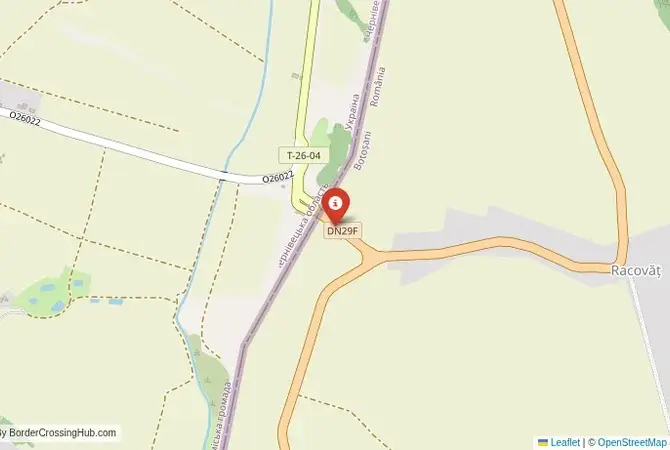
Approximate Border Location
Wait Times
15–60 min
Just crossed? Tap to report:
Operating Hours
6:00 AM–10:00 PM
Crossing Types
Pedestrians, vehicles
Border Type
Land crossing via road
Peak Times
7–10 AM
Daily Crossings
3,000–5,000 daily
Currency Exchange
Limited exchange; UAH, RON
Safety Information
Rural; calm
Languages Spoken
Ukrainian/Romanian
Accessibility Features
Ramps, assistance
About Dyakivtsi & Rakovets
Monthly Update (April 2026):
Cars gather in small groups, then clear gradually through the checkpoint. In April 2026, Dyakivtsi & Rakovets Border Crossing is mostly stable and lightly used. Processing into Romania can take slightly longer. Local travel and inspection routines shape the pace.
No Cell Service at the Border? No Problem.
Don’t get caught scrambling for paperwork when you lose signal. Download the complete South America Transit Guide directly to your device and access every critical detail, fast-track strategy, and border rule – 100% offline.
A New, Modern Crossing
Important Note for Travelers: Due to the ongoing war in Ukraine, all border crossings are under significant strain. Wait times can be long and unpredictable. It is essential to consult official government sources and live queue data for the most up-to-date information on its operational status before planning any travel. As of early 2026, wait times remain highly variable with occasional blockades and restrictions due to ongoing protests and security measures. The border crossing connecting the Ukrainian village of Dyakivtsi with Rakovets in Romania is one of the newest checkpoints on the border, officially opened for traffic in early 2023. It was a long-planned project, designed to improve local connectivity in the Bucovina region and to relieve congestion at the main crossing at Porubne-Siret. This is a modern facility, built with EU standards in mind, situated in a quiet, rural landscape. To cross here is to experience the most recent evolution of the Ukrainian-Romanian border, a route intended to be a model of efficient, small-scale cross-border traffic management.
Operational Details
This checkpoint connects Ukraine’s Chernivtsi Oblast with Romania’s Botoșani County. It is an international crossing with a key restriction: it is intended for passenger cars, buses, and light commercial vehicles. Its purpose is to serve the local communities and to provide a much-needed alternative to the overwhelmed Porubne-Siret crossing. It operates 24/7 and was constructed with a modern, efficient layout to provide a smooth and secure border crossing experience. Its opening was fast-tracked as a result of the 2022 invasion to improve Ukraine’s connections with the EU.
A History of a Divided Land
The history of this region is the history of Bucovina, a crown land of the Austrian Empire that was a famously multicultural melting pot of Romanians, Ukrainians, Germans, Jews, and Poles. The border, established after World War II, divided this historically integrated region. For decades, the communities in this part of the border had no direct crossing point, forcing them to make long detours to Siret. The opening of the Dyakivtsi-Rakovets crossing was a significant event for the local population, restoring a direct link that had been severed for over 70 years and promising to boost the local economy and facilitate family connections.
Border Crossing Procedure
The border crossing procedure is a standard two-part process for entering the EU, but it should be more efficient due to the new infrastructure and the focus on passenger traffic. You will first complete exit formalities at the new Ukrainian checkpoint at Dyakivtsi. After a short drive, you will arrive at the Romanian checkpoint at Rakovets for a full EU entry inspection by the Poliția de Frontieră and customs authorities. You will need a valid passport, vehicle registration, and international insurance (Green Card). As a new crossing, it offers a significantly faster alternative to Porubne-Siret, though as traffic increases, queues may develop.
The Surrounding Region of Bucovina
The surrounding area is a beautiful, rural landscape of rolling hills, characteristic of the Bucovina region. On the Ukrainian side, the crossing is near the town of Hertsa, the center of a district with a large Romanian ethnic majority. The road provides a good connection to the city of Chernivtsi. On the Romanian side, the crossing is a gateway to the Botoșani and Suceava counties. It provides good access to the famous painted monasteries of Bucovina, a UNESCO World Heritage site, and to the city of Suceava, the medieval capital of the Principality of Moldavia.
Practical Travel Information
Practical planning is key. The most important factor is to check the current vehicle restrictions. The roads leading to the crossing are regional and have been upgraded as part of the project. The official currencies are the Ukrainian Hryvnia (UAH) and the Romanian Leu (RON). Services at the border itself are very limited. It is essential to plan for fuel and any currency exchange in the larger towns. You will need the Romanian `rovinietă` vignette for your vehicle, which should be purchased online in advance.
Final Considerations
The Dyakivtsi–Rakovets border crossing is a symbol of hope and a practical step towards better integration. It stands as a successful example of Ukrainian-Romanian cooperation, a project that was completed in the midst of a war. It offers a faster and less stressful experience for eligible travelers and is a vital new link for the local communities of Bucovina. It is a border crossing that represents a forward-looking approach to border management, a new bridge designed to bring people closer together in a region with a long and shared history.
No reviews yet.