
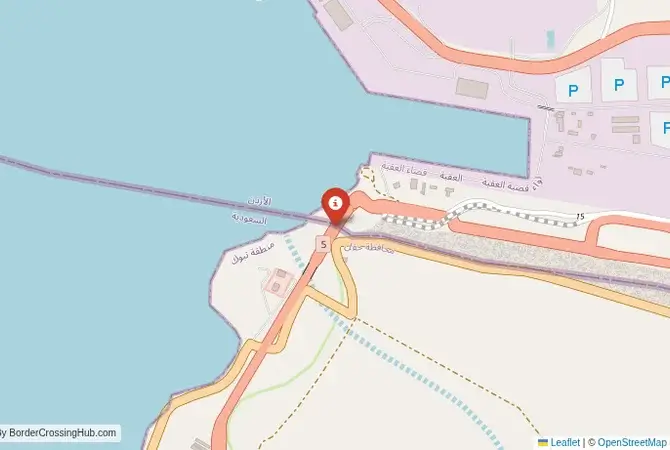
Approximate Border Location
Border Countries
- 🇯🇴Jordan
- 🇸🇦Saudi Arabia
Border Cities
- 🇯🇴Durra (Aqaba–Haql)
- 🇸🇦Haql (Saudi)
Wait Times
30-60 min typical
Just crossed? Tap to report:
Operating Hours
Open 12:00 AM-11:59 PM
Crossing Types
Pedestrians, vehicles, commercial
Border Type
Land crossing via road
Peak Times
7:00-10:00 AM, weekends
Daily Crossings
2000-3000 daily
Currency Exchange
Near Durra; JOD, SAR
Safety Information
Stable; desert driving risks
Languages Spoken
Arabic, English
Accessibility Features
Ramps, assisted access
About Durra (Aqaba–Haql) & Haql (Saudi)
Monthly Update (March 2026):
As of 03/2026, the Durra & Haql Border Crossing runs steadily with a mix of freight trucks and passenger vehicles. Customs checks for trucks can take longer, especially during midday. Cars usually move through faster. Trade shipments and desert travel routes shape the pace.
No Cell Service at the Border? No Problem.
Don’t get caught scrambling for paperwork when you lose signal. Download the complete Asia Transit Guide directly to your device and access every critical detail, fast-track strategy, and border rule – 100% offline.
A Crossing on the Red Sea
The border crossing connecting the area near Durra (south of Aqaba) in Jordan with Haql in Saudi Arabia is a journey along the spectacular coastline of the Gulf of Aqaba. This is a major international checkpoint, but its character is defined by the stunning beauty of its location, with the rugged, reddish mountains of the Sinai and the Hejaz plunging directly into the turquoise waters of the Red Sea. To cross here is to travel a route that is a gateway to some of the world’s best diving and a passage through a landscape of immense biblical and historical significance. It is a crossing that connects two modern kingdoms at the very edge of the Arabian desert.
Operational Details
This checkpoint connects the Aqaba Governorate of Jordan with the Tabuk Province of Saudi Arabia. It is a major international crossing, open 24/7 to all passenger cars, buses, and commercial freight. The facility is large and modern on both sides, designed to handle a significant volume of traffic, including tourists, pilgrims, and commercial goods moving between the two countries and onwards to the rest of the Gulf. The crossing can be busy, especially during holiday periods and the Hajj season, with recent 2025–2026 reports noting average passenger wait times of 1–3 hours and occasional longer delays for vehicles during peak pilgrimage flows.
A History of an Ancient Seaport
The history of this region is the history of the Red Sea as a major trade route since the time of the ancient Egyptians. The Gulf of Aqaba was a key part of the ancient Incense Route. The area is rich in biblical history, as it is believed to be the area where Moses led the Israelites. In the 20th century, the port of Aqaba became Jordan’s only outlet to the sea, a vital strategic and economic asset. The modern border was established in the 1920s. The crossing at Durra-Haql has grown in importance with the development of tourism and the massive new development projects, like NEOM, in northwestern Saudi Arabia.
The Border Crossing Procedure
The border crossing procedure is a rigorous and meticulous process. You will pass through large, modern, and highly secure facilities on both sides. You will need a valid passport and visas for both countries, which must be obtained in advance. A special Hajj or Umrah visa is required for pilgrims. Vehicle registration and international insurance are also necessary. The checks by both Jordanian and Saudi authorities are very thorough, and the process can be slow. Be prepared for detailed inspections of your vehicle and luggage.
The Surrounding Region: Jordan Side
On the Jordanian side, the crossing is just south of the city of Aqaba. Aqaba is Jordan’s premier beach resort, a major destination for diving and snorkeling in the rich coral reefs of the Red Sea. The city has a relaxed, friendly atmosphere, with numerous hotels, restaurants, and a beautiful waterfront. Aqaba is also the gateway to the magnificent desert landscapes of Wadi Rum, a UNESCO World Heritage site famous for its dramatic sandstone mountains and its connection to Lawrence of Arabia, and the ancient Nabatean city of Petra, one of the New Seven Wonders of the World.
The Surrounding Region: Saudi Arabia Side
On the Saudi side, the crossing is in the town of Haql. The Saudi Arabian coastline on the Gulf of Aqaba is stunning and has been largely undeveloped until recently. This region is now the focus of the NEOM project, one of the most ambitious development projects in the world, which aims to build a futuristic mega-city and a global hub for technology and tourism. The area is known for its pristine coral reefs and its beautiful, empty beaches. The crossing is a gateway to the Tabuk Province, a region of stunning and diverse desert landscapes, including the magnificent canyon of Wadi Al-Disah.
Practical Travel Information
Practical planning is essential for this route. You must have all your documents, including visas, in perfect order. The official currencies are the Jordanian Dinar (JOD) in Jordan and the Saudi Riyal (SAR) in Saudi Arabia. The coastal highway is modern and in excellent condition. Be aware of the strict laws and customs of Saudi Arabia, particularly regarding dress code and the prohibition of alcohol.
Final Considerations
The Durra–Haql border crossing is a journey through a landscape of spectacular coastal beauty and immense historical and religious significance. It is a busy, modern checkpoint that serves as a gateway to the tourist wonders of southern Jordan and the ambitious, newly opened destinations of northwestern Saudi Arabia. It is a passage that is defined by the stunning contrast of the red mountains and the blue sea. For the traveler, it is a formal and meticulous process, but one that opens the door to some of the most beautiful and historic landscapes in the Middle East.
No reviews yet.