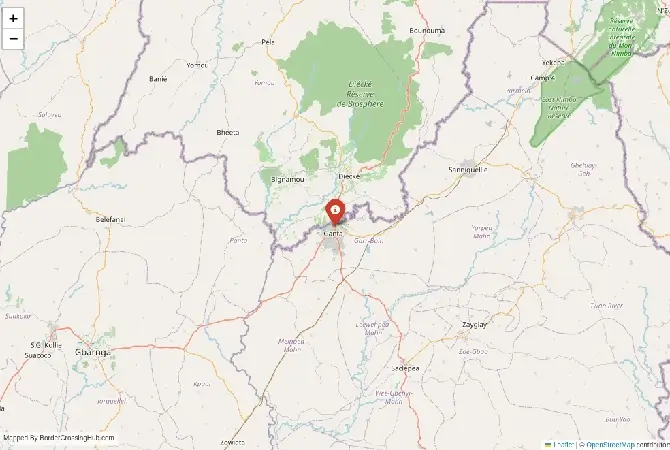
Monthly Update (September 2026):
Diecke and Ganta remains a regional Liberia-Guinea crossing with no significant September closure identified. It is much less important for international through traffic than the principal Guinea-Liberia corridor and remains dependent on local road and border infrastructure. Travelers using the route should allow extra time for the approach, particularly during the rainy season. There is no major new September restriction to report.
About this crossing
You will notice quickly that this is not an isolated crossing. Ganta is a busy commercial town, and that energy carries across the border into Diecke, creating a steady flow of people and goods.
Historical Context and Regional Links
The border here reflects long-standing connections between communities in Liberia and Guinea. Before modern borders were strictly enforced, movement across this المنطقة was common for trade, farming, and family ties.
Nearby Border Crossings



Ganta grew into a major trading hub in northeastern Liberia, partly due to its proximity to Guinea and Côte d’Ivoire. Diecke, while smaller, plays an important role as Guinea’s entry point into this corridor.
The legacy of regional conflicts in the 1990s and early 2000s also shaped the area, with crossings like this one becoming important for humanitarian access and movement.
Border Facilities and Infrastructure
Facilities at the Ganta–Diecke crossing are modest but functional. You will find immigration offices on both sides, along with basic customs areas.
Compared to more remote crossings, infrastructure here is slightly more developed, though still limited. Expect manual processing, paper records, and direct interaction with officials.
The layout is relatively straightforward, but signage is not always clear. You may need to ask for directions to complete each step of the process.
Operating Hours and Best Time to Cross
The border generally operates during daylight hours, with most activity taking place from morning to late afternoon.
Arriving early in the day is recommended. Traffic increases as traders and transport vehicles arrive, which can slow down the process later on.
Late crossings are not advisable, as staffing may be reduced and services limited.
Visa Requirements and Documentation
You should prepare all documents before reaching the border.
For Liberia, most travelers require a visa obtained in advance. Visa-on-arrival is not reliable at land crossings like Ganta.
For Guinea, a visa is also typically required in advance for most nationalities.
A yellow fever vaccination certificate is mandatory for both countries and is commonly checked.
Carrying printed copies of your documents is strongly recommended.
Crossing Procedure and Wait Times
The process follows the usual pattern: exit formalities on one side, then entry procedures on the other. The distance between offices is short and manageable.
Wait times are generally moderate. On a typical day, you might complete the crossing in 30 to 60 minutes. During busy periods, especially market days, delays can extend longer.
If you are traveling by shared transport, expect additional waiting time while all passengers are processed.
Trade Activity and Daily Movement
This crossing has a noticeable level of trade activity. You will see traders carrying goods, vehicles transporting supplies, and people moving between markets.
Unlike major freight corridors, traffic here is more focused on small to medium-scale commerce. This creates an active but not overwhelming environment.
The steady movement reflects the strong economic ties between Ganta and Diecke.
Road Conditions and Transport Links
Road access to this crossing is relatively good by regional standards. Ganta is connected to Liberia’s main road network, including routes leading toward Monrovia.
On the Guinean side, Diecke connects to regional roads that link to larger towns. Road quality can vary, but main routes are generally passable.
Public transport is available. Shared taxis and minibuses operate between towns and the border, making it accessible without private transport.
Seasonal and Weather Considerations
Weather can influence travel conditions, particularly during the rainy season. Heavy rains can affect road quality and slow traffic.
In the dry season, heat and dust are the main challenges. Waiting in queues without shade can be uncomfortable.
Planning your journey with seasonal conditions in mind can help reduce delays.
Scams & Warnings
As with many active crossings, you may encounter unofficial helpers offering assistance. These individuals often expect payment and are not necessary for completing the process.
You should follow official procedures and avoid paying for unnecessary services. If fees are requested, ask for receipts and clarification.
Another common issue is confusion about the process. With multiple steps, it is important to ensure you receive all required stamps before proceeding.
Local Atmosphere and Cross-Border Life
The Ganta–Diecke crossing reflects the daily interaction between Liberia and Guinea. You will see traders, families, and transport workers moving between the two countries.
Language can vary. English is widely spoken in Liberia, while French is common in Guinea. Local languages are also widely used.
The atmosphere is active but grounded in routine cross-border life.
Practical Tips for Travelers
You should keep your documents organized and easily accessible. Printed copies of visas and vaccination certificates are essential.
Carrying small denominations of local currency can help with legitimate fees and purchases. Food and water are available nearby, but having your own supplies is useful during delays.
Mobile network coverage is generally available but may vary near the border.
Final Thoughts
The Ganta–Diecke crossing is one of the more practical inland routes between Liberia and Guinea, supported by regional trade and accessible road connections.
Closing Note
You should approach this crossing with preparation and patience. It is active and functional, offering a reliable way to travel between the two countries with the right planning.
View all border crossings between Liberia and GuineaPractical information
Fuel
Liberia: <1 km - Guinea: <1 km
Currency
LRD,GNF exchangers
Safety information
Active, moderate checks
Connectivity
Highway,buses
Have you crossed here?
Help other travelers by sharing your experience, wait times, and any updates.