Monthly Update (September 2026):
Copacabana & Yunguyo remains a busy tourist route between Lake Titicaca's Bolivian and Peruvian sides, but there is no major new September restriction affecting travelers. The crossing is still a practical choice for visitors moving between Copacabana and Puno, with the main delays more likely to come from normal border processing than from any new disruption.
Driving there, or sending a driver? Send them this guide.
For reports and websites
Cite this page
Border Crossing Hub (2026). Copacabana & Yunguyo Border Crossing. Updated September 2026. https://bordercrossinghub.com/copacabana-yunguyo-border-crossing/<a href="https://bordercrossinghub.com/copacabana-yunguyo-border-crossing/">Copacabana & Yunguyo Border Crossing (Border Crossing Hub)</a>Put this crossing's card on your website
Free. It updates on its own when our information changes.
<iframe data-bch-card src="https://bordercrossinghub.com/copacabana-yunguyo-border-crossing/?bch_view=card" width="100%" height="980" scrolling="no" style="border:0;max-width:480px;display:block" loading="lazy" title="Copacabana & Yunguyo border crossing information"></iframe>
<p style="font-size:12px;margin:4px 0 0">Crossing information: <a href="https://bordercrossinghub.com/copacabana-yunguyo-border-crossing/">Border Crossing Hub</a></p>
<script src="https://bordercrossinghub.com/?bch_embed_js=1" async></script>Paste it where you want the card. The last line (a script) only adjusts the height and can be left out.
About this crossing
Operational Details
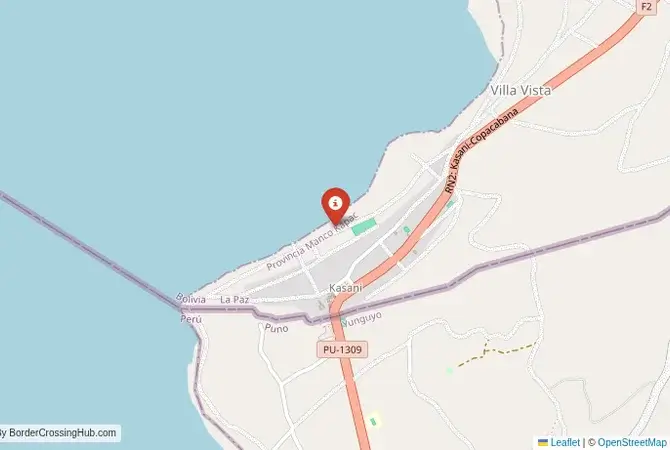
This checkpoint connects the La Paz Department of Bolivia with the Puno Department of Peru. It is a major international crossing, but it operates with limited hours, typically closing in the early evening. It is essential to check the current schedule before travel. The crossing is located a few kilometers outside the two towns, in a quiet, rural setting. The facilities are simple but functional. This is the most popular and direct route for tourists traveling on the classic "gringo trail" between La Paz, Copacabana, Puno, and Cusco.
A History of the Inca Heartland
The history of this region is the history of the great civilizations of the Altiplano. Lake Titicaca was the sacred birthplace of the Inca civilization. The Isla del Sol, just off the coast of Copacabana, is where the first Inca, Manco Cápac, is said to have been created by the sun god, Inti. The entire region is dotted with sacred sites (huacas). The modern border, established in the 19th century, divided the lake and the historic territory of the Aymara and Quechua peoples. The crossing at Copacabana-Yunguyo is a modern gateway that allows travelers to explore this unified cultural and historical landscape.
Nearby Border Crossings


Border Crossing Procedure
The border crossing procedure is a standard two-part process that is generally more relaxed and straightforward than at the busier Desaguadero crossing. You will first complete exit formalities at one country's immigration office. You then walk or drive a short distance through a "no man's land" to the other country's checkpoint for their entry inspection. You will need a valid passport. Visa requirements vary by nationality, and it is essential to check them in advance. The process is usually quite fast, but queues can form when several international buses arrive at the same time. A yellow fever vaccination certificate is required for entry into Bolivia at this high-altitude crossing.
The Surrounding Region: Bolivia Side
On the Bolivian side, the town of Copacabana is a major tourist destination and a pilgrimage site. It is famous for its magnificent 16th-century basilica, home to the statue of the Virgen de Copacabana, the patron saint of Bolivia. The town has a beautiful setting on the shores of the lake and is the main departure point for boat trips to the sacred Isla del Sol and Isla de la Luna, with their Inca ruins. The hike over the island is a classic backpacker experience. The town has a relaxed, bohemian atmosphere.
The Surrounding Region: Peru Side
On the Peruvian side, the town of Yunguyo is a smaller, quieter market town. It is the gateway to the magnificent Lake Titicaca region of Peru. The nearby city of Puno is the main tourist hub, the departure point for boat trips to the famous floating Uros islands and the traditional islands of Taquile and Amantaní, where visitors can experience the local culture through homestays. The road from the border also leads to the historic city of Cusco, the former capital of the Inca Empire, and the gateway to Machu Picchu.
Practical Travel Information
Practical planning is essential for this route. The most important factor is the limited operating hours of the border. The high altitude (over 3,800 meters) can cause altitude sickness (soroche). It is crucial to acclimatize properly. The official currencies are the Bolivian Boliviano (BOB) in Bolivia and the Peruvian Sol (PEN) in Peru. Currency exchange facilities are widely available. Many international buses ply this route, and they will wait for all passengers to complete the border formalities. This is the most convenient way to cross for most travelers.
Final Considerations
The Copacabana–Yunguyo border crossing is a journey through a landscape of sacred waters and ancient myths. It is a peaceful and stunningly beautiful gateway to some of the most important cultural and natural treasures in South America. The journey through it is a rite of passage for many travelers exploring the Andes. It is a border that is defined by the magnificent lake it serves, a passage that connects two charming towns and two parts of a shared, ancient world. It is a crossing that is as much a part of the adventure as the destinations themselves.
View all border crossings between Bolivia and PeruHeading to Copacabana & Yunguyo? Take this with you.
One page with the hours, waits, emergency numbers and coordinates. Works without signal.
Practical information
Fuel
Bolivia: <1 km - Peru: <1 km
Currency
Available near Yunguyo (PEN, BOB)
Safety information
Generally safe, lake hazards
Connectivity
Wi-Fi at checkpoints, 4G
Have you crossed here?
Help other travelers by sharing your experience, wait times, and any updates.