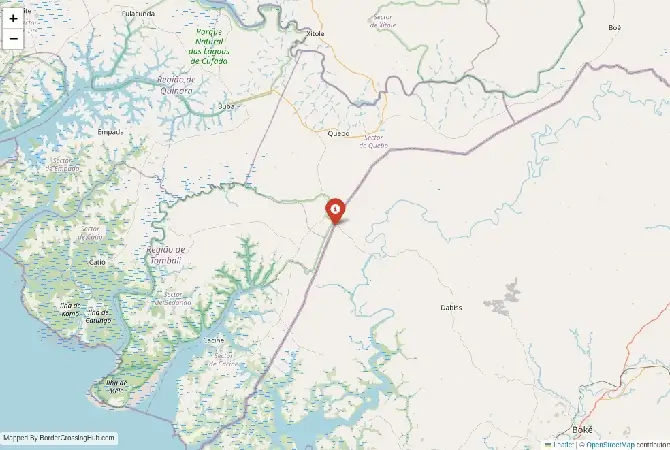
Monthly Update (September 2026):
Contabane & Guinea remains a collection of minor frontier routes rather than a conventional high-volume international border crossing. No significant September change has been identified. Travelers should not expect the facilities or predictable processing available at major regional ports, and the availability of individual rural crossing points can depend on local conditions. For an international journey, a recognized main crossing is generally the more predictable option.
About this crossing
You are not dealing with one structured checkpoint here. Instead, you are entering a zone where borders feel more like lines on a map than controlled entry points.
A Border Defined by Practice Rather Than Infrastructure
This stretch of the Guinea-Bissau and Guinea boundary reflects colonial history, but in practice, daily life has often ignored strict divisions. Portuguese and French administrations once governed each side, yet communities continued to trade, intermarry, and move freely across the region.
Nearby Border Crossings



Today, that legacy remains visible. Many locals cross regularly without formal procedures, particularly along smaller footpaths. For you as a foreign traveler, however, those same routes can present serious complications if used incorrectly.
Understanding the Nature of the Crossing
You should approach the Contabane area with caution from the outset. Not every path or track you encounter is an official border crossing. Some routes have limited oversight, while others may have occasional checkpoints staffed by local authorities.
This lack of consistency is what makes the area challenging. You might find a small office with immigration officers one day, only to encounter an unmanned crossing the next. Conditions depend heavily on local administration and resources.
If you are looking for a predictable and regulated crossing experience, this is not the place.
Official Procedures and What to Expect
If you manage to locate a recognized checkpoint near Contabane, the process will resemble other rural crossings in West Africa. You will need to exit Guinea-Bissau with a passport stamp before entering Guinea and completing entry formalities.
The difficulty lies in identifying where these steps actually take place. There is often no clear sequence or signage guiding you from one side to the other. You may need to ask multiple people for directions, and even then, answers can vary.
Wait times are unpredictable. On some occasions, you might complete the process in under 30 minutes. In other cases, delays can stretch much longer if officials are absent or processing is slow.
Visa Requirements and Documentation
You must have all required visas arranged in advance. Guinea requires visas for most foreign travelers, and this region is not suitable for obtaining one on arrival. Guinea-Bissau also has visa requirements that you should meet before arriving.
Carry multiple printed copies of your passport and visa. In areas with limited resources, officials may request copies for their records, and there are no facilities nearby to produce them.
Do not assume flexibility when it comes to documentation. Even in informal settings, missing paperwork can lead to delays or refusal of entry.
Road Conditions and Getting There
Reaching Contabane is not straightforward. Roads in eastern Guinea-Bissau are often unpaved and can vary greatly in condition. During the dry season, they are dusty but passable. In the rainy season, they can become muddy and difficult to navigate.
On the Guinea side, conditions are similar or slightly more challenging. Tracks may be narrow, uneven, and poorly maintained. Travel speeds are low, and journeys take longer than expected.
Transport options are extremely limited. Shared vehicles operate irregularly, and you may need to rely on local arrangements to continue your journey.
Safety Concerns You Should Take Seriously
This is not a crossing you should approach casually. The combination of remoteness, lack of clear authority, and inconsistent procedures creates a higher level of uncertainty than at established border posts.
Unofficial fees are a common issue. Individuals may present themselves as helpers or intermediaries and request payment for guiding you through the process. In some cases, even those appearing to be officials may ask for unclear charges.
You should remain polite but firm. Ask for explanations if any fee is requested, and avoid handing over money without understanding the reason.
Because of the isolation, assistance is limited if something goes wrong. You should ensure someone knows your route and expected timing before you attempt the crossing.
Seasonal Challenges and Timing
Weather has a strong influence on this region. During the rainy season, roads can become nearly impassable, and some crossing points may be temporarily unusable. Flooding and mud can add hours to your journey or force you to turn back.
The dry season offers better conditions, though heat and dust can still make travel uncomfortable. Border activity may slow during the hottest parts of the day.
Crossing early in the morning is often the best option. You are more likely to find officials present and avoid weather related disruptions.
Local Life and Cross Border Movement
The communities around Contabane rely heavily on agriculture and small scale trade. You will see fields of crops, livestock, and local markets where goods are exchanged across the border.
Languages spoken include Portuguese and Crioulo in Guinea-Bissau, French in Guinea, and a range of local languages on both sides. Communication can be a challenge if you do not speak any of these, so basic preparation helps.
Facilities are minimal. There are no reliable banking services, and access to food or supplies is limited. You should bring everything you need with you.
Economic and Cultural Significance
Even without formal infrastructure, this border zone plays an important role in local economies. Goods move informally between Guinea-Bissau and Guinea, supporting livelihoods on both sides.
Cultural ties remain strong. Families often have connections across the border, and traditions are shared despite the administrative divide.
For you, this means the atmosphere is less rigid but also less predictable.
Practical Advice Before You Go
Preparation is essential if you plan to cross here. Bring sufficient cash, organize your documents carefully, and allow extra time for delays. Do not rely on digital tools or services, as connectivity is limited.
It is wise to confirm in advance whether a particular crossing point near Contabane is recognized and staffed. Without this information, you risk arriving at a location where formal crossing is not possible.
Remain patient and adaptable. Situations can change quickly, and flexibility is key to avoiding frustration.
Closing Thoughts
The Contabane area offers a glimpse into a form of border crossing shaped more by local practice than formal systems. You will encounter minimal infrastructure, uncertain procedures, and a need for careful planning. While it can be an interesting route for experienced overland travelers, it is not the most reliable option. Choosing a more established crossing is often the safer and more predictable alternative.
View all border crossings between Guinea-Bissau and GuineaPractical information
Currency
GNF,XOF informal
Safety information
Rural, low oversight
Connectivity
Limited cellular coverage
Have you crossed here?
Help other travelers by sharing your experience, wait times, and any updates.