
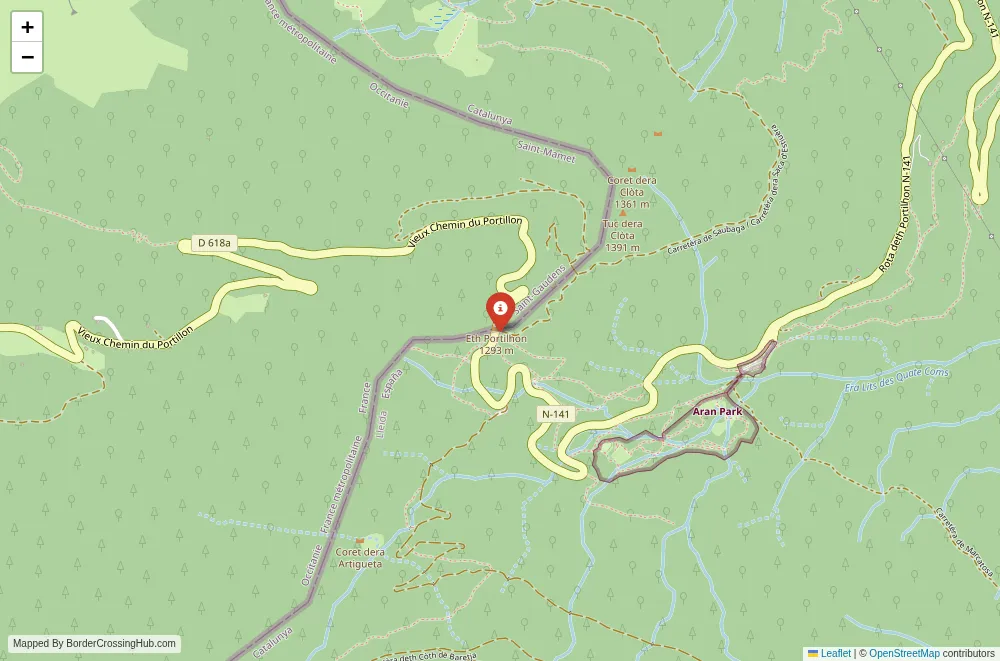
Approximate Border Location
Wait Times
Cars 0-10m; peaks 20-60m summer
Just crossed? Tap to report:
Operating Hours
Open 24 hrs; weather closures possible
Crossing Types
Cars,motos,bikes; narrow mountain road
Border Type
Land crossing via mountain road
Peak Times
Sat-Sun 09:00 AM-05:00 PM; Jul-Aug
Daily Crossings
800-4,000/day
Currency Exchange
EUR only; ATMs in Luchon/Vielha
Safety Information
Steep curves; occasional restrictions/controls
Languages Spoken
French/Spanish
Accessibility Features
Limited; narrow shoulders, few ramps
About Col du Portillon & Portillon
The Col du Portillon border crossing climbs to 1293 meters in the central Pyrenees, marking a narrow mountain pass that directly connects Bagnères-de-Luchon in France’s Haute-Garonne department to Bossòst in Spain’s Val d’Aran (Lleida province, Catalonia).
Location and Basic Connections
You approach this pass along the D618A road (French side) from Bagnères-de-Luchon or the N-141 (Spanish side) from Bossòst. The summit sits in a forested clearing with the border line running right through it, often marked by a small brick pillar or stones carved with F (France) and E (España). The route links the French Pyrenees to the Val d’Aran, offering a quieter alternative to larger crossings like Somport or Bielsa tunnel. Buses from Luchon reach the valley base, but the final steep section requires private vehicles or bikes. Cyclists and drivers use it for scenic transits between southern France and northern Catalonia.
Alternative Names
This point is known as Col du Portillon, Coll de Portilló (Catalan), Port d’eth Portilhon (Aranese), or Paso del Portillón.
Historical Background
The pass follows ancient shepherd trails across the Pyrenees, formalized as a border route after the 1659 Treaty of the Pyrenees reshaped much of the frontier. It gained cycling fame through appearances in the Tour de France (stage finishes or crossings). The road saw upgrades over decades, but remains narrow and winding. During the Spanish Civil War, similar Pyrenean passes served as refugee routes, though Portillon stayed peripheral. Today, the summit holds remnants of old border posts amid forest.
Geopolitical Significance
As a Schengen internal border, the pass has no permanent controls; France and Spain allow free movement for most travelers. France’s temporary internal Schengen checks (extended to April 30, 2026, for security reasons like terrorism and migration) apply sporadically across borders, but quiet secondary points like Portillon see rare patrols. No major disruptions or closures reported in early 2026 beyond typical winter weather. It supports local tourism, cross-border commuting, and occasional freight in this low-population valley.
Practical Crossing Procedures
You drive or cycle straight over without stopping. The border is unmarked beyond summit signs or rocks; no booths exist. Spot checks by police or customs may happen (ID, vehicle docs, goods inspection), but they’re uncommon here. Most nationalities cross freely in Schengen (90 days visa-free short stay). Carry your passport or ID for any verification. Vehicles need registration and insurance. Customs limits apply for alcohol, tobacco, or other items; declare if over duty-free. No pedestrian or bike bans, though the road is narrow and winding.
Typical Wait Times and Operating Hours
The pass operates 24/7 when open, with no queues or formal hours. Random checks last minutes if they occur. Winter weather causes short closures from snow or avalanches, but the low elevation keeps it open more often than higher cols.
Transportation Options
Private cars or motorcycles dominate due to the steep, remote climb. No direct public buses cross routinely; reach Luchon (France) or Vielha/Bossòst (Spain) by regional services, then drive or taxi up. Cycling is popular for the challenging ascent. The route suits independent travelers or those linking French spa towns to Catalan valleys.
Road Conditions and Scenery
Both sides feature tight switchbacks, steep gradients (average 6-7%, with sharper pitches), and narrow lanes through dense forest. The French ascent from Luchon is more consistent and challenging; the Spanish descent to Bossòst feels faster. Scenery includes shaded woods, mountain streams, and open summit views of surrounding peaks. Winter requires chains; summer brings clear roads but potential rockfall or heat.
Scams and Warnings
Remote mountain passes like this attract few scams, but narrow roads demand caution with oncoming traffic. Poor weather strands drivers; carry supplies and check forecasts. Random ID checks may occur; cooperate. The area has low crime, but altitude and curves pose driving risks. No major issues reported for visitors.
Nearby Attractions
Bagnères-de-Luchon offers thermal spas, casinos, and Pyrenean trails. Bossòst provides Val d’Aran charm with Romanesque churches and river walks. Nearby Mont Perdu (Monte Perdido) massif and Ordesa National Park lie accessible for hiking. The pass suits cyclists chasing Tour de France cols or drivers seeking quiet Pyrenean scenery.
Seasonal Variations and Delays
Winter risks snow, ice, and short avalanche closures; chains often required. Summer delivers reliable access and peak cycling traffic. No major seasonal shutdowns beyond weather.
Cultural and Economic Role
The pass sustains ties between Luchon and Val d’Aran, boosting tourism and local trade. It mixes Occitan, Catalan, and Aranese influences in food, festivals, and mountain life.
Final Planning Notes
Carry ID, check weather/road status via local sources or apps, and prepare for steep, narrow driving. This fits adventurous drivers or cyclists exploring the Pyrenees.
Tackling This Pyrenean Summit Pass
Col du Portillon offers a straightforward, scenic border hop at a low-key Pyrenean col, where forest roads cross from France to Spain with minimal fuss. With weather awareness and standard prep, you enjoy this quiet frontier link in the mountains.
No reviews yet.