
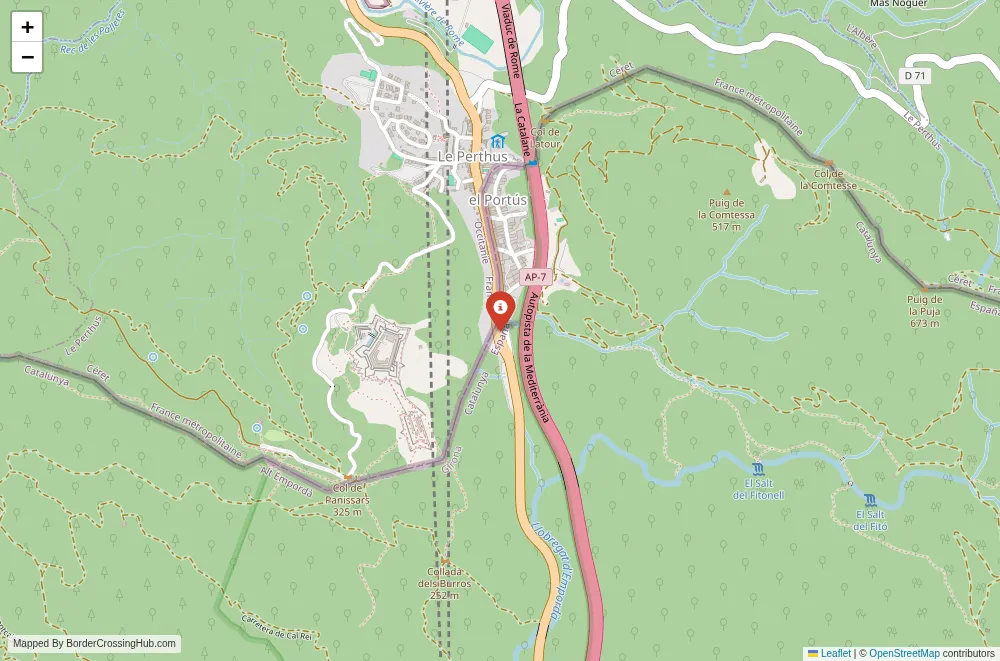
Approximate Border Location
Wait Times
Cars 0-20m; peaks 30-90m holiday traffic
Just crossed? Tap to report:
Operating Hours
Open 24 hrs (12:00 AM-11:59 PM)
Crossing Types
Ped,cars,buses; no routine controls
Border Type
Land crossing via motorway
Peak Times
Fri-Sun 10:00 AM-06:00 PM; summer
Daily Crossings
15,000-60,000/day
Currency Exchange
EUR only; ATMs/FX in town
Safety Information
Traffic jams; occasional police checks
Languages Spoken
French/Spanish
Accessibility Features
Good sidewalks; accessible shops/services
About Col du Perthus & Le Perthus
The Col du Perthus Le Perthus border crossing slices through the eastern Pyrenees at a low altitude of around 283 meters, serving as the busiest and most direct road link between France’s Pyrénées-Orientales department and Spain’s Catalonia region, right in the heart of the divided town of Le Perthus El Pertús.
Location and Basic Connections
You arrive at this crossing along the A9 motorway from France (becoming the AP-7 in Spain) or the parallel N9 national road, with the border running straight through the main street of Le Perthus. The French town merges seamlessly with the Spanish side called Els Límits, about 20 km south of Perpignan and 10 km north of La Jonquera. High-speed traffic flows freely on the autoroute, while the old N9 road passes through the commercial heart of town. Trains use the nearby Perthus Tunnel for high-speed rail between Perpignan and Figueres. Buses from Perpignan or Girona stop nearby, and parking fills quickly around shopping areas.
Alternative Names
This point is called Col du Perthus, Le Perthus border, Paso del Pertús, or the La Jonquera Le Perthus crossing.
Historical Background
The pass has marked the Franco-Spanish frontier since the Treaty of the Pyrenees in 1659, which redrew much of the boundary after decades of war. Le Perthus grew around this strategic route, with the border bizarrely splitting the main street: one side French, the other Spanish, based on an old agreement placing sovereignty along the road’s right-hand pavement. Vauban built the imposing Fort de Bellegarde nearby in the 17th century to guard the pass. During the Spanish Civil War’s Retirada in 1939, hundreds of thousands of Republican refugees poured through here into France. The modern A9 autoroute and Perthus rail tunnel (opened 2010) turned it into a major transport artery.
Geopolitical Significance
As part of the Schengen Area, France and Spain maintain no routine passport checks at Le Perthus for EU citizens or most visitors. The crossing handles massive daily flows of vehicles, shoppers, and freight, making it a key economic conduit between the two countries. Occasional spot checks occur for security, migration, or smuggling, especially after events like terrorist attacks or migration surges. Temporary controls have appeared in past years, but in early 2026 the border operates openly with minimal disruptions reported on the main routes. Rail freight through the Perthus Tunnel faced brief interruptions from nearby incidents, but road traffic stays steady.
Practical Crossing Procedures
You drive straight through on the A9/AP-7 without stopping in normal conditions. No permanent booths block the autoroute, though random police or customs patrols may pull vehicles over for checks. On the N9 old road, the border is marked by stone pillars in the town center, and you may notice different signage or languages shifting. Most nationalities cross freely within Schengen (up to 90 days visa-free for short stays). Carry your passport or ID at all times, as spot checks happen. Vehicles need standard documents like registration and insurance. Customs rules apply for goods over duty-free limits, especially alcohol or tobacco from Spanish shops.
Typical Wait Times and Operating Hours
The crossing runs 24/7 on the motorway with no fixed hours or queues in routine flow; cars move at highway speeds. Random checks rarely exceed a few minutes unless something flags suspicion. The old N9 road through town sees no formal waits but traffic jams from shoppers during peak hours or weekends. Occasional patrols add brief delays, but nothing like pre-Schengen eras.
Transportation Options
The A9/AP-7 motorway offers the fastest route, with frequent services between Perpignan, Barcelona, and beyond. Trains via the Perthus Tunnel connect Perpignan to Girona or Barcelona. Local buses serve the town from both sides. Taxis or rideshares work for short hops, though parking fills fast around commercial zones. Walking through town lets you experience the split-border oddity firsthand.
Road Conditions and Scenery
The A9/AP-7 stays modern, multi-lane, and well-maintained with mountain views transitioning to coastal plains. The old N9 winds through the town with shops on both sides, offering glimpses of the Pyrenees foothills. Scenery mixes rugged hills, vineyards, and Mediterranean scrub, with the Fort de Bellegarde looming above.
Scams and Warnings
The heavy shopping focus attracts pickpockets in crowded stores or parking areas; keep valuables secure. Currency changers or touts may offer poor rates; use banks or ATMs. Some report minor overcharges in border shops. The area has low violent crime against tourists, but stay alert amid crowds. Random police checks occur; cooperate fully. No major safety issues stand out beyond typical tourist-zone theft risks.
Nearby Attractions
Le Perthus itself revolves around duty-free shops selling alcohol, tobacco, perfumes, and Spanish goods. Fort de Bellegarde offers tours with panoramic views (seasonal openings). Nearby, the Albères hills provide hiking, while Perpignan features Catalan history and markets. On the Spanish side, La Jonquera has basic services, and farther south lies Figueres with the Dalí Theatre-Museum.
Seasonal Variations and Delays
Summer brings heavy traffic from tourists and shoppers, with occasional slowdowns on the N9. Winter sees lighter flow but potential wind or rare snow on higher approaches. Holiday periods spike congestion in commercial zones. Weather rarely closes the main motorway.
Cultural and Economic Role
The divided town thrives on cross-border shopping, blending French and Spanish influences in daily life. Duty-free commerce drives the economy, with locals and visitors exploiting price differences. It exemplifies practical Schengen integration in a historic frontier setting.
Final Planning Notes
Carry ID always for potential checks, and watch limits on duty-free goods. Use the motorway for speed or the old road for the quirky town experience. This suits drivers or shoppers heading between southern France and northern Spain.
Crossing This Pyrenees Low Pass
Col du Perthus Le Perthus gives you an effortless Schengen border hop through a uniquely split town, where history meets modern commerce. With basic awareness of ID rules and crowds, you pass through smoothly on one of Europe’s most used frontier roads.
No reviews yet.