
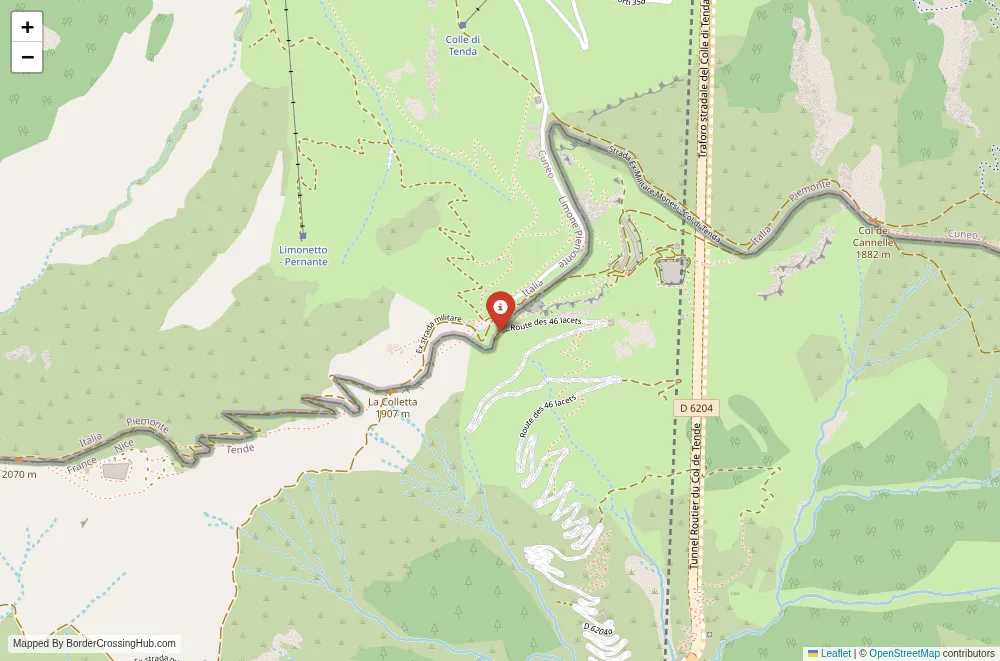
Approximate Border Location
Wait Times
Cars 10-40m; peaks 60-240m works
Just crossed? Tap to report:
Operating Hours
Restricted: variable 06:00 AM-10:00 PM
Crossing Types
Cars only; tunnel/works limit; no trucks often
Border Type
Land crossing via mountain road tunnel
Peak Times
07:00-09:00 AM; 04:00-08:00 PM
Daily Crossings
1,000-6,000/day
Currency Exchange
EUR only; ATMs in Tende/Limone
Safety Information
Work zones + closures; check schedules
Languages Spoken
French/Italian
Accessibility Features
Paved areas; access varies during works
About Col de Tende & Colle di Tenda
Col de Tende connects France to Italy through one of the oldest Alpine passes in the Maritime Alps, where the border runs along a high mountain road linking the French town of Tende to the Italian village of Limone Piemonte.
Location and Basic Connections
You reach this crossing where the French commune of Tende in Alpes-Maritimes meets Limone Piemonte in the province of Cuneo, Piedmont. It sits at 1870 meters elevation along the D6204 (French) continuing as the SS20 (Italian), one of the main routes between the French Riviera and Italian Piedmont. Foreign visitors cross here when traveling from Nice or Ventimiglia in France toward Cuneo, Turin, or the Italian ski resorts, or the reverse for French Alpine villages and the Mercantour National Park. Alternative names include the Col de Tende border, Colle di Tenda, or Tende Pass crossing. As a Schengen internal point, it normally allows free movement with no fixed booths, but temporary controls remain active on the French side as of February 10 2026.
Historical Background and Geopolitical Role
The pass has served as a strategic route since Roman times, part of the Via Julia Augusta linking the coast to the Po Valley. It gained importance in the Middle Ages for trade and military movements between Provence and Piedmont. The border was formalized in the 1860 Treaty of Turin after the unification of Italy, placing the pass under French control. During World War II, it saw fighting between Italian and French forces in 1940 and later Allied advances in 1944-45, with heavy damage to the road and nearby tunnels. The current road tunnel (opened 1882, expanded in the 20th century) bypasses the summit but remains closed to heavy vehicles at times, forcing use of the old pass road. Post-Schengen since 1995, the crossing has facilitated tourism between the French Riviera and Italian Alps, though periodic temporary controls have returned due to migration and security issues.
Current Status and Safety Considerations
France maintains temporary internal border controls with Italy until at least April 30 2026, citing persistent terrorism risks, irregular migration pressures along Mediterranean routes, organized smuggling networks, and public order concerns. Italy conducts targeted internal checks on Alpine routes until July 31 2026, focusing on migration and security. At this high-altitude pass, controls consist of random police stops on the French side, often on the descent from the summit or near Tende, rather than fixed booths. Travelers report occasional vehicle checks or ID requests, particularly during peak migration seasons or after security alerts, with waits rarely exceeding 30 minutes. The area has low crime typical of remote mountain passes, with no widespread scams or aggressive touts. Carry your passport or national ID at all times, especially in winter when weather can complicate travel.
Operating Hours and Wait Times
The pass road and tunnel operate 24 hours with no routine barriers under Schengen conditions. Temporary controls introduce variability: most vehicles pass without stop, while a random check adds 5 to 30 minutes for document verification or questions. The crossing sees moderate tourist and local traffic, with potential delays during summer holidays, winter ski seasons, or targeted operations. The tunnel closes periodically for maintenance or avalanche risk (usually announced in advance), forcing use of the old summit road which can be slower and weather-dependent. Winter snow or ice often requires chains, and summer thunderstorms can reduce visibility.
Visa Requirements for Foreign Visitors
Schengen rules apply: EU/EEA/Swiss citizens travel freely with valid ID or passport. Non-EU nationals qualify for visa exemptions up to 90 days in any 180-day period if eligible, or hold a Schengen visa. The Entry/Exit System registers non-EU travelers at external borders but not routinely at internal points like this; spot checks may verify your status or documents. Present your passport during any control, plus proof of accommodation, funds, or onward travel if requested. No fees occur at this crossing.
Crossing Procedures Step by Step
You approach on the D6204 from Tende or SS20 from Limone Piemonte, climbing to the pass summit where the border lies near the tunnel entrances and old road. Normally, drive straight across as the Alpine scenery continues and signs switch languages. If French police conduct a control, expect a roadside pull-over near the summit or descent for ID presentation and basic travel questions. Provide documents promptly; the process ends quickly amid mountain traffic. Pedestrians and cyclists have limited options due to the pass road’s steepness and traffic, often using parallel trails if available. The transition feels abrupt yet scenic, with immediate access to ski areas or valley descents on both sides.
Transportation Options and Road Details
No direct public transport crosses the pass: regional buses reach Tende from Nice or Breil-sur-Roya on the French side, and Limone Piemonte from Cuneo on the Italian side. Driving uses the winding D6204/SS20, paved but steep with hairpin turns, passing through tunnels, forests, and alpine meadows. Scenery includes dramatic peaks, snowfields in winter, wildflowers in summer, and distant Mediterranean glimpses on clear days. Traffic stays moderate outside peak seasons. Cycling challenges fit riders on the steep ascent, with rewarding descents. Winter requires chains or snow tires.
Nearby Attractions and Practical Tips
Tende offers a medieval old town, the Tende Fort, and access to Mercantour National Park. Limone Piemonte provides ski resorts and Italian Alpine trails. Carry ID due to controls. Euros work on both sides; cards accepted widely. Pack layers for high-altitude weather, chains in winter, and water for remote stretches. Check tunnel status and weather forecasts seasonally. Cross in daylight for safer mountain driving and views.
Cultural and Economic Significance
The crossing sustains cross-border tourism in this Maritime Alps region, where visitors enjoy seamless access to French and Italian ski areas, hiking, and historic sites. Shared Alpine heritage appears in local cuisine, traditions, and mountain culture. It supports local economies through winter sports and summer nature tourism, exemplifying Schengen’s high-altitude integration amid temporary security measures.
Final Planning Notes
Check official EU or national sources for updates on temporary controls, tunnel status, and road conditions before travel, keep ID ready, and allow extra time for weather or random checks. This scenic Alpine pass route offers a dramatic border passage between France and Italy when you stay prepared.
No reviews yet.