
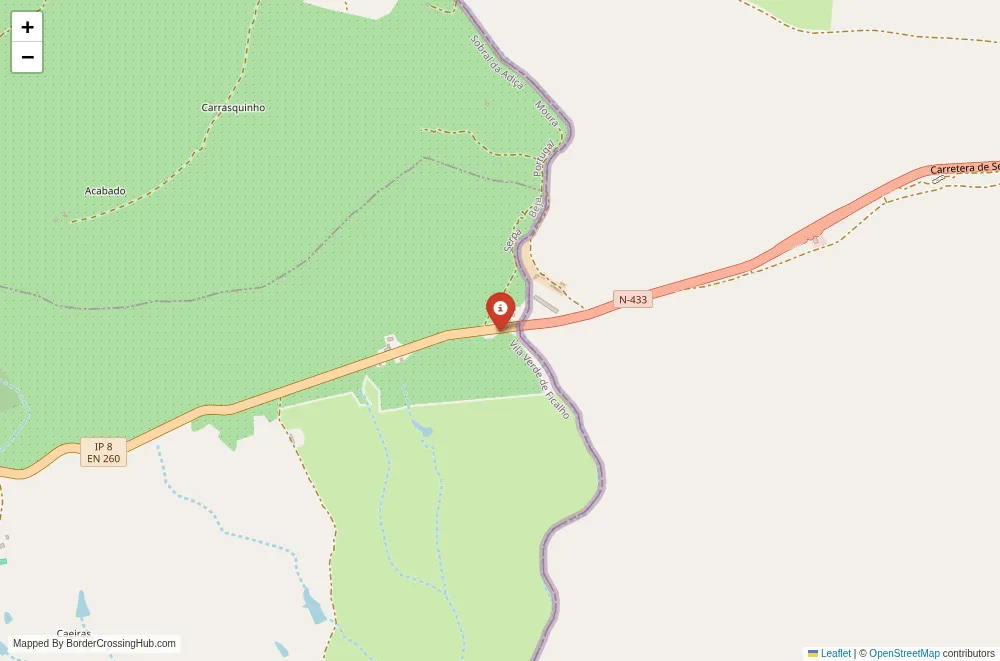
Approximate Border Location
Wait Times
Cars 0-10m; peaks 15-60m weekends
Just crossed? Tap to report:
Operating Hours
Open 24 hrs (12:00 AM-11:59 PM)
Crossing Types
Ped,cars,buses; local road
Border Type
Land crossing via road (regional)
Peak Times
11:00 AM-04:00 PM; summer
Daily Crossings
1,500-6,000/day
Currency Exchange
EUR only; ATMs in Serpa/Aracena area
Safety Information
Low risk; occasional police checks
Languages Spoken
Spanish/Portuguese
Accessibility Features
Step-free sidewalks in villages
About Castro Marim & Ayamonte
Monthly Update (March 2026):
As of 03/2026, the Castro Marim & Ayamonte Border Crossing stays moderately busy but steady. Cars travel across the Guadiana River bridge with small slowdowns heading into Spain during weekend travel. Mornings usually move quicker before tourist traffic builds. Coastal tourism and holiday travel shape most of the activity here.
No Cell Service at the Border? No Problem.
Don’t get caught scrambling for paperwork when you lose signal. Download the complete Europe Transit Guide directly to your device and access every critical detail, fast-track strategy, and border rule – 100% offline.
The Guadiana International Bridge carries you over the wide mouth of the Guadiana River on a graceful cable-stayed span, linking Castro Marim in Portugal’s eastern Algarve directly to Ayamonte in Spain’s Huelva province.
Alternative Names
This crossing is widely known as the Guadiana International Bridge, Ponte Internacional do Guadiana (Portuguese), Puente Internacional del Guadiana (Spanish), the Castro Marim-Ayamonte border, or simply the Ayamonte-Castro Marim bridge.
Current Status
Portugal and Spain share full Schengen membership, so the border remains open with no permanent passport or vehicle checks. You drive across the bridge without stopping under normal conditions. Random spot checks by Portuguese GNR or Spanish Guardia Civil can occur (often aimed at commercial vehicles or specific security concerns), but they are infrequent and rarely affect private cars or tourists. A cooperation center at the former bilateral police station on the bridge supports joint policing and information exchange between both countries. The bridge handles steady local, tourist, and some freight traffic without major disruptions reported in 2026.
Historical Background
The Guadiana River has divided Portugal and Spain here since medieval times, with the frontier line established by early treaties. The current cable-stayed bridge opened on August 22, 1991, replacing older ferry services and providing a modern link for the A22 motorway (Portugal) and A-49 (Spain). It became the third-longest bridge in Portugal at 666 meters, with a main span of 324 meters. The area around Castro Marim carries a long history of defense: the town’s hilltop castle and star-shaped walls were built to guard against Spanish incursions, while Ayamonte served as a key river port.
Geopolitical and Economic Role
This is the southernmost land crossing between Portugal and Spain and a vital artery for the eastern Algarve and western Andalusia. It supports daily cross-border routines: Portuguese residents often head to Ayamonte for shopping (cheaper fuel, groceries, tobacco), while Spaniards cross for Algarve beaches, seafood restaurants, or Portuguese products. Tourism flows heavily in both directions, especially during summer. Freight uses the bridge alongside larger motorways, and the route connects the Algarve to Huelva, Seville, and beyond.
Visa Requirements for Foreign Visitors
Schengen rules apply equally to Portugal and Spain. If your nationality qualifies for visa-free entry, you cross with just a valid passport or national ID. Most non-EU visitors receive 90 days in any 180-day period across the area. Carry your travel document at all times, though checks are very rare on this bridge for private travelers.
Crossing Procedures Step by Step
By car or motorbike, follow the A22 motorway (Portugal) from Faro or Vila Real de Santo António toward Castro Marim. You reach the bridge toll plaza (if toll applies on the Portuguese side after crossing), drive across the 666-meter span with no stop, and continue onto the A-49 in Spain toward Ayamonte. Pedestrians and cyclists can use the bridge sidewalk (narrow but available); the walk takes about 10-15 minutes. No immigration booths, forms, or queues exist routinely. The reverse direction follows the same seamless process.
Typical Wait Times and Peak Periods
Most crossings take seconds by car and a few minutes on foot. Delays only build during peak summer holidays, weekends, or major events when Algarve tourism spikes. Even then waits rarely exceed 10-20 minutes unless there is an accident or police operation. The bridge moves smoothly outside high season.
Operating Hours
The bridge operates 24 hours a day, every day of the year, as a public motorway link.
Transportation Options to and From the Border
Drive the A22 from Faro (about 45 minutes) or Tavira to Castro Marim, then cross. On the Spanish side, the A-49 connects Ayamonte to Huelva or Seville. Regional buses serve Vila Real de Santo António (Portugal) and Ayamonte (Spain), but direct cross-border services are limited; many walk or take a short taxi between the towns. A small ferry also runs between Ayamonte and Vila Real de Santo António (on the Portuguese side of the river mouth) for foot passengers, complementing the bridge. Cycling works well on regional paths.
Road Conditions and Scenery
The A22 and A-49 are modern motorways with good surfaces and multiple lanes. The bridge itself is wide enough for traffic but narrow for pedestrians. Views are spectacular: the wide Guadiana estuary, salt marshes, flamingos in the nearby nature reserve, distant hills, and the contrasting skylines of Castro Marim’s fortress and Ayamonte’s riverfront.
Seasonal Variations and Weather Impacts
Summer sees the heaviest traffic from tourists and brings hot, sunny conditions. Winter rain or fog can reduce visibility on the bridge, but closures are rare. Strong winds occasionally affect larger vehicles. The route stays open year-round.
Nearby Attractions
Castro Marim features its impressive hilltop castle with panoramic views, the Reserva Natural do Sapal (marshland with birdwatching), and a quiet historic center. Ayamonte offers a charming old town, riverside promenade, fresh seafood restaurants, and ferry access to Isla Canela beaches. The nearby Reserva Natural do Sapal de Castro Marim e Vila Real de Santo António provides trails and flamingo sightings. Both sides suit short walks, photography, and tasting local specialties (Portuguese cataplana or Spanish jamón).
Common Scams and Warnings
Serious scams remain rare at this straightforward crossing. Some travelers report occasional overcharging at roadside shops or fuel stations near the bridge, or pushy vendors in busier areas. Parking can become chaotic in peak season. Keep valuables secure when stopping or walking, and avoid leaving items visible in cars. Normal driving caution applies on the bridge due to occasional wind.
Travel Tips and Preparation
Carry euros (both countries use them), passport/ID, and vehicle papers. Check toll status on the Portuguese side (sometimes free for short crossings). Bring a camera for the bridge views. If walking, note the narrow sidewalk and summer heat. Combine the crossing with a meal in Ayamonte and a visit to Castro Marim castle for a perfect day trip.
Cultural and Economic Significance
The bridge sustains strong ties between eastern Algarve and Huelva province, with shared river heritage, seafood traditions, and cross-border shopping habits. Daily movement keeps local economies linked in this scenic coastal frontier zone.
Final Planning Advice
Check summer traffic if heading during holidays. Bring your documents, drive or walk the bridge for the estuary views, and explore both towns. This elegant crossing delivers one of the most scenic and relaxed ways to hop between Portugal and Spain. Safe travels.
No reviews yet.