Monthly Update (September 2026):
Bum La Pass & Tsona County / Tibet remains a highly restricted India–China border area rather than a normal tourist crossing. There is no new September development indicating that the pass has opened to ordinary international travelers, so independent overland travel through Bum La remains impractical.
About this crossing
Location and Connections
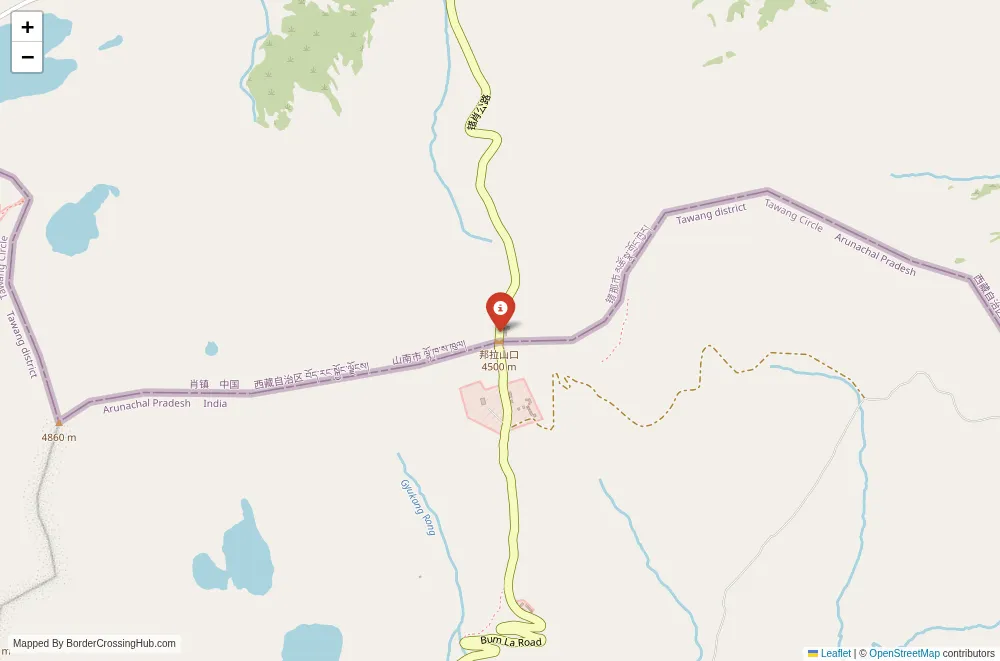
The pass lies along the McMahon Line, the de facto boundary in this sector, roughly 37 kilometers north of Tawang town in Arunachal Pradesh. From Tawang, the approach follows a winding, high-altitude road built and maintained by the Border Roads Organisation (BRO), passing through Sela Pass (at 4,170 meters) and Nuranang before reaching the Bum La post. On the Chinese side, it connects to Tsona (Cona) County, with roads leading toward Lhasa or other parts of southern Tibet. The terrain consists of stark, windswept plateaus, glacial lakes, and rocky ridges typical of the eastern Himalayas. No civilian trade infrastructure exists; the area features military outposts, observation posts, and basic shelters on both sides. No rail or air links serve directly; access depends on road travel under heavy security oversight.
Historical and Geopolitical Background
Bum La has long held strategic importance due to its position along one of the shortest routes from Tibet into Arunachal Pradesh. The pass gained notoriety during the 1962 Sino-Indian War, when Chinese forces advanced through it, capturing Tawang before withdrawing. Post-war, it remained a flashpoint, with both sides establishing forward posts and conducting regular flag meetings to manage incidents. The pass saw symbolic importance in 2006 when the first formal flag meeting occurred after decades, and it hosted several subsequent meetings to discuss troop disengagements or confidence-building measures. In recent years, tensions flared with the 2020 Galwan Valley clash elsewhere along the LAC, prompting India to accelerate infrastructure like all-weather roads and tunnels (including the Sela Tunnel opened in 2024). China has built extensive facilities opposite Bum La, including villages and roads under its border consolidation program. Despite periodic standoffs, the pass hosts biannual flag meetings and remains a venue for de-escalation talks. Fun fact: Bum La is home to a small Buddhist shrine maintained by Indian troops, where prayers are offered for peace, reflecting the spiritual dimension of this militarized frontier.
Nearby Border Crossings




Current Status and Operating Hours
As of early 2026, Bum La Pass remains closed to civilian traffic and foreign visitors. Access is restricted to Indian military personnel, authorized officials, and very limited groups with special permits from the Indian Army or Ministry of Home Affairs. No trade or tourism occurs here; the crossing functions only for official flag meetings (typically held twice a year) and emergency communications. The pass operates seasonally, open from June through October when snowmelt allows road access, with daytime hours only (roughly 9:00 a.m. to 4:00 p.m. local time) due to extreme cold and wind. Winter snow closes the route completely, often from November to May. High-altitude weather brings blizzards, sub-zero temperatures even in summer, and sudden storms. Security remains tight, with both sides maintaining forward deployments and surveillance. Monitor updates through Indian Army statements, MEA advisories, or local Tawang administration, as LAC tensions or bilateral talks can alter access protocols.
Crossing Procedures Step by Step
No public crossing procedures exist due to the military-only status. Flag meetings follow a strict protocol: Indian and Chinese delegations meet at a designated point near the pass, exchange greetings, discuss issues (patrols, incidents, or de-escalation), and return without crossing. Civilians or unauthorized personnel attempting approach face immediate interception by Indian forces. For rare permitted visits (such as official tours or media under escort), Indian side clearance involves multiple layers of verification (Aadhaar, permits, security briefing), followed by escorted movement to the post. Chinese side maintains similar controls. Wait times for meetings are minimal, but any civilian presence requires days of prior approval.
Visa Requirements for Foreign Visitors
The pass offers no entry for foreigners or civilians. Arunachal Pradesh requires a Protected Area Permit (PAP) or Inner Line Permit (ILP) for Indian citizens from certain states and restricted access for foreigners. Even with permits, Bum La remains off-limits to tourists. Chinese side requires specific visas and approvals for any Tibet entry. No visa-on-arrival or independent crossing possible. Verify via MEA or Indian Home Ministry, as the area falls under strict restricted zone rules.
Transportation Options and Road Details
From Tezpur or Guwahati, fly to Tawang's planned advanced landing ground or drive via Bhalukpong and Bomdila (12-14 hours to Tawang). From Tawang, army or BRO vehicles or escorted jeeps reach Bum La (3-4 hours on high-altitude roads with steep drops, switchbacks, and snow risks). No public transport; movement requires military escort or special permission. Roads stay challenging: narrow, prone to landslides, and closed in winter. Acclimatization mandatory to avoid altitude sickness.
Scams & Warnings
No scams occur due to restricted access, but unauthorized attempts to approach lead to detention or fines. High altitude risks acute mountain sickness; carry oxygen and medications. Geopolitical tensions along the LAC require extreme caution; stray incidents or standoffs possible. Governments advise against travel near the border without authorization. Monitor news for escalations; register with authorities if permitted.
Nearby Attractions and Practical Tips
Tawang offers the famous Tawang Monastery, Madhuri Lake, and Sela Pass views. Bum La itself provides panoramic Himalayan vistas under escort. Carry warm clothing, medications, water, snacks, and power banks; facilities minimal. Follow military guidelines strictly if permitted.
Final Notes for Planning
Bum La Pass remains a military-controlled frontier with no civilian crossing. Access is limited to authorized personnel; tourism or trade opportunities do not exist here. Monitor official channels for any changes, prioritize safety, and explore Tawang's accessible sites instead. Safe travels.
View all border crossings between India and ChinaPractical information
Currency
INR; CNY not at pass; cash in Tawang
Safety information
High-altitude; strict controls
Connectivity
No Wi-Fi; limited/no cellular signal
Have you crossed here?
Help other travelers by sharing your experience, wait times, and any updates.