
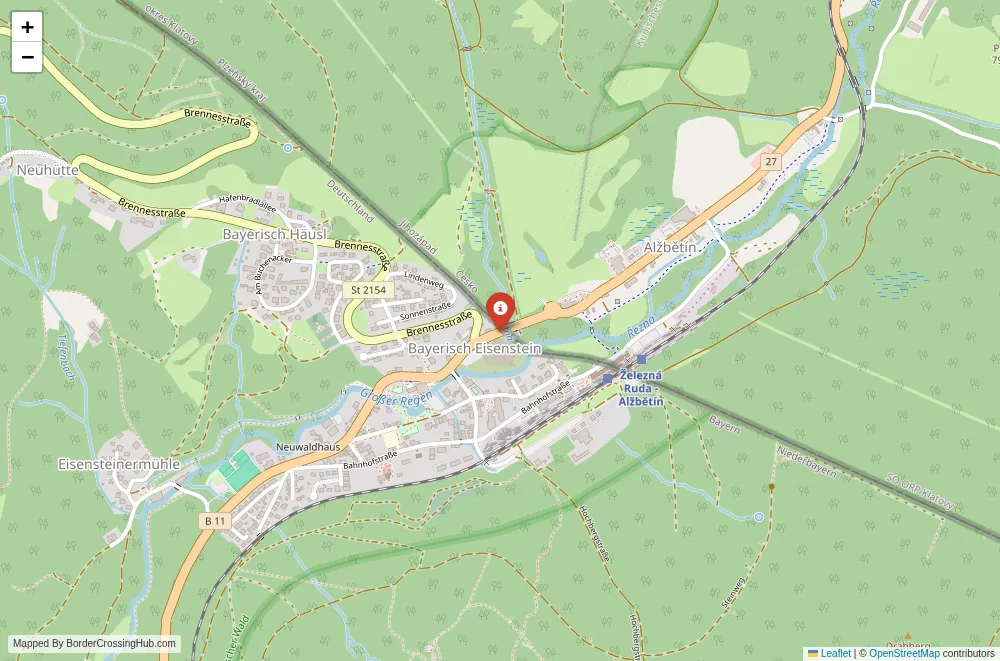
Approximate Border Location
Border Countries
Border Cities
- 🇩🇪Bayerisch Eisenstein
- 🇨🇿Železná Ruda
Wait Times
Train 0-15m; cars 0-10m; peaks 20-60m
Just crossed? Tap to report:
Operating Hours
Open 24 hrs (12:00 AM-11:59 PM)
Crossing Types
Trains,ped,cars,bikes; no routine checks
Border Type
Land crossing via road+rail station area
Peak Times
Weekend mid-day; winter ski season
Daily Crossings
2,000-9,000/day
Currency Exchange
EUR; CZK in Železná Ruda; ATMs
Safety Information
Weather/ice risk; occasional patrols
Languages Spoken
German/Czech
Accessibility Features
Station step-free areas; access varies
About Breitenau & Krásný Les
Monthly Update (March 2026):
As of 03/2026, the Breitenau & Krásný Les Border Crossing remains fairly busy but stable. Traffic moves along the highway corridor, though trucks sometimes stack up briefly on the Czech side during peak hours. Midday usually flows more smoothly once commuter traffic clears. Freight demand and weekend travel can shift the pace a bit.
No Cell Service at the Border? No Problem.
Don’t get caught scrambling for paperwork when you lose signal. Download the complete Europe Transit Guide directly to your device and access every critical detail, fast-track strategy, and border rule – 100% offline.
Breitenau connects Germany to the Czech Republic along the A17 autobahn in Saxony’s Ore Mountains, where the former border post linked the motorway to the Czech D8 and served as a key route from Dresden toward Prague before Schengen eliminated routine checks.
Location and Basic Connections
You reach this crossing where the German locality of Breitenau (part of Börnersdorf-Breitenau in Saxon Switzerland-Osterzgebirge district) meets Krásný Les (Schönwald) on the Czech side in the Ústí nad Labem Region. It sits along the A17 motorway (German) continuing as the D8 (Czech), in hilly terrain near the Ore Mountains. Foreign visitors use it when driving from Dresden or Pirna in Germany toward Ústí nad Labem, Prague, or other Czech destinations, or the reverse for trips into Saxony. Alternative names include the Breitenau-Krásný Les border crossing or Breitenau Schönwald crossing. As a Schengen internal motorway point, it normally has no fixed infrastructure, with the former post converted to a parking area, but temporary controls persist on the German side as of February 10 2026.
Historical Background and Geopolitical Role
The border follows the post-World War II Czech-German line set by the 1945 Potsdam Agreement. The A17 opened in 2006, with the Breitenau-Krásný Les post designed minimally from the start, anticipating Schengen accession for Czechia on December 21 2007, which ended routine checks exactly one year later. The facility stood about 4.7 km from the actual border on the German side and was equipped simply. Post-Schengen, it became seamless for traffic between Dresden and Prague via the E55 corridor. A joint German-Czech police station opened nearby in Petrovice/Peterswald to handle cooperation. The crossing reflects infrastructure integration in this Ore Mountains region, facilitating heavy goods and passenger flow while highlighting EU enlargement’s impact on borders.
Current Status and Safety Considerations
Germany upholds temporary internal border controls with Czechia until at least March 15 2026, prompted by irregular migration, smuggling networks, asylum pressures, and security threats from global conflicts. These result in random spot checks rather than fixed booths at motorway points. Czechia does not impose routine reciprocal controls here. At this major route, checks can cause queues during targeted operations or peaks, with trucks and cars sometimes delayed, as seen in past instances of reinstated controls. The area has low crime typical of transit zones, with no widespread scams or aggressive touts reported. Carry your passport or national ID at all times to manage any verification.
Operating Hours and Wait Times
The motorway operates 24 hours with no routine barriers under Schengen norms. Temporary controls introduce variability: most vehicles pass without stop, while random checks add 5 to 20 minutes or more for document inspection or questions. This busy corridor can see longer waits during holiday periods, weekends, or operations, with trucks occasionally forming columns. Off-peak times, like early mornings or weekdays, often move faster. Weather in the Ore Mountains affects flow: winter snow or ice slows traffic, while fog or rain reduces visibility.
Visa Requirements for Foreign Visitors
Schengen rules apply: EU/EEA/Swiss citizens travel freely with valid ID or passport. Non-EU nationals qualify for visa exemptions up to 90 days in any 180-day period if eligible, or hold a Schengen visa. The Entry/Exit System registers non-EU travelers at external borders but not routinely here; spot checks may verify your status or documents. Present your passport during any control, plus proof of accommodation, funds, or onward travel if requested. No fees occur at this crossing.
Crossing Procedures Step by Step
You approach on the A17 from Germany or D8 from Czechia, where the former post area now features parking but no routine stops. Normally, drive straight across as the motorway continues seamlessly and signs change languages. If police run a control, expect a lane pull-over or temporary setup for ID presentation and basic questions. Provide documents promptly; the process resolves amid highway flow. Pedestrians and cyclists have limited options here due to the motorway focus. The transition appears routine, with Ore Mountains scenery on both sides.
Transportation Options and Road Details
The A17/D8 motorway provides fast access from Dresden (about 45 minutes) to Prague (around 2 hours under clear conditions). No direct rail or bus crosses exactly here; nearby alternatives include other routes. Roads stay well-paved and high-capacity, passing through hilly forests, valleys, and occasional tunnels. Scenery features Ore Mountains ridges, green slopes, and distant views. Traffic flows steadily but thickens during peaks or operations. Cycling or walking is impractical on the motorway itself.
Nearby Attractions and Practical Tips
Saxon Switzerland-Osterzgebirge offers rock formations, hiking, and Elbe views nearby; on the Czech side, head toward Ústí nad Labem or Prague. Carry ID due to controls. Euros work on both sides, Czech koruna useful in Czechia; cards accepted widely. Pack for mountain weather with layers. Fuel or rest at the former post parking if needed. Drive carefully with speed limits shifting slightly. Cross in daylight for safer mountain conditions.
Cultural and Economic Significance
The crossing drives heavy cross-border trade and tourism along the Dresden-Prague corridor, linking economic hubs. It supports regional ties in the Ore Mountains, where nature and history blend German and Czech influences. Joint police cooperation enhances security while facilitating flow.
Final Planning Notes
Check official EU or national sources for updates on temporary controls before travel, keep ID ready, and allow buffer time for possible checks or traffic. This major motorway route offers efficient passage between Germany and Czechia when you stay prepared.
No reviews yet.