
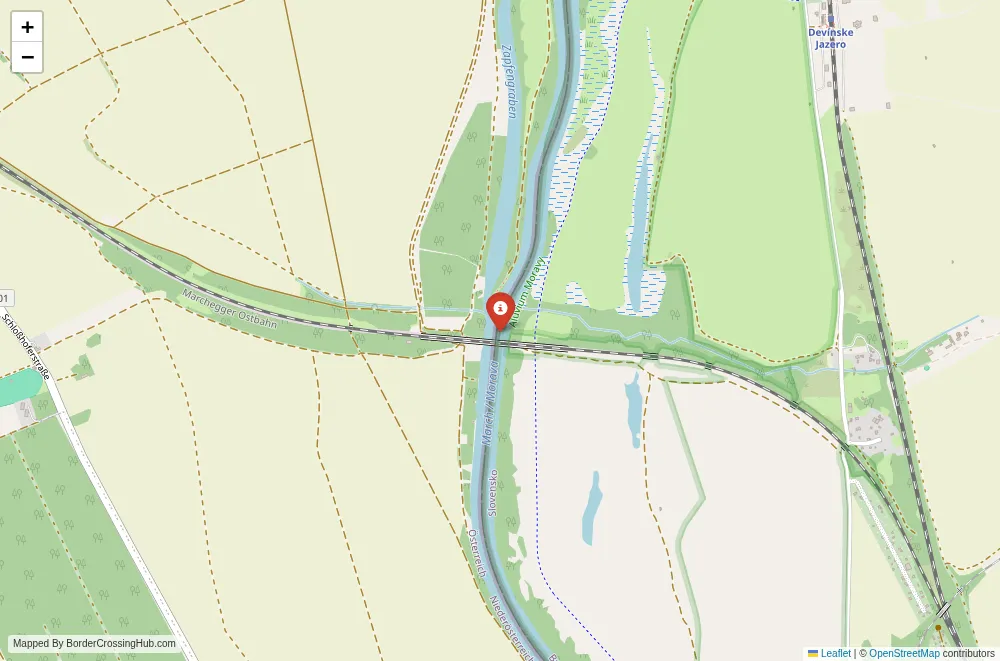
Approximate Border Location
Wait Times
Train 0-15m; road 0-10m; peaks 20-60m
Just crossed? Tap to report:
Operating Hours
Open 24 hrs; rail by timetable
Crossing Types
Trains,ped,cars,bikes; local bridges
Border Type
Land crossing via road+rail corridor
Peak Times
Morning 07:00-09:00 AM; weekends
Daily Crossings
6,000-25,000/day
Currency Exchange
EUR only; ATMs in Bratislava/Marchegg
Safety Information
River routes; fog/flood disruptions possible
Languages Spoken
Slovak/German
Accessibility Features
Station access varies; some step-free
About Bratislava & Devínska Nová Ves / Marchegg
Bratislava Devínska Nová Ves / Marchegg connects Slovakia to Austria along a key rail corridor in the Morava River floodplain, where the border crosses the historic bridge linking Devínska Nová Ves on the outskirts of Bratislava to Marchegg in Lower Austria’s Weinviertel region.
Location and Basic Connections
You reach this crossing where Devínska Nová Ves, a district of Bratislava in western Slovakia, meets Marchegg in Austria’s Lower Austria province. It lies along the electrified railway line (Slovak ŽSR / Austrian ÖBB) over the Morava River bridge, about 6 km from Devínska Nová Ves station and directly at the border near Marchegg. Foreign visitors use it primarily by train when traveling between Bratislava and Vienna, with regional and some international services resuming on this route since October 2025 after full electrification and reconstruction. Alternative names include the Devínska Nová Ves Marchegg border or Bratislava-Morava River rail crossing. As a Schengen internal rail point, it normally has no routine passenger checks, but temporary controls apply to land borders as of February 11 2026.
Historical Background and Geopolitical Role
The border traces the Austro-Hungarian frontier formalized after the 1918 dissolution of Austria-Hungary and the 1920 Treaty of Trianon, which placed Bratislava under Czechoslovakia while leaving Marchegg in Austria. The railway line dates to 1848 as part of the Empress Elisabeth Railway connecting Vienna to Pressburg (Bratislava). During the Cold War, the Iron Curtain severed cross-border rail services, with the Morava River bridge heavily guarded. Passenger traffic remained suspended until post-1989 reopening, with full electrification delayed by technical and funding issues. Reconstruction on the Slovak side (2.4 km single-track section to the border) completed in 2025, allowing electric services to resume on October 11 2025, cutting travel time to Vienna to around 56 minutes via this route. The line now serves as a faster, sustainable alternative to the Kittsee-Petržalka route, boosting cross-border commuting and tourism between Slovakia’s capital and Austria’s capital region.
Current Status and Safety Considerations
Austria continues temporary internal border controls with Slovakia until at least June 15 2026, citing persistent irregular migration along Balkan routes, smuggling networks, strain on asylum systems, and heightened security threats from conflicts in Ukraine and the Middle East. Slovakia maintains targeted internal checks on Schengen borders until July 31 2026, focusing on migration and public order. For this rail crossing, controls occur sporadically through onboard or station verifications rather than routine stops at the border itself. Travelers report these as infrequent on regional trains, with most journeys unaffected. The area around Devínska Nová Ves and Marchegg has low crime typical of suburban and rural rail zones, with no common scams or aggressive behavior noted for passengers. Carry your passport or national ID at all times in case of any verification.
Operating Hours and Wait Times
The railway operates according to timetable, with no fixed border hours since it’s integrated into the line. Regional passenger trains run several times daily in each direction, often with short platform waits for connections. Temporary controls add variability: most trains cross without interruption, while a random check might delay boarding or add 5 to 20 minutes for document inspection. Passenger services see minimal delays here compared to road borders. Peak commuter or holiday periods could see slightly more activity, though nothing like road queues. Weather rarely affects rail here, but fog or winter conditions might cause minor timetable adjustments.
Visa Requirements for Foreign Visitors
Schengen rules govern movement: EU/EEA/Swiss citizens proceed freely with valid ID or passport. Non-EU nationals enjoy visa exemptions for up to 90 days in any 180-day period if eligible, or require a Schengen visa. The Entry/Exit System registers non-EU arrivals at external borders but not routinely on this internal rail line; spot checks may verify your stay or documents. Present your passport during any control, and have proof of purpose, funds, accommodation, or onward travel ready if asked. No additional fees occur at this crossing.
Crossing Procedures Step by Step
You board a regional train in Slovakia (from Bratislava hlavná stanica via Devínska Nová Ves) or Austria (from Marchegg or Vienna). Normally, the train continues across the border without stopping, as the bridge marks the line and language announcements shift. If authorities conduct a control, police may board at Devínska Nová Ves or Marchegg station or perform an onboard check for ID presentation and basic travel questions. Provide documents promptly; the process ends fast amid passenger flow. No separate pedestrian or vehicle options exist here—it’s rail-exclusive. The transition feels seamless, with rural views of the Morava floodplain continuing on both sides.
Transportation Options and Road Details
Regional trains (often operated by ZSSK in Slovakia and ÖBB in Austria) connect Devínska Nová Ves to Bratislava and Marchegg to Vienna, with several daily services for commuters and visitors. No direct road crossing aligns exactly here; nearby road borders like Kittsee-Berg handle vehicles. The rail line passes through flat Morava floodplain scenery with farmland, meadows, and occasional woods. Scenery remains open and agricultural. Traffic on trains stays moderate, ideal for relaxed travel. Cycling or hiking paths nearby allow exploration of the Morava River area.
Nearby Attractions and Practical Tips
Devínska Nová Ves offers access to Bratislava’s northern suburbs and the Devín Castle ruins; Marchegg provides quiet rural charm and proximity to the Marchfeld plain and Hainburg an der Donau castle. Carry ID due to controls. Euros work on both sides; cards widely accepted on trains and in stations. Pack for northern weather with layers for cooler rail journeys. Check timetables ahead for connections. Use the train for an easy, scenic border hop without driving hassles.
Cultural and Economic Significance
The crossing underpins commuter and regional passenger links in this Morava corridor, supporting trade between Bratislava and Vienna regions. Shared history from the Empress Elisabeth Railway era lingers, while cross-border commuting and tourism grow. It exemplifies practical Schengen rail integration amid temporary security measures.
Final Planning Notes
Monitor official EU or national sites for updates on temporary controls close to your travel, keep ID accessible, and check train schedules for any rare disruptions. This rail-focused route provides a convenient, low-key way to cross between Slovakia and Austria when you stay prepared.
No reviews yet.