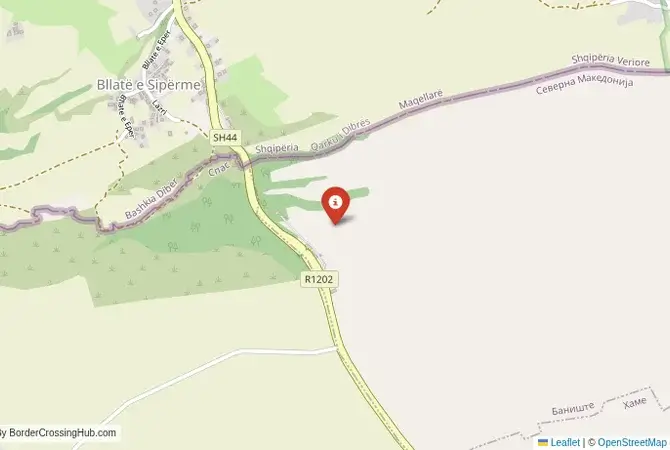
Approximate Border Location
Border Countries
Border Cities
- 🇦🇱Bllatë
- 🇲🇰Spas
Wait Times
15–60 min typical
Just crossed? Tap to report:
Operating Hours
06:00 AM–10:00 PM
Crossing Types
Pedestrians, private vehicles
Border Type
Land crossing via road
Peak Times
07–10 AM mornings
Daily Crossings
1,500–2,500 crossings
Currency Exchange
Limited nearby (ALL, MKD)
Safety Information
Quiet border area
Languages Spoken
Albanian/Macedonian
Accessibility Features
Ramps, assistance offered
About Bllatë & Spas
Monthly Update (March 2026):
As of 03/2026, the Bllatë & Spas Border Crossing runs quietly in the mountain corridor between Albania and North Macedonia. Traffic stays light, mostly locals and small vehicles. Inspections move steadily unless a small group of cars arrives together. Weather in the highlands can sometimes slow the drive.
No Cell Service at the Border? No Problem.
Don’t get caught scrambling for paperwork when you lose signal. Download the complete Europe Transit Guide directly to your device and access every critical detail, fast-track strategy, and border rule – 100% offline.
The Main Debar-Peshkopi Crossing
The border crossing connecting the area near Bllatë in Albania with Spas in North Macedonia is the main and most important checkpoint between the two nations. This is the main highway, the E65, that links the Albanian capital, Tirana, with the North Macedonian capital, Skopje, via the city of Debar. It is a busy, 24/7 international crossing, a modern facility that serves as a critical corridor for trade, tourism, and transit. To cross here is to travel through the historic Dibra (Debar) region, a mountainous and culturally rich area that has been a crossroads of the Balkans for centuries. It is a journey through a landscape of dramatic river valleys, high mountains, and a shared Albanian heritage.
Operational Details
This checkpoint connects Albania’s Dibër County with the Polog Statistical Region of North Macedonia. It is a full-service international crossing, open to all passenger cars, buses, and commercial freight. The facility has been modernized in recent years to handle the increasing volume of traffic. It is the preferred route for most travelers and for the majority of the trade moving between the two countries. The crossing can be very busy, especially during the summer tourist season, when the diaspora from North Macedonia’s large Albanian population travels to Albania for holidays.
A History of a Divided Region
The history of this region is the history of the Dibra region, which has a predominantly Albanian population. For centuries, this was a unified cultural and economic area within the Ottoman Empire. The modern border, established in the early 20th century, divided the region, leaving the main city of Debar (Dibër in Albanian) in what would become Yugoslavia (and later North Macedonia) and the surrounding hinterland in Albania. This division separated the city from its traditional economic and social partners. The opening and modernization of this crossing has been a key factor in the economic and social revitalization of this historically divided region.
Border Crossing Procedure
The border crossing procedure is a standard two-part process. You will first complete exit formalities at one country’s checkpoint and then proceed to the other country’s checkpoint for entry inspection. You will need a valid passport or, for citizens of many European countries, a national ID card. Vehicle registration and international insurance (Green Card) are also necessary. The process is generally straightforward, but queues can be long during peak season, so it is wise to allow for extra time in your travel schedule.
The Surrounding Region: Albania Side
On the Albanian side, the crossing is the gateway to the Dibër County, a mountainous and scenic region. The road from the border follows the valley of the Black Drin River. The nearby city of Peshkopi is the main regional center and is known for its thermal sulphur baths. The region is part of the Korab-Koritnik Nature Park, and the highest peak in both Albania and North Macedonia, Mount Korab, is located on the border in this region. The new “Arbër Road” (Rruga e Arbërit) has dramatically improved the connection from this region to the capital, Tirana.
The Surrounding Region: North Macedonia Side
On the North Macedonian side, the crossing is just a few kilometers from the historic city of Debar. Debar is located on the shores of the large Debar Lake and is known for its own thermal spas. The city is the center of the Albanian community in this part of North Macedonia. The crossing is the gateway to the magnificent Mavrovo National Park, the largest national park in the country, with its beautiful lake, ski resort, and the famous half-submerged church of St. Nicholas. The road from here leads towards the capital, Skopje.
Practical Travel Information
Practical planning for this route is straightforward. The main highway is well-maintained. The official currencies are the Albanian Lek (ALL) in Albania and the Macedonian Denar (MKD) in North Macedonia. Currency exchange facilities are available at the border, but rates are often better in the cities. Ensure your vehicle’s Green Card insurance explicitly covers both Albania and North Macedonia. Services like petrol stations are readily available on the main route.
Final Considerations
The Bllatë–Spas border crossing is the main artery connecting Albania and North Macedonia. It is a busy, efficient checkpoint that serves as a gateway to some of the most spectacular mountain scenery in the Balkans. It is a journey through a region with a rich, shared Albanian heritage. For the modern traveler, it is a straightforward and essential passage for exploring the rich and diverse landscapes and cultures of these two beautiful Balkan nations.
No reviews yet.