
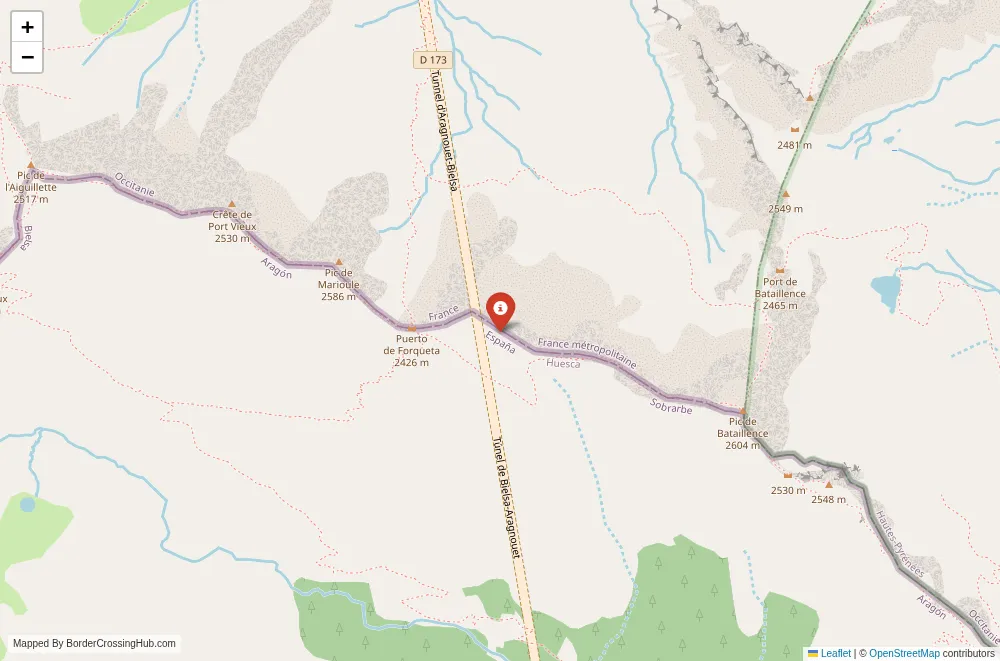
Approximate Border Location
Wait Times
Cars 5-25m; peaks 45-180m closures
Just crossed? Tap to report:
Operating Hours
Open 24 hrs; occasional 10:00 PM-06:00 AM closures
Crossing Types
Cars,buses; tunnel limits; no hazmat
Border Type
Land crossing via road tunnel
Peak Times
08:00-11:00 AM; summer; snow alerts
Daily Crossings
1,000-6,000/day
Currency Exchange
EUR only; ATMs in Bielsa/Saint-Lary
Safety Information
Avalanche/snow can close road; check alerts
Languages Spoken
French/Spanish
Accessibility Features
Tunnel walkways; limited services at portals
About Bielsa & Aragnouet
The Bielsa Aragnouet border crossing tunnels through the central Pyrenees at around 1,830 meters on the French side, connecting the Spanish town of Bielsa in Huesca province (Aragon) directly to Aragnouet in France’s Hautes-Pyrénées department via a single-tube road tunnel.
Location and Basic Connections
You find this pass deep in the Pyrenees National Park area, with the tunnel entrance on the Spanish side along the A-138 road from Bielsa (about 20 km of steep climb from the town) and on the French side along the D-173 from Aragnouet or Saint-Lary-Soulan. The tunnel itself spans roughly 3 km and links the upper valleys of the Cinca (Spain) and Aure (France). Buses from Barbastro or Aínsa in Spain reach Bielsa, then local transport or private vehicles cover the final ascent. On the French side, connections come from Lourdes or Tarbes via Saint-Lary. The route suits those traveling between Aragón and the French central Pyrenees, often as an alternative to busier crossings like Somport or Portalet.
Alternative Names
This crossing is known as Túnel de Bielsa-Aragnouet, Tunnel d’Aragnouet-Bielsa, Paso de Bielsa, or Port de Bielsa.
Historical Background
The tunnel opened in 1976 as a binational project to improve connectivity across the Pyrenees, with the border line formally fixed inside the tunnel by a 1980 Franco-Spanish agreement. It replaced older mule tracks and high passes used historically by shepherds and traders. The area ties into the Mont Perdu (Monte Perdido) massif, a UNESCO World Heritage site since 1997 for its dramatic karst landscape spanning both countries. Maintenance and safety upgrades have continued, including avalanche prevention measures.
Geopolitical Significance
This tunnel ranks among the key trans-Pyrenean links, managed jointly by the Consorcio Túnel Bielsa-Aragnouet. As a Schengen internal border, no routine passport controls apply for most travelers, though spot checks occur for security or customs. It supports tourism, winter sports access, and freight between Aragón and southern France. Weather-driven closures happen frequently in winter due to avalanche risk, with decisions made by a joint committee (often involving the French side at Aragnouet). In early 2026, the tunnel has seen multiple temporary closures from heavy snow and avalanches (e.g., early January and mid-February incidents), but reopens after assessments. As of February 2026, it remains open with incidents and chain requirements reported recently; check the official consortium site or phone line (974 563 151 from Spain, 0800 91 60 33 from France) for real-time status.
Practical Crossing Procedures
You drive straight through the tunnel without stopping in normal conditions. No permanent booths exist due to Schengen rules. Random patrols may stop vehicles for ID, customs (goods over limits), or safety checks. Most nationalities cross freely (90 days visa-free in Schengen). Carry your passport or ID, vehicle registration, insurance, and chains in winter. Prohibited items include hazardous materials and pedestrians/bicycles inside the tunnel. Vehicles over 3.5 tonnes face night restrictions (typically 22:00 to 06:00 when active). The tunnel is bidirectional in a single tube, so alternating flow or signals manage traffic.
Typical Wait Times and Operating Hours
The tunnel operates 24/7 when open, with no fixed hours beyond seasonal/weather closures. Waits are minimal (none in clear flow), but avalanche risks or maintenance cause full shutdowns lasting hours to days. Recent 2026 closures (e.g., early February) lasted several days before reopening with chain obligations. Night restrictions for heavy vehicles apply when enforced.
Transportation Options
Private cars dominate due to the remote, steep roads. Buses are limited; some regional services reach Bielsa or Saint-Lary, then taxis or rideshares cover the rest. No direct public transport crosses routinely. Cyclists and pedestrians are banned in the tunnel; use other routes. The drive offers a dramatic climb on both sides, often with trailers or caravans in mind.
Road Conditions and Scenery
The Spanish A-138 climbs steeply with switchbacks, narrow lanes, and exposure to snow/ice. The French D-173 side stays winding but less extreme. The tunnel itself is single-tube, bidirectional, and well-lit. Scenery shifts from deep valleys and forests to high alpine meadows, peaks, and reservoirs. Winter demands chains; summer brings clear views but possible rockfall.
Scams and Warnings
Remote mountain crossings like this see few scams, but poor weather strands drivers—carry supplies. Avalanche closures are common; don’t attempt if closed. Chains are mandatory in incidents (as reported February 2026). Random checks may occur; cooperate. The area has low crime but high altitude risks (though lower than some passes). Monitor official updates via the consortium site or phone, as conditions change fast.
Nearby Attractions
Bielsa offers quiet mountain village life, access to the Ordesa y Monte Perdido National Park trails, and the Pineta Valley. Aragnouet features the Templar church ruins and nearby Piau-Engaly ski resort. The tunnel links to Mont Perdu hikes, Gavarnie Cirque, or Saint-Lary’s thermal baths and skiing. The zone suits nature lovers and winter sports enthusiasts.
Seasonal Variations and Delays
Winter (November-April) brings frequent avalanche closures, snow, and chain needs—expect interruptions. Summer (May-October) offers reliable access with stunning scenery. Recent 2026 events show multiple short closures from storms.
Cultural and Economic Role
The tunnel sustains local ties between Bielsa and Aragnouet valleys, boosting tourism and seasonal work. It blends Aragonese and Occitan influences in food, festivals, and mountain traditions.
Final Planning Notes
Check status before travel via bielsa-aragnouet.org or the info line. Carry chains in winter, passport, and supplies. This suits drivers ready for mountain conditions and potential weather waits.
Passing Through This Pyrenean Tunnel
Bielsa Aragnouet provides a dramatic, tunnel-based border hop in the heart of the Pyrenees, linking remote valleys with minimal fuss when open. Stay updated on avalanche risks and road conditions for a safe journey across this high-altitude link.
No reviews yet.