
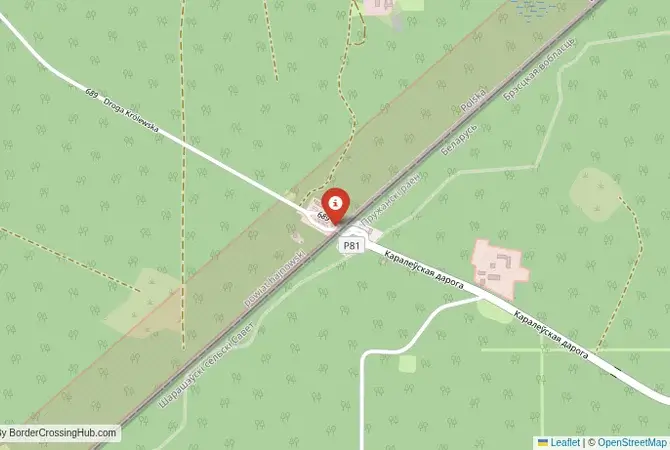
Approximate Border Location
Wait Times
10-45 min pedestrians/vehicles
Just crossed? Tap to report:
Operating Hours
6:00 AM-8:00 PM
Crossing Types
Pedestrians, vehicles
Border Type
Land crossing via road
Peak Times
7-10 AM
Daily Crossings
800-1500 travelers/vehicles
Currency Exchange
Near Białowieża (BYN, PLN)
Safety Information
Remote, forest risks
Languages Spoken
Belarusian/Polish
Accessibility Features
Ramps, limited assistance
About Białowieża & Pierarova
Monthly Update (April 2026):
The crossing stays quiet, with only occasional vehicles appearing through the day. During April 2026, Białowieża & Pierarova Border Crossing is mostly stable and very lightly used. Checks are present but not rushed. Access restrictions and local conditions influence how often it’s used.
No Cell Service at the Border? No Problem.
Don’t get caught scrambling for paperwork when you lose signal. Download the complete South America Transit Guide directly to your device and access every critical detail, fast-track strategy, and border rule – 100% offline.
A Closed Gateway in a Primeval Forest
Important Note for Travelers: This border crossing has been closed by the Polish authorities since 2020 and remains closed as of early 2026 due to the ongoing political and migrant crisis at the Belarus-Poland border. It is not operational. This guide is provided for historical and informational purposes only. The border crossing between the Polish village of Białowieża and Pierarova in Belarus is arguably the most unique and symbolic checkpoint on the entire border. It is located in the very heart of the Białowieża Forest, a UNESCO World Heritage site and one of the last and largest remaining parts of the immense primeval forest that once stretched across the European Plain. This was not a crossing for cars or trucks; it was exclusively for pedestrians and cyclists. To cross here was to take a quiet walk or a bike ride from one part of the ancient forest to the other, a journey that emphasized the unity of the ecosystem over the political division of the border. It was a passage that felt less like an international frontier and more like a gate in a park.
Operational Details
This checkpoint connected Poland’s Podlaskie Voivodeship with the Brest Region of Belarus. Its purpose was entirely for tourism, allowing visitors to experience the entirety of the trans-boundary Białowieża Forest, which is managed as two separate national parks by Poland and Belarus. The crossing operated with limited daylight hours and was a simple, low-key affair, in keeping with its natural setting.
A History of Conservation and Cooperation
The history of this crossing is tied to the conservation of the Białowieża Forest. The forest is home to the largest free-roaming population of European bison, as well as hundreds of other species of flora and fauna. Recognizing the ecological importance of the entire forest ecosystem, a visa-free travel regime was established for this specific crossing, allowing tourists who entered through it to visit the Belarusian part of the national park for up to three days without needing a full Belarusian visa. This was a unique arrangement designed to promote eco-tourism and cross-border cooperation in managing the shared natural heritage. The crossing became a popular destination for nature lovers, cyclists, and those seeking a unique travel experience.
A Simple Border Procedure
The border crossing procedure was as simple as its setting. Travelers would walk or cycle to the Polish checkpoint, a small wooden building staffed by the Polish Border Guard. After an exit check of their passports, they would proceed along a path through the forest for a few hundred meters to the Belarusian checkpoint at Pierarova. Here, they would undergo an entry check. The process was typically relaxed and personal. The main requirement was that tourists had to have pre-booked services (like a park tour or accommodation) with the Belarusian national park authorities to be eligible for the visa-free entry. Travelers were generally not permitted to travel beyond the designated tourist zone of the park.
The Forest as a Destination
The main attraction was the forest itself. The Białowieża National Park is a place of incredible beauty and biodiversity. On the Polish side, visitors can explore the Strictly Protected Area with a licensed guide, visit the European bison show reserve, and walk along nature trails. The village of Białowieża is a charming tourist hub with hotels, restaurants, and a beautiful wooden Orthodox church. On the Belarusian side, the national park is managed differently, with a greater emphasis on managed tourism. The park headquarters at Kamieniuki features a large hotel complex, a zoo with enclosures for bison and other animals, and the residence of the Belarusian Ded Moroz (Father Frost), a popular attraction for families. The visa-free crossing was the only way for most tourists to easily experience both sides of this magnificent forest.
Closure and Fortification
The closure of the crossing in 2020 was a direct result of the deteriorating political relationship between Belarus and the West. The migrant crisis, in which the Belarusian government was accused of facilitating the illegal passage of migrants into the EU, led Poland to fortify its border and close most of the smaller checkpoints, including this one. A high-tech border wall has since been constructed through large parts of the forest, a move heavily criticized by environmentalists for its impact on wildlife migration, with reinforcements and completion targeted through 2025 amid ongoing security concerns.
Final Considerations
The Białowieża–Pierarova crossing was a unique and precious symbol of cross-border cooperation and the shared natural heritage of Europe. Its closure is a casualty of modern geopolitics, a sad chapter in the history of the ancient forest. While it is currently inaccessible, its story remains a powerful reminder of a time when it was possible to peacefully walk from one country to another through the heart of a primeval wilderness. For now, it exists only in the memories of those who were fortunate enough to experience it, a lost passage through the last wild forest in Europe.
No reviews yet.