
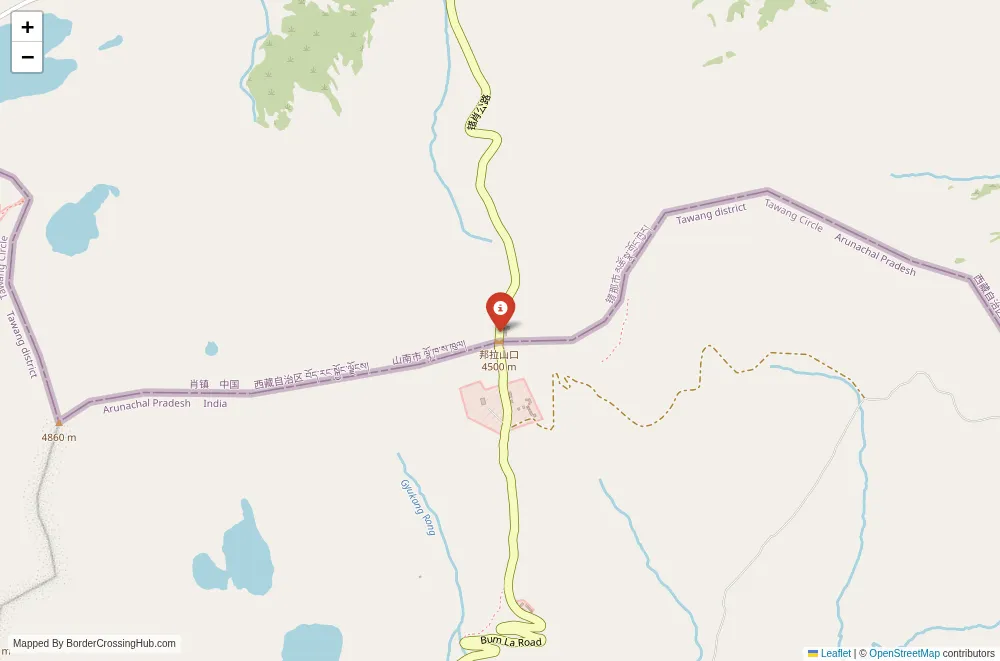
Approximate Border Location
Wait Times
Closed/limited; delays 240-720m if open
Just crossed? Tap to report:
Operating Hours
Seasonal daylight; permit-only
Crossing Types
Permit/military; no public crossing
Border Type
Land crossing via high-altitude pass
Peak Times
Summer mornings; limited windows
Daily Crossings
0-100/day
Currency Exchange
INR; CNY not at pass; cash in Tawang
Safety Information
High-altitude; strict controls
Languages Spoken
Hindi, Chinese, English
Accessibility Features
Not accessible; steep road
About Bhitthamore & Malibara / Jaleshwar
Monthly Update (March 2026):
As of 03/2026, the Bhitthamore & Malibara / Jaleshwar Border Crossing ticks along with moderate cross-border movement. Pedestrians and motorbikes pass steadily, while cars sometimes stack up briefly on the Nepal side during inspections. Midday often moves the smoothest. Local trade and family visits shape the flow.
No Cell Service at the Border? No Problem.
Don’t get caught scrambling for paperwork when you lose signal. Download the complete Asia Transit Guide directly to your device and access every critical detail, fast-track strategy, and border rule – 100% offline.
The Bhitthamore-Malibara border crossing (also known as Bhitthamore on the Indian side in Bihar’s Sitamarhi district and Malibara or Jaleshwar on the Nepali side in Madhesh Province’s Jaleshwar municipality) connects northern Bihar in India to the central Terai region of Nepal across a short stretch of open land. You use this point when traveling overland from northern India toward Janakpur or other parts of Nepal’s Madhesh Province, often as an alternative to the busier Sunauli-Bhairahawa or Raxaul-Birgunj crossings. The crossing lacks a major bridge or river barrier, relying instead on a simple road that crosses the international boundary near the village of Bhitthamore, with immigration posts on both sides facilitating local trade, daily commuting, and passenger movement in a densely populated Terai corridor.
Location and Connections
Bhitthamore lies in Sitamarhi district of Bihar, India, about 25 kilometers from Sitamarhi town and roughly 200 kilometers north of Patna. On the Nepali side, Malibara connects directly to Jaleshwar municipality in Madhesh Province, with onward roads to Janakpur (around 30 kilometers), Dhalkebar, and eventually Kathmandu. The crossing consists of a single-lane road with Indian and Nepali immigration buildings positioned close together, allowing a quick walk or drive between them. The surrounding landscape features flat, fertile Terai plains, rice paddies, sugarcane fields, and bustling roadside markets. No river or major physical barrier divides the two sides, making it one of the more seamless India-Nepal crossings in terms of terrain, though security checks and crowds create bottlenecks during peak hours.
Historical and Geopolitical Background
The India-Nepal border spans 1,751 kilometers, characterized by its open nature under the 1950 Treaty of Peace and Friendship, which allows citizens of both countries to cross freely without visas. Bhitthamore-Malibara developed as a local transit point in the post-independence era, serving communities where Maithili, Bhojpuri, and Tharu people live on both sides of the line. The crossing supports small-scale trade in agricultural goods, textiles, and consumer items, as well as seasonal labor migration between Bihar and Nepal’s Madhesh Province. It has remained relatively low-profile compared to larger crossings, with occasional disruptions from floods during the monsoon or local political unrest in Madhesh Province. The 2015 Madhesh protests and subsequent border blockades affected nearby crossings more severely, but Bhitthamore stayed functional for local use. Fun fact: the area near Jaleshwar holds religious significance for Hindus, with nearby Janakpur considered the birthplace of Sita in the Ramayana, drawing pilgrims who sometimes cross at this point during festivals.
Current Status and Operating Hours
As of early 2026, Bhitthamore-Malibara operates normally for pedestrians and light vehicles, with no major long-term closures reported. The crossing functions daily, typically from 6:00 a.m. to 8:00 p.m., though informal crossings by locals occur outside these hours. Peak traffic occurs during market days, festivals, or early mornings when commuters travel for work in Janakpur or Sitamarhi. Monsoon flooding (June to September) can submerge low-lying roads or cause temporary halts, while winter fog occasionally delays movement. Security remains visible, with India’s Sashastra Seema Bal (SSB) and Nepal’s Armed Police Force (APF) conducting routine checks. The crossing sees moderate volumes of buses, jeeps, motorcycles, and foot traffic. Confirm current conditions through local administration, MEA advisories, or traveler forums, as seasonal weather or occasional local disputes can affect access.
Crossing Procedures Step by Step
You process exit and entry on both sides. From India to Nepal: at the Bhitthamore Indian post, present your passport or voter ID (for Indian citizens) for exit registration or stamp, then clear customs if carrying goods. Walk or drive the short distance to the Malibara Nepal immigration post for entry stamp (Nepali citizens cross freely; foreigners receive visa-on-arrival or use pre-arranged visa). The reverse applies when returning: Nepal exit stamp followed by Indian entry (possible customs check for restricted items). Procedures involve manual document verification, occasional bag or vehicle scans, and questions about travel purpose. Wait times usually range from 10 minutes to over an hour during busy periods or vehicle queues. Foreigners generally find the process simple and quick, though expect additional scrutiny for larger amounts of goods or extended stays.
Visa Requirements for Foreign Visitors
Indian and Nepali citizens cross without visas under the 1950 treaty, using ID cards, voter IDs, or other recognized documents. Foreigners entering Nepal from India can obtain visa-on-arrival at land borders (15 days for $30 USD, 30 days for $50 USD, 90 days for $125 USD; payable in cash, USD preferred). Bring passport photos and exact fees. Passports need at least six months validity. India requires no visa for Nepali citizens but may check foreigners for onward permits if traveling to restricted areas in India. Rules remain stable, but confirm via embassies or official portals, as enforcement can vary at smaller crossings.
Transportation Options and Road Details
From Delhi or Patna, trains or buses reach Sitamarhi or Muzaffarpur, then shared jeeps, taxis, or auto-rickshaws cover the distance to Bhitthamore (1-2 hours from Sitamarhi). From Malibara, buses or shared taxis head to Jaleshwar, Janakpur, or Kathmandu. Private cars cross freely for citizens; foreigners may need vehicle permits or temporary import forms. Roads from Sitamarhi remain paved and in reasonable condition; the Nepal side includes highways with occasional potholes and traffic. Monsoon flooding can delay travel or require detours. The full route from Delhi to Kathmandu takes 2 to 3 days with border time. Daylight journeys are recommended for safety and visibility.
Scams and Safety Warnings
Common minor issues include inflated fares from unofficial drivers near Sitamarhi or poor exchange rates from street changers (use banks or ATMs instead). Some travelers report persistent touts offering transport or “help” with forms. The area remains generally safe for transit, but petty theft can occur in crowds. Nepal’s Madhesh Province occasionally sees political protests or road blockades; monitor local news. Avoid unofficial crossings or nighttime travel. Register with embassies if staying longer in Nepal.
Nearby Attractions and Practical Tips
Bhitthamore offers quiet rural views and proximity to Sitamarhi’s historical sites. Malibara leads to Jaleshwar’s temples and Janakpur’s Ram Janaki Temple, a major pilgrimage center. Carry INR/NPR cash, bottled water, snacks, sunscreen, and multiple passport copies. Start journeys early to avoid heat or queues; consider Raxaul-Birgunj as a backup if needed. Translation apps help with local interactions.
Final Notes for Planning
Bhitthamore-Malibara provides a convenient and low-key crossing between India and Nepal’s Madhesh Province, benefiting from the open-border policy for citizens and straightforward visa-on-arrival for foreigners. Confirm current status, prepare visas and fees in advance, and time your travel for daylight hours. With basic preparation, it offers reliable passage across this fertile Terai frontier. Safe travels.
No reviews yet.