
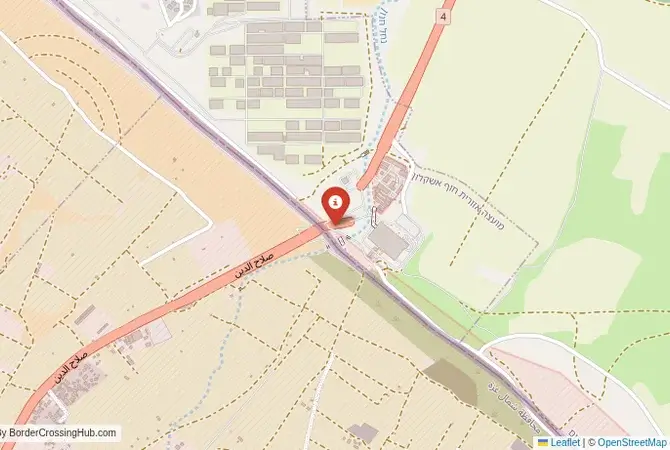
Approximate Border Location
Border Countries
Border Cities
- 🇮🇱Erez Crossing
Wait Times
60-180 min variable
Just crossed? Tap to report:
Operating Hours
7:00 AM-7:00 PM restricted
Crossing Types
Pedestrians only
Border Type
Land crossing via road
Peak Times
Variable, situation-based
Daily Crossings
800-1200 daily
Currency Exchange
Limited near Erez; ILS
Safety Information
Restricted; heightened security
Languages Spoken
Accessibility Features
Ramps, assisted access
About Beit Hanoun & Erez Crossing
Monthly Update (March 2026):
In 03/2026, the Beit Hanoun & Erez Crossing Border Crossing stays tightly controlled with limited movement. Crossings usually involve pre-approved travelers and security checks that take time. Most of the day remains quiet around the gates. Security conditions and permit schedules shape the flow.
No Cell Service at the Border? No Problem.
Don’t get caught scrambling for paperwork when you lose signal. Download the complete Asia Transit Guide directly to your device and access every critical detail, fast-track strategy, and border rule – 100% offline.
Erez Crossing: A Symbol of a Protracted Conflict
Located at the northern end of the Gaza Strip, the Erez Crossing (known as Beit Hanoun on the Palestinian side) is the sole pedestrian passage for people moving between Israel and Gaza. It is less a border crossing in the traditional sense and more of a fortress-like terminal designed to manage and restrict movement as part of a comprehensive blockade imposed on the Gaza Strip since 2007. The physical structure itself is a testament to the security situation: a long, caged-in concrete and steel corridor several hundred meters long, equipped with remotely operated gates, turnstiles, and extensive surveillance equipment. It is a place that embodies the deep-seated conflict, the separation of populations, and the immense security apparatus that defines this frontier.
A History of Shifting Control
Before the blockade, the Erez Crossing served a different function. It was part of the Erez Industrial Area, and thousands of Palestinian workers would cross daily to jobs in Israel, making it a place of economic exchange, however unequal. Following Israel’s disengagement from Gaza in 2005 and the subsequent takeover of the Strip by Hamas in 2007, Israel, in coordination with Egypt, implemented a land, air, and sea blockade. This action fundamentally transformed Erez. It ceased to be a crossing for laborers and became a chokepoint, a place where movement is the rare exception, not the rule. Its history mirrors the trajectory of the Israeli-Palestinian conflict, moving from a degree of interaction to almost complete separation and containment. The procedures and infrastructure have evolved to reflect this reality, prioritizing security above all else.
The Crossing Procedure for Authorized Individuals
For the very small number of people authorized to cross, the process is multi-layered and can be lengthy and stressful. It is not a simple matter of showing a passport.The Permit System: The foundation of any travel through Erez is the permit. Permits are issued by the Israeli military body COGAT (Coordination of Government Activities in the Territories). The application process is arduous and requires extensive documentation justifying the need for entry. The vast majority of applications from Palestinians are for urgent medical cases to receive treatment in Israel or the West Bank. For foreigners, permits are typically limited to staff of the UN, ICRC, and certain other approved NGOs.The Israeli Side: The process begins at a large, modern terminal on the Israeli side. Authorized individuals present their passport and the specific permit to Israeli officials. This is followed by rigorous security screening, including luggage X-rays and personal checks. Questioning about the purpose of the visit is standard.The Corridor: Once cleared, the individual enters the long, enclosed walkway. This section is often automated, with travelers proceeding through a series of remotely controlled turnstiles and gates. It is a sterile and impersonal experience.The Palestinian Side: At the end of the corridor, one arrives at a checkpoint manned by officials from the Palestinian Authority. A short distance further is a final checkpoint controlled by Hamas authorities. Passports and travel documents are inspected at both points before the individual is formally inside the Gaza Strip.
The Reality of the Frontier
The Erez Crossing is a place of immense human drama and bureaucratic rigidity. For the Palestinians who are granted permits, often for life-or-death medical reasons, it is a lifeline. For the aid workers and diplomats who use it, it is a constant reminder of the complexities and hardships of the situation within Gaza. The crossing is frequently closed without notice by Israeli authorities in response to security incidents, such as rocket fire from Gaza, leaving people stranded on either side, and remains largely closed for civilian movement in 2026 amid ongoing restrictions and ceasefire dynamics. The entire area is a high-security zone. It is a stark illustration of one of the world’s most intractable conflicts, a place where the movement of a single person is subject to the highest levels of scrutiny and political consideration.
No reviews yet.