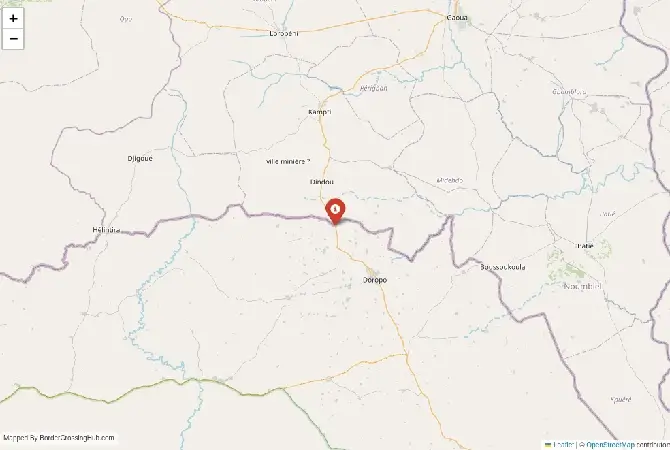
Monthly Update (September 2026):
Batié & Bouna remains a remote Burkina Faso-Côte d'Ivoire crossing with no significant September reopening or closure identified. The surrounding northern Côte d'Ivoire border zone remains security-sensitive, with current guidance advising against travel within 40 km of the Burkina Faso border. For travelers, the main issue is therefore security rather than expected border queues. Conditions on the approach can also deteriorate during the rainy season, so this route should not be treated as an easy substitute for the main Laléraba-Niangoloko corridor.
About this crossing
You will not encounter the scale of traffic seen at crossings like Niangoloko–Laléraba. Instead, this route reflects a more rural setting, with lower volumes of travelers and a slower pace overall.
Security Situation You Should Consider Carefully
This region, particularly on the Burkina Faso side near Batié, has experienced security challenges in recent years. You should treat this crossing with caution and consult up-to-date travel advisories before planning your journey.
Nearby Border Crossings

Military presence, checkpoints, and occasional movement restrictions are possible. While the Ivorian side around Bouna is generally more stable, proximity to border مناطق can still present risks.
You should only consider this route if you have reliable information about current conditions.
Historical and Regional Context
The border here follows colonial boundaries between French-administered territories that later became Burkina Faso and Ivory Coast. Unlike major crossings shaped by large-scale trade, this one developed through local agricultural and market connections.
Batié and Bouna have long served as regional centers for surrounding rural communities. Cross-border movement is often tied to farming, livestock, and small-scale commerce.
This history explains why the crossing remains relatively low-key compared to more strategic routes.
Border Facilities and Infrastructure
Facilities at Batié and Bouna are basic. You will find small immigration offices rather than large checkpoints, and infrastructure is limited.
Electricity and digital systems may not always be reliable. Much of the process is handled manually, including passport checks and record-keeping.
The layout is simple but not always clearly marked. You may need to ask officials where to go to complete each step of the process.
Operating Hours and Availability
The crossing generally operates during daylight hours, though exact times are not always strictly enforced. Officials may not be present outside typical working hours.
Arriving early in the day is recommended to avoid complications. Late arrivals can result in delays or the need to wait until the following day.
Unlike major crossings, there is little flexibility in operating hours.
Visa Requirements and Documentation
You should prepare all documents before arriving.
For Burkina Faso, most travelers require a visa obtained in advance. Visa-on-arrival is not reliable at smaller crossings like Batié.
For Ivory Coast, a visa is typically required before arrival. While Ivory Coast offers an eVisa system, it is mainly designed for air travel, so you should confirm whether it applies to land crossings.
A yellow fever vaccination certificate is mandatory for both countries and is often checked.
Carrying printed copies of all documents is strongly advised.
Crossing Procedure and Wait Times
The process is straightforward but informal. You will exit one country and then complete entry procedures on the other side, usually within a short walking distance.
Wait times are generally short due to low traffic. On a typical day, you might complete the crossing in 20 to 40 minutes. However, delays can occur if officials are unavailable or if additional checks are required.
Because this is not a high-traffic crossing, timing depends more on staffing than on queues.
Road Conditions and Access
Reaching this border can be challenging. Roads in the region are often unpaved or in varying condition, especially on the Burkina Faso side.
During the rainy season, these roads can become muddy and difficult to pass. Travel times can increase significantly, and some routes may become temporarily inaccessible.
On the Ivory Coast side, access to Bouna is somewhat better, with connections to regional road networks. However, conditions can still vary.
Public transport options are limited. Shared taxis and minibuses may operate between towns, but direct routes to the border are not guaranteed. Many travelers rely on private or arranged transport.
Seasonal and Environmental Factors
Weather plays a significant role in accessibility. The rainy season can disrupt travel due to poor road conditions and occasional flooding in low-lying areas.
In the dry season, heat and dust are the main challenges. You should prepare for long stretches without services and limited shade.
The surrounding landscape is largely savannah, with agricultural activity depending on seasonal rainfall.
Scams & Warnings
Even at quieter crossings, you should remain cautious. Requests for unofficial payments can occur, particularly if officials assume you are unfamiliar with local procedures.
You should stay polite but firm. Ask for receipts when fees are requested and avoid paying anything unclear.
Another issue is inconsistent information. Procedures may vary depending on who is on duty, so confirming each step is important.
Local Life and Cross-Border Movement
This crossing reflects the daily routines of nearby communities. You will likely see farmers, traders, and families moving between Batié and Bouna.
The atmosphere is relaxed compared to busier borders, but this also means less structure. You should be prepared to take initiative in completing the process.
French is widely spoken on both sides, along with local languages.
Practical Tips for Travelers
You should carry enough water, food, and fuel, as services near the border are limited.
Mobile network coverage may be weak, so having offline maps or written directions is useful.
Keeping your documents organized and accessible will help speed up the process.
Flexibility is essential, as delays and unexpected changes are always possible in this region.
Final Thoughts
The Batié–Bouna crossing is a quiet but functional link between Burkina Faso and Ivory Coast, shaped by local movement and rural conditions.
Closing Note
You should approach this crossing with caution and preparation. It can be used with the right planning, but for many travelers, more developed and secure border points may offer a more predictable experience.
View all border crossings between Burkina Faso and Ivory CoastPractical information
Fuel
Burkina Faso: 2 km - Ivory Coast: 2 km
Currency
XOF,CFA limited
Safety information
Remote, light checks
Connectivity
Rural roads, vans
Have you crossed here?
Help other travelers by sharing your experience, wait times, and any updates.