Monthly Update (September 2026):
Ban Khao Din & Phsar Prom remains unavailable for ordinary Thailand-Cambodia overland travel. Thailand-Cambodia land crossings are still closed as of September 4 despite the ceasefire, so travelers should not expect this smaller crossing to be usable simply because fighting has eased. The closure affects the wider frontier rather than this checkpoint alone, making an alternative route or air travel necessary for now.
About this crossing
A History of a Local Lifeline
The history of this crossing is purely local. It has never been a major route for armies or kings. Its existence is a testament to the everyday needs of the farmers and traders who live along the border. The region is a major agricultural area, known for producing cassava, corn, and rice. The crossing at Phsar Prom allows Cambodian farmers to bring their produce to markets in Thailand and to buy Thai goods, such as fertilizer and equipment. During the years of conflict in Cambodia, this, like all borders, was a more dangerous and informal place, a porous frontier used by refugees and guerillas. Its formalization as an official, though minor, checkpoint is part of the broader effort by both governments to regulate trade and improve security along their long and often difficult-to-control frontier. It is a border that is not defined by grand historical events but by the simple, enduring rhythms of agricultural life. It is a place that serves its local community, a functional lifeline in a rural landscape, and its story is one of the quiet, persistent need for cross-border exchange that exists independently of high-level politics. The development of this crossing reflects a bottom-up economic reality rather than a top-down strategic vision.
The Border Crossing Procedure: A Basic and Uncertain Affair
This is a very quiet border, and its status for international travelers remains uncertain. While it may be officially designated as an international crossing, the officials may be unaccustomed to processing foreign passports, and facilities may be limited. You must verify its current status before attempting to use it. The border is open during daylight hours only. Exiting Cambodia (Phsar Prom): The Cambodian immigration and customs post is a very basic facility, likely a small, simple building. You will present your passport to the officer and get your exit stamp. The process will be simple, but may be slow if the officials need to make calls to verify the procedure for your nationality. They may be surprised to see a foreign traveler, so a patient and friendly demeanor is essential. The No-Man's-Land: You will then cross a short, dusty no-man's-land to the Thai side. The area is rural and undeveloped. Entering Thailand (Ban Khao Din): The Thai immigration post is also a small, local facility. You will present your passport to the officer. For most nationalities, Thailand offers a visa exemption stamp. The officials will process your entry. The key challenge here is that, as this is not a designated tourist entry point, they may subject you to more detailed questioning about your travel plans and your reasons for using such an obscure crossing. It is important to be polite, patient, and have all your documents, including proof of onward travel and accommodation, in order.
Nearby Border Crossings


Route, Onward Travel, and Major Caveats
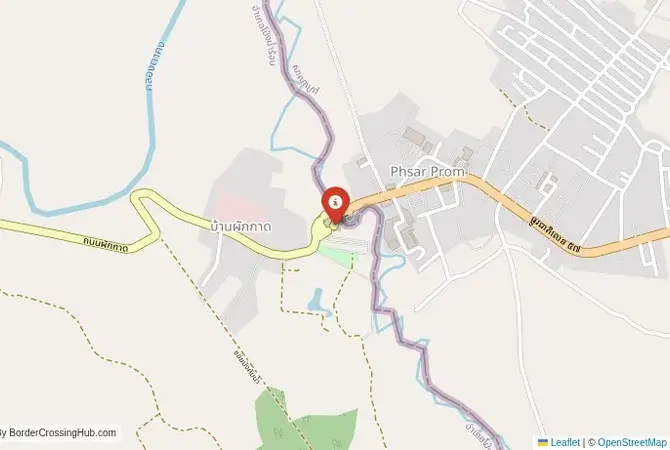
This crossing is located in a very rural area on both sides. On the Cambodian side, the road connects to the town of Sampov Loun and eventually to the main highway that runs to Battambang. The road conditions can be poor, especially in the rainy season, and may require a sturdy vehicle. On the Thai side, the crossing is in a remote part of Sa Kaeo province, and the road connects to the main highway between Aranyaprathet and Chanthaburi. The biggest challenge of using this crossing is transportation. There is no formal public transport waiting on either side. You would need to have your own vehicle or be prepared to hire a local, informal motorbike taxi or car for a considerable price to get you to the nearest town with onward bus connections. This lack of transport makes the crossing highly impractical for most travelers. The uncertainty of its status for foreigners is another major risk. You could travel for hours to get here, only to be turned away. Reliable, up-to-date information is very difficult to obtain from outside the immediate area.
Final Contextual Note: A Route for Locals, Not Tourists
The Phsar Prom-Ban Khao Din crossing is a fascinating point on the map, a glimpse into the local, agricultural life of the Thai-Cambodian border. It serves a vital purpose for the communities that live there. However, for the international overland traveler, it is not a recommended or viable option. The combination of its remote location, the uncertainty of its status for foreigners, the basic facilities, and the almost complete lack of onward transportation makes it a very risky choice. The nearby crossings at Poipet (for Siem Reap), Pailin (for Battambang), or Pong Nam Ron (for Battambang) are all much better equipped, more reliable, and more convenient for travelers. The Phsar Prom crossing is a border that is best left to the local people it was designed to serve, a place that reminds travelers that not all lines on the map are meant to be crossed by everyone.
View all border crossings between Cambodia and ThailandPractical information
Fuel
Cambodia: <1 km - Thailand: <1 km
Currency
Limited exchange (KHR, THB)
Safety information
Safe, remote area
Connectivity
Limited Wi-Fi, 3G
Have you crossed here?
Help other travelers by sharing your experience, wait times, and any updates.