Staying near the crossing? Places to stay around Baisieux & Froyennes on Booking.com Partner link: we may earn a commission, at no extra cost to you.
Crossing by bus or train? Lille to Brussels: times and fares on 12Go Partner link: we may earn a commission, at no extra cost to you.
Monthly Update (October 2026):
Baisieux & Froyennes remains a useful France-Belgium road connection in October, with no significant new border restriction reported. Traffic is generally shaped by the wider Lille-Tournai commuter network rather than formal border checks. Travelers using Baisieux & Froyennes should watch for ordinary weekday congestion on the approach roads.
Driving there, or sending a driver? Send them this guide.
For reports and websites
Cite this page
Border Crossing Hub (2026). Baisieux & Froyennes Border Crossing. Updated October 2026. https://bordercrossinghub.com/baisieux-froyennes-border-crossing/<a href="https://bordercrossinghub.com/baisieux-froyennes-border-crossing/">Baisieux & Froyennes Border Crossing (Border Crossing Hub)</a>Put this crossing's card on your website
Free. It updates on its own when our information changes.
<iframe data-bch-card src="https://bordercrossinghub.com/baisieux-froyennes-border-crossing/?bch_view=card" width="100%" height="980" scrolling="no" style="border:0;max-width:480px;display:block" loading="lazy" title="Baisieux & Froyennes border crossing information"></iframe>
<p style="font-size:12px;margin:4px 0 0">Crossing information: <a href="https://bordercrossinghub.com/baisieux-froyennes-border-crossing/">Border Crossing Hub</a></p>
<script src="https://bordercrossinghub.com/?bch_embed_js=1" async></script>Paste it where you want the card. The last line (a script) only adjusts the height and can be left out.
About this crossing
Location and Basic Connections
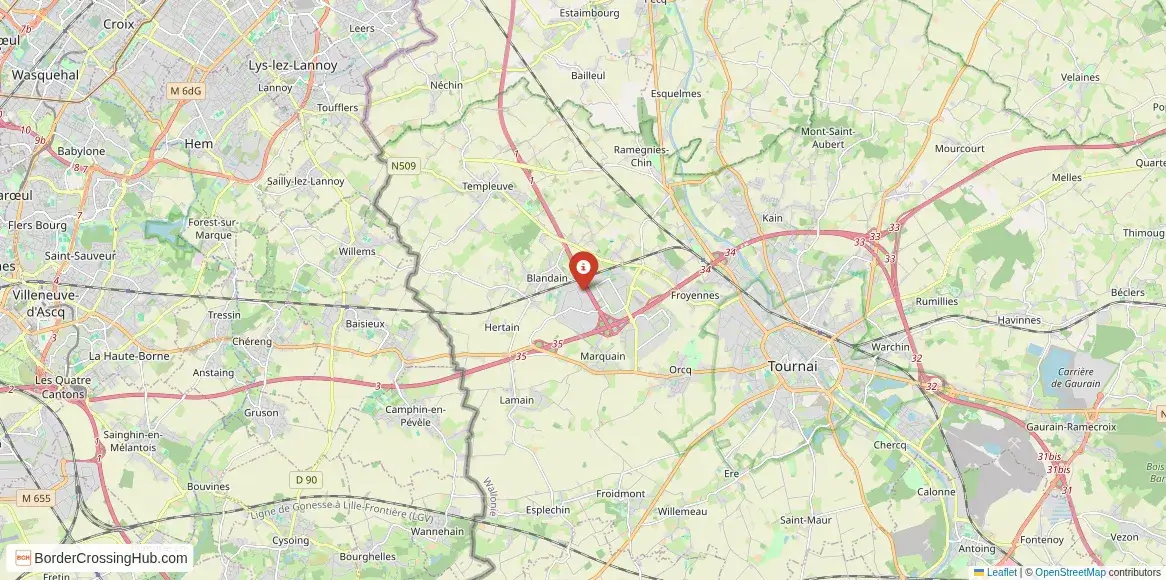
You come to this crossing where the French commune of Baisieux in the Nord department meets Froyennes, a district of Tournai in Belgium's Hainaut province. It sits in the rolling plains of the Pévèle and southern Flanders, roughly 15 kilometers southeast of Lille and close to the Scheldt River basin. Foreign visitors often use it when heading from Lille toward Tournai, Mons, or farther into Wallonia, or the other way for day trips from Belgium into northern France. Alternative names include the Baisieux-Froyennes border or sometimes the Tournai-Lille fringe crossing. As a Schengen internal point, it normally has no fixed checks, but temporary measures stay active as of February 2026 due to security extensions across France and Belgium.
Historical Background and Geopolitical Role
The France-Belgium border in this sector follows lines drawn after Belgium's independence in 1830, with the 1839 Treaty of London setting much of the final demarcation. The area around Baisieux and Froyennes remained agricultural for centuries, with villages tied to local markets and the nearby textile centers of Lille and Tournai. During World War I, the broader region saw fighting as part of the Western Front, though this specific spot avoided the heaviest trenches. In World War II, it lay near liberation routes in 1944. Post-war, Benelux economic cooperation and Schengen from 1995 turned it into an open link, supporting commuter patterns and regional integration in the cross-border Eurometropole Lille-Kortrijk-Tournai. Rail connections here date back to the 19th century, with the line from Lille to Tournai crossing at this point.
Nearby Border Crossings


Current Status and Safety Considerations
France keeps temporary internal border controls with Belgium until at least April 30, 2026, because of ongoing jihadist threats, increases in antisemitic incidents, criminal networks tied to smuggling and irregular migration, and pressures near the Channel coast that could allow radicalized individuals to move. Belgium runs targeted internal checks on roads, buses, trains, and some flights until July 31, 2026, aimed at migration control and security. At quieter crossings like this one, police conduct random stops rather than permanent booths, often on access roads or near villages. Travelers mention brief ID checks if selected, with most passages unaffected. The rural setting keeps risks low, no notable scams or aggressive touts reported here unlike busier external borders. Stay alert for general road safety, especially on narrow lanes, and carry ID to avoid any holdup.
Operating Hours and Wait Times
The crossing operates around the clock on public roads, with no barriers or fixed hours under standard Schengen rules. Temporary controls bring occasional interruptions: many people cross without notice, while a random check might add 5 to 20 minutes for passport presentation and questions. This rural point sees far less traffic than motorways, so waits rarely build up even during spot operations. Rush hours or weekends around local events could slightly raise the odds of a stop near the main road. Weather plays a small role, with occasional fog in winter or heavy rain slowing rural driving, but the road stays open year-round.
Visa Requirements for Foreign Visitors
Schengen rules cover everything: EU/EEA/Swiss citizens travel freely with national ID or passport. Non-EU visitors get visa exemptions for up to 90 days in any 180-day period if their nationality qualifies, or they need a valid Schengen visa. The Entry/Exit System (EES), rolling out fully in 2026, handles biometrics at external borders but not routinely at internal ones like this; spot checks might still verify your status. Keep your passport or ID on hand, plus any supporting papers like hotel bookings or return tickets if asked during a control. No entry or exit fees apply here.
Crossing Procedures Step by Step
You approach on quiet country roads from either side, often with little to mark the exact line beyond a sign change from French to Dutch/French (bilingual in Belgium) or a small boundary marker. Normally, you drive straight through without stopping. If police run a control, they might flag you down at a roadside point or near a junction for ID check and basic questions about your trip. Hand over documents calmly; the interaction usually wraps up fast in this low-volume area. Pedestrians and cyclists follow the same roads, sometimes using paths along fields. The switch feels subtle, with farmland and houses continuing on both sides.
Transportation Options and Road Details
Regional trains run frequently between Lille-Flandres and Tournai, stopping at Baisieux on the French side and Froyennes on the Belgian side, making rail one of the easiest ways across. The line handles about a dozen services daily in each direction, with quick rides of 20-30 minutes from Lille to Tournai. Local buses connect nearby villages, though less frequent. For drivers, secondary roads like the D941 or N7 lead here from Lille or Tournai, paved but narrow in places with speed limits dropping to 50-70 km/h. Scenery includes open fields, scattered farms, small woods, and occasional wind turbines. Cycling works well on flat terrain, with some marked paths in the area. Traffic stays light outside commute times.
Nearby Attractions and Practical Tips
Tournai, just a short ride away on the Belgian side, boasts one of Belgium's oldest cathedrals, a UNESCO-listed belfry, and riverside walks. In France, head toward Lille for its Flemish-style architecture, vibrant markets, and museums. Carry your passport or ID always because of controls. Euros serve both countries, with cards accepted widely even in rural spots. Bring water or snacks if traveling by bike or waiting for a train. Watch for tractors on country roads during harvest seasons. For rail users, check timetables ahead as some services might face minor adjustments. Cross in daylight if possible for better visibility on smaller lanes.
Cultural and Economic Significance
This crossing supports everyday ties in a region where people cross for work, shopping, or family visits without much thought. Agriculture dominates locally, with cross-border sales of produce and goods common in markets. The rail link ties into broader economic flows between Lille's metro area and Wallonia's cities. Shared history shows in bilingual signs, local dialects blending French and Picard influences, and similar cuisine featuring beers and stews. Seasonal changes bring harvest activity in autumn or quiet winters with frost on fields.
Final Planning Notes
Verify the latest on temporary controls from official EU or national travel sites close to your trip, keep ID ready at all times, and allow a bit of extra time for any random check. This peaceful rural route suits relaxed regional exploration between northern France and Belgium when you stay prepared.
View all border crossings between France and BelgiumHeading to Baisieux & Froyennes? Take this with you.
One page with the hours, waits, emergency numbers and coordinates. Works without signal.
Practical information
Fuel
France: <1 km - Belgium: <1 km
Currency
EUR only; ATMs in nearby towns
Safety information
Low risk; watch speeding on rural lanes
Connectivity
Wi-Fi points; 4G
Have you crossed here?
Help other travelers by sharing your experience, wait times, and any updates.